
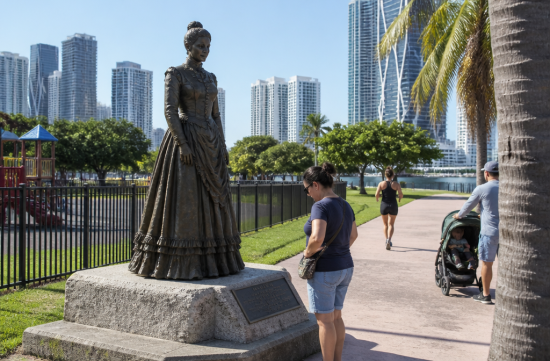
Last weekend, while walking through Bayfront Park, I found myself standing in front of a large bronze statue of a woman next to the playground at the southern end of the park. Usually, I would just think of it as a statue, but that day, I strangely felt compelled to read the plaque all the way through.
The subject was a woman named Julia Tuttle. She is often referred to as the mother of Miami by the people of Miami.
When I got home and looked it up, I found explanations stating that Miami is the only major city in the United States founded by a woman. Cities like New York, Chicago, and LA all have names that are male.
Julia Tuttle was born in Cleveland, Ohio, in 1849. After losing her husband, she moved to this southern land in 1891 with her two grown children.
The land she purchased was on the north bank of the Miami River and included the old military fort of Fort Dallas. This is precisely the area where downtown skyscrapers now stand.
At that time, this place was a remote area filled with mosquitoes and swamps, with only a few settlers. Just having land doesn't create a city.
Tuttle was most focused on the railroad. She repeatedly persuaded Henry Flagler, who was laying tracks along the east coast of Florida, to extend the line down to this southern end.
Initially, he was indifferent. There was no reason to lay tracks all the way to such a distant swamp.
The weather changed the situation. During the winter of 1894 to 1895, a severe cold snap hit Florida, causing significant damage to orange crops in the northern regions.
This is where a famous anecdote comes in. Tuttle sent Flagler a bouquet of orange blossoms that were still blooming, demonstrating that the south was unaffected by the cold.
However, this story is met with skepticism among historians. Some say it was an investigator sent by Flagler who brought the flowers, and others claim it was a bouquet of various flowers and leaves, not just orange blossoms.
I found this part particularly interesting. The process of refining the myth of the city's birth into such a fragrant scene shows how people wanted to remember her.
What is certain is the outcome. In April 1896, the first train arrived in Miami, and on July 28 of the same year, Miami was officially incorporated as a city.
There is a bittersweet aspect as well. The very person who helped create the city, Tuttle, was unable to vote in the city's incorporation. At that time, women did not have the right to vote.
It's as if the person who founded the city couldn't even stamp her name on its birth certificate. Reflecting on this in front of the statue felt a bit strange.
Then, two years later, in September 1898, Tuttle passed away at the age of forty-nine. She only saw the city she dreamed of take its first steps.
There is also a fair point to consider. Mary Brickell, who owned land across the river, also participated in negotiations with Flagler, so some argue she should be seen as another mother of Miami.
Now, the neighborhood name Brickell comes from that family, so it might be more accurate to view the city as one created by two women rather than just one hero.
In fact, for a long time, Tuttle was not honored as much as she should have been. The bronze statue honoring her was erected in Bayfront Park around 2010.
It took over a century. The observation that most monuments around the city are dedicated to men has also been made by local media in a similar context.
Reading this story naturally reminded me of Kim Man-deok from Jeju. She was a female merchant during the Joseon Dynasty who amassed great wealth and saved starving people during a famine.
Both women changed the course of their communities with their own wealth and judgment in times when it was difficult for women to engage in economic activities. In Korea, there are memorials and statues honoring Kim Man-deok, but I found it a bit surprising that Tuttle is not as well-known in the U.S.
Living as an immigrant, I often learn about this country's history through local statues or street names rather than textbooks. Miami also has a bridge named Julia Tuttle Causeway, and I felt a bit embarrassed that I had passed by it countless times without knowing who it was named after.
In a way, she was also an immigrant. She left a familiar place and invested her money and time in an uncertain future in a strange southern land.
Perhaps that's why I saw parallels with the time when I first came to America and struggled to open a bank account. The scale is incomparable, but the feeling of forging a path in an unfamiliar land likely wasn't so different.
This July marks the 130th anniversary of Miami becoming a city. While it may seem like a city filled with glamorous beaches and buildings, I want to remember that its beginnings were marked by the determination of a woman who never received a ballot.
The next time you visit Bayfront Park, take a moment to pause in front of that statue next to the playground. A few lines on the plaque can change how you see the city.
What stories are hidden behind the street names or statues in your neighborhood? If you have any surprising stories, I would love for you to share them.
 silverdre
 AlmondCookFly





 Art patch |

 Rice Shop Uncle BLOG |
 Noodle Noodle |

 Chino Min |

 Glow Yo |

 Dr. Kelso |

 Komet Park |

 Florida Gario |
 donggul donggul |
 korvix |
 Noodle Zin |
 Forever Tiger Teacher |
 strongman |
 U.S. Military Recruitment Information |
 |
 cherry cherry |
 Star Way |
 Pleasant K |
 Spaghetti Flying Religion |
 Texas Migration Story |
 Forever Coco is Bangga |
 nougat |
 coloradoman |
 Village Man |
 endone |
 Live and that's it |
 what gives |
 willow woo |