
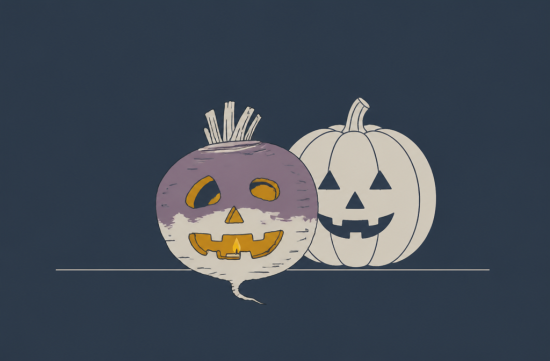
These days, orange pumpkins are piled high at the entrance of every grocery store. I ended up picking one up while shopping.
But while checking out, I suddenly wondered, why do we carve faces into pumpkins? The answer was quite surprising. The original Jack-o'-lantern was not a pumpkin, but a turnip.
If we look closely at the origins, it starts in Ireland and Scotland. According to History.com, people in these regions carved scary faces into turnips and placed them by windows or doors to ward off wandering evil spirits.
In England, they used large beets, and there are records of carving potatoes as well. Essentially, the root vegetables that were commonly available in those areas served as the canvas.
This custom is connected to the ancient Celtic festival of Samhain. It was a day to celebrate the end of summer and the beginning of the Celtic New Year. Over time, this evolved into the night before November 1st, which is now known as Halloween.
So, who is Jack? This is where the legend of Stingy Jack comes in. History.com explains that this story first appeared in print in the 19th century.
The plot is quite amusing. Jack tricks the devil into turning into a coin to avoid paying for his drinks, and then he places the coin next to a silver cross so the devil can't return to his original form. There's also a tale of him climbing a tree and preventing the devil from coming down.
Ultimately, Jack dies and cannot enter either heaven or hell. He ends up wandering forever with a glowing ember placed inside a hollowed-out turnip. This glowing turnip is what became known as Jack's lantern.
Honestly, I felt a bit sad at this point. A person who tried to be clever ends up belonging nowhere. As an immigrant, this feeling is strangely familiar.
However, one thing must be clarified. Just because the legend was printed in the 19th century doesn't mean that the custom of carving turnips started then. Historians are not sure when this practice began.
The name itself originally had nothing to do with vegetables. According to the Oxford English Dictionary, jack-o'-lantern was used in the 1660s in England to refer to a man with a lantern or a night watchman.
At a similar time, it also referred to strange flickering lights over marshes, known as will-o'-the-wisps. The usage referring to carved lanterns was first recorded in 1837. It's surprising to see such a long journey for a single word.
So, what did the original turnip lantern look like? The answer can be found at the National Museum of Ireland. In 1943, a teacher from the Donegal area donated a turnip lantern to the museum.
The teacher explained that it was a form they used to make in that area around 1900. By then, it was a tradition that no one was making anymore, just a memory. So, they wanted to document it.
The original has since decayed, and now a plaster model is displayed at the Country Life branch in County Mayo. I looked for a photo, and it looks genuinely scary. The wrinkled face is far from cute.
When did pumpkins appear? The key point is that pumpkins are a crop from the Americas. They were not originally common vegetables in Ireland.
Irish and Scottish immigrants brought the vegetable carving tradition with them to America. And here, they found pumpkins that were much larger and easier to hollow out than turnips. Naturally, the materials changed.
History.com suggests that thanks to this wave of immigration, pumpkin carving in America transformed from a fall pastime into a symbol of Halloween. The customs brought by immigrants became a defining scene in America.
I really liked this part. The landscape we think of as very American actually comes from the memories of immigrants. It felt similar to how Korean families make songpyeon during Chuseok.
Of course, if we look at it more balanced, it's hard to say that everything is solely an Irish creation. There were already fall traditions in America involving carving pumpkins, and various traditions mixed to create the current form.
Additionally, there are multiple versions of the Stingy Jack story. So, it's more accurate to view this as one of several explanations rather than the only origin.
Out of curiosity, I bought a turnip and tried carving it myself. In conclusion, I wouldn't recommend it. It's tougher than I expected, and you hardly get anywhere with a spoon; you have to wrestle with a small knife for a while.
The finished product was about the size of a fist, and the face was all crooked. But when I put a tea light inside and turned off the lights, the atmosphere changed dramatically. It was much creepier than a pumpkin.
I think I understand a bit why the old Irish people tried to ward off evil spirits with this. The small, bumpy face glowing softly in the dark looked genuinely ominous.
If anyone is planning to do this with a child, please make sure an adult handles the knife. The turnip is slippery and hard, making it easy to injure your hands.
Still, this year, I think I will ultimately return to pumpkins. One experience with a turnip is enough for me. However, I plan to keep a small turnip lantern next to the big pumpkin.
Having a small turnip next to a big pumpkin will look like a little timeline showing where this tradition came from. If a neighbor asks, I'll be ready to share this story.
What will you be carving this year? Are you going for the traditional turnip or sticking with pumpkins? I think I'm leaning towards pumpkins.
 Snickerdoo








 Korean Mom |
 novapixel |
 Peter Pan Pet |
 horse |
 Sunset Oregon |
 Chino Min |

 DREAM BIG |
 Information on All Regions of the United States |
  SWAT TEAM BLK |
  frostbite |
  330 Forever My Love |
  El Dorado |
  dralix58 |
  Gorama Round |
  Skydiving |
  dreamport |
  Yellow Snowman |
  Toaster Pizza Magic Show |
  velvetnom |
  Anytime Journey |
  Mrs. Duluth |
  jaxter |
  Atlanta Mama |
  Baguette Blog |
  Tan Sol |
  US Embassy |