
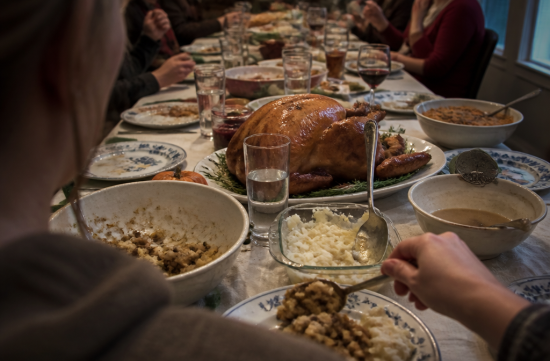
Imagine the scene of family gathered around the Thanksgiving table. The turkey always takes center stage, proudly occupying the largest dish.
However, I've often seen everyone piling their plates with stuffing, mashed potatoes, and gravy, while only taking a piece or two of turkey breast.
In fact, a travel publication surveyed 1,042 American adults and found that turkey was ranked as the most disliked dish among Thanksgiving foods.
The percentage of those who said they disliked it reached 35%, while stuffing and ham were close behind at around 32% each, making turkey clearly the least favorite.
Despite this, the same year's survey revealed that 67% of respondents planned to eat turkey that Thanksgiving. This means that even if they don't like it, they still put it on the table, which is quite the irony of American holiday traditions.
The main reason turkey is often overlooked is, as many know, its dry and tough texture.
The breast and thigh meat cook at different rates; by the time the thigh meat reaches a safe temperature, the breast meat has already lost all its moisture. Additionally, turkey thigh meat has less fat than chicken thigh meat, making it prone to becoming dry if cooked even slightly too long.
Most turkeys sold in stores today are breeds that have been selectively bred to grow large in a short period, which contributes to this issue. As they are mass-produced to meet size and price demands, flavor has become secondary to volume.
In contrast, wild turkeys or those raised on small farms are often noted to have much richer flavors, suggesting that the mass production system itself is a cause of the bland taste.
Interestingly, turkey was not originally the star of Thanksgiving.
There is no clear record of turkey being served at the first Thanksgiving feast in Plymouth in 1621. Historians suggest that the menu likely featured more venison, shellfish, and corn.
Turkey became established as the holiday's main dish due to 19th-century magazines and cookbooks promoting that image, especially after President Lincoln declared Thanksgiving a national holiday in 1863.
The story of Benjamin Franklin advocating for the turkey as a symbol of America is also well-known, but the reality is a bit different.
In a letter to his daughter in 1784, Franklin expressed his discontent with the bald eagle being chosen as the national symbol, stating that the turkey was a more respectable bird.
This story gained traction after a 1962 New Yorker cover depicted a turkey instead of a bald eagle, illustrating how myths can be created.
Interestingly, surveys show that older generations tend to like turkey more.
Among respondents aged 60 and older, only about 24% said they disliked turkey, which is significantly lower than younger generations. Perhaps it's the nostalgia tied to the smells and sights of many years that endears them to it; I find myself leaning that way as well.
In Korean households, I've often seen turkey on the table as a mere formality, while chopsticks reach for ribs or japchae first.
This is simply enjoying a holiday in our own way in a new country, but perhaps it's the most honest reflection of turkey's lack of popularity.
From my perspective in environmental work, it seems wasteful to roast such a large turkey every year, only to have more than half of it left over.
Choosing a turkey size that matches the number of people rather than habitually buying a large one for the holiday is much better for both wallets and refrigerators.
If it were up to me, I would place just one symbolic turkey on the table and fill the rest with dishes everyone actually enjoys. After all, everyone tends to reach for the stuffing first; isn't it time to be honest about that?
 MoonWalker








 Giant Squid and Sweet Potato Soup |
 Lol Life |
 lavender |
 logger |
 Conflite Teacher |
 Generation X |
 Live and that's it |

 Del la moda |
 My Circle |
  Tart Tart |
  Min's blog |
  Tora Tora |
  pixel77 |
  cuteasducks |
  Lemon Kim |
  What can make money? |
  An ant castle |
  Haha and Bomi Blog |
  glenview 89 |
  Valley Hong |
  novapixel |
  Idaho's Sumi's House |
  Mr. Midwest America |
  wildfire |
  legalway |
  postcard |
  cheesecake07 |
  My Miami Stories |
  windylotus |