
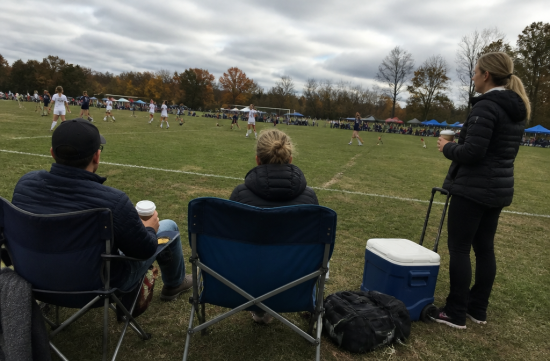
On Saturday morning, while sipping a latte by the window at my favorite café, I overheard a conversation at the next table. They were discussing the costs of club soccer trips, and when I heard that it could amount to thousands of dollars in a season, I instinctively set my cup down.
What stuck with me even more was the next comment. "But if you get a scholarship in college, it all comes back, right?"
I wondered if that was really the case, so I looked up some numbers when I got home. To cut to the chase, it turns out the calculations are not as straightforward as one might hope.
First, let's see how much is being spent. According to the Aspen Institute's Project Play survey, American families spent an average of $1,016 on their child's primary sport in 2024.
This is a 46% increase from 2019. This figure is an overall average, so for club teams that travel to different states every weekend, the amount can be significantly higher.
Parents have high expectations as well. In a 2025 survey by New York Life, 83% of parents believed their child had the skills to play at the college level, and 49% were confident they would receive an athletic scholarship.
In the same survey, 25% reported that they had dipped into savings or emergency funds due to sports expenses. This part made me feel a bit heavy-hearted.
So, what's the reality? According to numbers released by the NCAA, only 2% of high school athletes receive college athletic scholarships.
Looking at it by sport makes it even clearer. For the 2024-25 season, the probability of a female high school soccer player competing on an NCAA team is 7.9%, with only 2.8% in Division I.
For male soccer, the overall probability is 5.9%, and it drops to 1.4% for Division I. Male basketball has an overall probability of just 3.6%.
Conversely, sports with thinner high school participation tend to have higher probabilities. Male ice hockey stands at 14.1%, and male lacrosse at 14.7%, making them worth noting in hockey-loving areas.
One common misconception is that making a college team is the same as receiving a scholarship.
According to NCAA data from 2023-24, 59% of Division I athletes receive athletic scholarships, while 64% in Division II do. This means that even among Division I athletes, 41% compete without a scholarship.
Division III does not offer athletic scholarships at all. However, 80% of Division III athletes receive financial aid based on academic performance or family circumstances.
The Ivy League is similar. Although it is a Division I league, it does not offer athletic scholarships, and athletes receive only need-based financial aid like regular students.
So, the saying "if you're good at sports, you'll get a scholarship to a prestigious school" is only half true. While a coach's recommendation can help with admissions, it doesn't determine the amount of scholarship money.
Not all scholarships cover full tuition either. Schools can offer full, partial, or no aid at all, meaning many athletes only receive partial support.
Starting in the 2025-26 season, the landscape will change. Due to the House lawsuit settlement, as of July 1, 2025, Division I schools participating in the settlement will no longer have limits on the number of scholarships per sport, but there will be a cap on roster sizes.
The potential increase in scholarship spots is good news. However, there are concerns that roster sizes, such as limiting women's soccer to 28 players, will reduce the number of walk-on opportunities.
Moreover, whether schools will fill the cap on scholarships depends on their budgets. It feels premature to rely solely on the new regulations and start crunching numbers.
So, if I were in your shoes, I would start by writing down the annual club costs based on receipts. The feeling is entirely different when you see the actual total compared to just thinking it's thousands of dollars.
Then, I would compare that amount to what it could have been if it were placed in a 529 college savings account. The point isn't to suggest quitting sports, but rather to avoid viewing scholarships as a return on investment.
If you're seriously considering college, make sure to keep your grades up as well. In Division III or the Ivy League, where there are no athletic scholarships, grades and financial aid ultimately determine tuition costs.
If you've made contact with a coach, it's wise to ask specifically about roster spots and the amount of aid, and if possible, get it in writing. There's a big difference between expressing interest and receiving an actual offer.
If Division I or II is your goal, check the NCAA Eligibility Center registration process in advance. Each school has different requirements, so it's best to ask your high school counselor or the relevant department at the college directly.
Honestly, I don't think club sports are a waste of money. The responsibility learned from being part of a team and the experience of getting back up after a loss are invaluable and cannot be quantified in scholarships.
However, trying to recoup that value through scholarships can wear out both parents and kids. It's a shame when a sport that was once enjoyable turns into a calculation of returns.
By the time the parents at the next table got up, my latte had also gone cold. I hope you can support your child with a heart as soft as custard while keeping a clear eye on the numbers.
 Jellybean




 morvex37 |
 Ari Songhan American Immigration Life |
 Bearded Strawberry Smoothie |
 Heart Ticker |
 Duck Duck Go |
 NO CAP LIFE |
 tiramisu |
 bagel90 |

 Tart Tart |
 Tennessee Land |
  custardnew |
  Chimhanbang Korea ACU |
  See South Carolina |
  dorex |
  Taek Jun |
  Choi Cho |
  Anova US Beauty Information |
  whiskerbread |
  Yo Lock Me Up |
  pecantop |
  self-evaluation |
  |
|  stalion |
  anchor |
  Smile Face |
  The Long Shot |
  Anjollinya Blog |
  Investment Beginner Company Information Encyclopedia |
  sweetfox |