
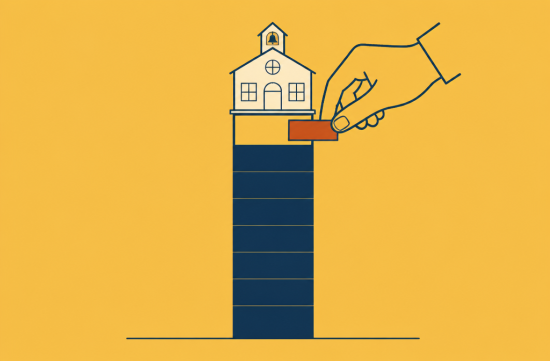
Walking along the forest path thick with fallen leaves brings a sense of calm, but these days, thoughts of school follow me even there. This is due to the news that the income limit for private school vouchers has indeed been removed.
To get straight to the point, it's true. According to a report from the Indiana Department of Education, the income cap was eliminated in May 2025 and will take effect on July 1, 2026.
Now, anyone who is a legal resident of Indiana and is between the ages of 5 and 22 can qualify, regardless of income. The age is based on October 1 of that school year.
Just last school year, the income limit for a family of four was set at $237,910. I thought that was a generous threshold, but now it has disappeared.
So, how much will they receive? The amount varies depending on the school district, and it is determined by the lesser of the district's amount and the total tuition and fees of the school.
Looking at the estimated amounts for the 2026-27 school year released by the Department of Education, the IPS district will receive $7,455.74. Warren Township will get $7,298.85, and Pike Township will receive $7,146.63.
Washington Township will receive $6,988.80, while Lawrence Township will get $7,073.96. Heading north, Carmel Clay will receive $6,395.35, and Hamilton Southeastern will get $6,459.55.
Just comparing IPS and Carmel Clay shows a difference of $1,060.39, which was a bit surprising. The state funding per student varies by district, and this difference arises because they use 90% of that amount as a cap.
But will this money cover the tuition entirely? In many cases, it does not.
Out of 80,548 students using the program in the 2025-26 school year, 60,641 received the 90% cap amount. Only 19,907 students received full tuition and fees coverage.
According to an analysis by Chalkbeat of voucher schools within the IPS boundaries, the median difference between the voucher and tuition was $1,694. This is based on 21 out of 31 schools that provided amounts, including five online schools.
This figure does not include additional costs such as field trip fees or technology fees. It also does not reflect any school-specific scholarships or sibling discounts.
There is also a significant variation between schools. Providence Cristo Rey's tuition for the 2026-27 school year is $27,900, but the school estimates the family contribution to be between $365 and $2,100. The rest is covered by scholarships and corporate work programs.
Some schools, like The Oaks Academy, charge different tuition based on family size and regional median income. So, it's premature to give up just by looking at the tuition chart on their website.
If you are considering a home, you should first check the dates. The first application period was from March 1 to September 1, and the second period is from November 1 to January 15 of the following year. Approval must come within this timeframe, so waiting until the deadline can be problematic.
If you enter in the second round, the amount is halved. IPS district will receive $3,727.87, and Warren Township will get $3,649.43.
Last school year, 1,418 students entered in the second round. While that's not a large number, it does mean there is a pathway to switch schools mid-semester.
Applications are not submitted directly by families to the state government. Instead, families register with participating schools, and the schools submit the paperwork through the system.
If I were in your position, I would first ask the school three things: How much will we actually pay after the voucher, what additional costs are there beyond tuition, and what are the admission requirements?
It's also important to know that if a child leaves school mid-year, the funding will be reduced for that period. If special education services are needed, they must be specified when applying to the service provider.
A list of participating schools is available on the Department of Education's website, and you can also find the estimated amounts there. The contact number is 317-232-6610.
There are no official figures yet on how many applicants have increased this school year. The latest report only includes data up to the 2025-26 school year, so I won't share unverified numbers.
However, just looking at last year's figures, the trend is clear. The approved funding amount was $548,012,632, an increase from $497,195,861 the previous year, and the number of participating schools rose to 395.
Comparing the 66,412 applications based on income from last year to the previous year, the number of applications over $200,000 increased from 5,435 to 7,146. Meanwhile, applications under $50,000 decreased from 16,238 to 11,905.
69.5% of students have no record of attending Indiana public schools. This has led to criticism that tax dollars are going to families that can already afford tuition.
There are also arguments in favor of the program. Supporters say parents should have the right to choose schools, and that families with many children may struggle with tuition even if their income appears high.
Honestly, I feel disappointed that the income cap has been completely removed. I believe that money should go first to children from families that are truly struggling.
There was also news that Bob Behning, the state representative who helped create the voucher system, lost his election. We will have to wait and see how the system changes in the future.
Still, while the system is in place, it is the parents' responsibility to calmly consider the best path for their family. Whether public or private, I believe that a school where a child can comfortably thrive is the most important thing.
 RapidStone98
 StarTalker


 lattepop |
 Well Done Sir |

 butter 90 |

 MacMorningBlog |
 Texas Migration Story |

 nagaduri |
 Yellow Snowman |

 yolo1990 |
 Now or Never |

 U.S. Weather Bureau News |
 Noodle Noodle |
 Hakuna Matata |
 pixel77 |
 uplifted |
 moo moo |
 winter |
 windstone |
 My winter |
 Gomo Nim |
 oneonly |
 blixon24 |
 canyon |
 juniper |
 novaline |
 sunny side |
 kimchi warrior |
 nero kim |
 refresh |
 rainyday |
 springw |