

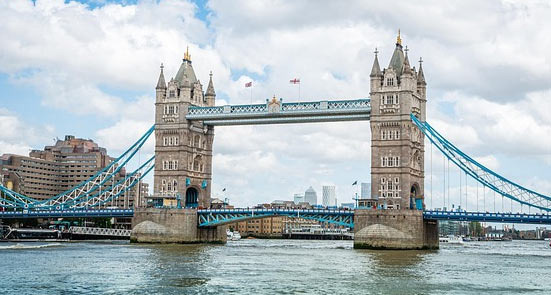
As a co-pilot working for American Airlines and frequently traveling on European routes, London feels particularly special among European cities.
Among them, Tower Bridge, standing tall over the River Thames, is a place I must visit every time I come to London. While Big Ben and Buckingham Palace symbolize royal authority and national pride, Tower Bridge represents the confidence and technological prowess of England during the Industrial Revolution.
In the late 19th century, London experienced explosive population and economic growth due to the Industrial Revolution. The eastern part of the Thames, specifically the current Docklands area, rapidly developed into a center of commerce and trade, but transportation issues became severe. Although there were already several bridges towards Westminster, there was no suitable connecting bridge to the east, forcing people to use boats to cross the river, leading to increasing traffic congestion.
However, simply building a bridge would not solve all the problems. The Thames was the lifeblood of London and a center of trade, so large ships needed to be able to navigate freely. Therefore, the contradictory condition was set that "the bridge must allow ships to pass underneath it."
To solve this problem, the London authorities held an international design competition in 1876. Over 50 designs were submitted, including ideas to replace the bridge with an underwater tunnel. Ultimately, in 1884, the design by architect Horace Jones and engineer John Wolfe Barry was selected.
Their idea featured Gothic-style towers on both sides and a movable central section. This design was revolutionary, as it could accommodate both road and water traffic.
Construction began in earnest in 1886. Over 400 workers were involved for about eight years, using an enormous amount of steel. To lay the foundation, massive concrete pillars were erected on the riverbed, and a steel framework was built on top, finished with Portland stone and Cornish granite. As a result, the bridge became both functional and aesthetically pleasing.
The two towers serve not just as decoration but also have structural roles. When the bridge is raised, counterweights are installed inside the towers to maintain balance, initially operated by steam engines. Although it has since been converted to electric operation, visitors can still see the original steam engine room in the internal exhibition.
Completed in 1894
On June 30, 1894, Tower Bridge was officially opened. A grand ceremony was attended by Prince Edward (later Edward VII) and Queen Alexandra. London gained not just a bridge but a new city symbol that combined technological prowess and architectural beauty.
Interestingly, there was much debate about the design even at that time. Some criticized the Gothic towers as being overly ornate, while others praised the harmonious blend of tradition and modernity. However, it has now established itself as a representative landmark of London, proving its value through history.
When flying over London, Tower Bridge serves as a distinct reference point in the cityscape. The view of the Thames, connecting Westminster's Big Ben, St. Paul's Cathedral, and Tower Bridge to the east, is always overwhelming. However, the weight felt when walking on the bridge is entirely different from seeing it from the sky.
Looking down from the glass-floored observation deck, cars appear like toys, and boats crossing the Thames seem to come within reach. Walking while feeling the river breeze naturally brings to mind the laborers of the 19th century who struggled to build this bridge.
Today, Tower Bridge functions not just as a tourist attraction but also as a vital transportation hub. The central section is still raised several times a day to allow ships to pass, and the City of London publishes this schedule so visitors can check in advance. The sight of the bridge opening remains one of London's top attractions.
Additionally, nearby are the Tower of London, St. Katharine Docks, and the financial district, making it a great area to explore together. A single visit can provide a sense of both London's history and present.
Tower Bridge is not just a structure for crossing the river. It embodies the confidence of the 19th-century Industrial Revolution, the spirit of challenge from the engineers of the time, and the pride of the citizens of London. Perhaps that is why this bridge is always the first landmark that comes to mind whenever I visit London.
After completing a flight mission and taking off into the sky again, I always think the same thing as I see Tower Bridge getting smaller out the window.
"This bridge will forever remain the heart of London, no matter how much time passes."







 tiramisu |
 bagel90 |
 lattecu |
 Tart Tart |
 U.S. Weather Bureau News |
  Tonky |
  viroma |
  cookie |
  Live and that's it |
  Alright Twain |
  eatontown blog |
  HAWAII Korean Church News |
  Amore |
  linex |
  Balancework |
  laro90 |
  MEDBIO American Doctor Blog |
  SWAT TEAM BLK |
  DREAM BIG |
  frostbite |
  330 Forever My Love |
  El Dorado |
  dralix58 |
  Gorama Round |
  Skydiving |