

My child asked if they could go to a friend's house right after returning from school. So, I asked if they had the friend's mom's contact information.
In the past, I would have just said yes, but here, that response doesn't come first. Raising a child in America quickly teaches you that making plans is necessary for meeting friends.
This arrangement is called a playdate. It refers to a situation where parents set a date, time, and place in advance for the kids to play together.
Honestly, when I first heard this term, it felt a bit awkward. I wondered if we really needed to schedule playtime for kids.
Curious, I looked into the history of the word. The Merriam-Webster dictionary notes that the term was first recorded in writing in 1975.
The year noted by the dictionary indicates the earliest written record, meaning it may have been used in speech before that.
Interestingly, different dictionaries have slightly varying timelines. Dictionary.com suggests it was first recorded between 1985 and 1990.
In 1996, the term was also discussed on the mailing list of the American Dialect Society, where mothers mentioned that they had recently started using the term playdate.
This means that the term has not been part of everyday language for very long. It seems to have emerged within just over a generation. Many parents raising kids today may not have heard this term in their own childhoods.
So, what was it like before? Historian Howard Chudacoff referred to the early 20th century as a golden age for children's unstructured play.
It was a time when neighborhood kids would gather on their own and scatter back home at dusk. This is not much different from our childhood memories.
Peter Gray, a psychologist at Boston College, argued in a 2011 paper published in a play-focused academic journal that children's free play has steadily declined since around 1955.
The reasons he identified are striking. Neighbors have become less familiar with each other, and parents' worries about what might happen to unsupervised children have increased.
He also mentioned the pressure of schoolwork and the perception that free play is a waste of time. While TV and video games are often blamed, he argued that they alone cannot explain the decline.
Of course, Gray himself acknowledged that there is a correlation between the decrease in play and children's emotional issues, but he noted that it's difficult to assert causation.
After reading this, I began to see playdates in a different light. They seem to be an alternative created by parents in the absence of neighborhood play.
In fact, in this neighborhood, houses are often far apart, and it's not a distance that a child can walk to a friend's house alone. Ultimately, someone needs to drive them to meet.
With many dual-income families and packed schedules after school with swimming, music lessons, and tutoring, if kids wait for their schedules to align, they might not get to play even once a month.
So, parents coordinate via text to agree on days and decide who will drop off and pick up the kids. Initially, it felt cumbersome, but after a few times, we got the hang of it.
When inviting for the first time, it's best to keep it short, around two hours. It's also courteous to ask in advance if there are any allergies or pets in the home.
Setting an end time in advance makes it easier for everyone. If the pickup time is clear, the child can prepare mentally, and it reduces the likelihood of tantrums at goodbye.
When meeting at a new house for the first time, it's common for parents to stay briefly before leaving. It's also a chance for everyone to get familiar with each other.
Among Korean parents, there are mixed feelings about this culture; on one hand, it's welcomed, but on the other, it can feel burdensome. Contacting other parents in English can be a significant hurdle.
Still, I believe that that one text message is a substantial gift for the child. After playing outside of school once, you can clearly see the kids becoming closer.
Parents also naturally start conversations. It's not uncommon to gather school news or local event information this way.
However, there are definitely downsides. Since adults arrange all the meetings, it seems that children have fewer opportunities to find friends and resolve conflicts on their own.
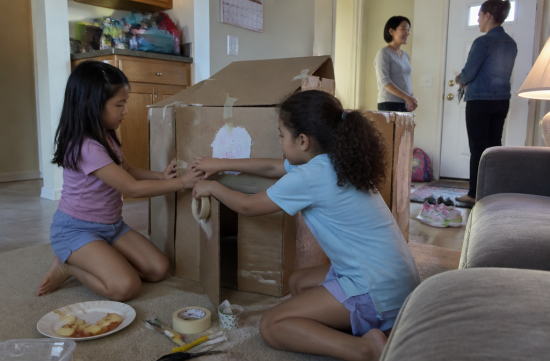
So, even when I schedule a playdate, I try not to interfere as much as possible. I let the kids decide what to do and how to play.
If they fight, I wait a bit to see if they can work it out, and if they say they're bored, I let them be bored. During that time, kids often come up with surprisingly creative games.
Even if adults set the schedule, leaving the playtime to the kids is the compromise I've found. While we can't bring back the neighborhood, we can still preserve a bit of that freedom.
 VanillaMoto
 MoonSoga


 Gomo Nim |

 lattepop |

 Well Done Sir |

 butter 90 |

 MacMorningBlog |

 Yellow Snowman |


 Alpha and Omega World |

 rissa |

 korvex93 |
 strawberry |
 US Regional Information Local News |
 USA Business News |
 Blondee |
 E whisper |
 Potato House |
 freshmint |
 Ansaso |
 Golado |
 babybay |
 honeycom |
 French Macarons |
 Exploring American Life Information |
 Sunshine Blog |
 Community Cross |
 Sayonara H |
 What can make money? |
 Information Search LifeMAN |
 morvex37 |
 neontrail |