
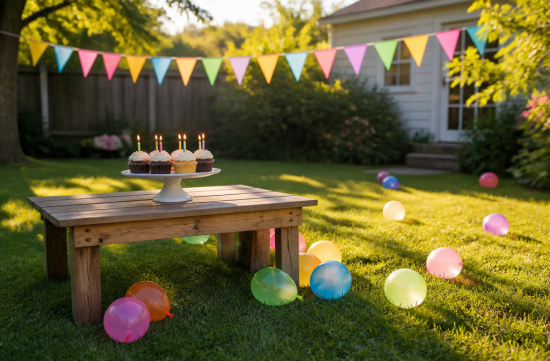
Recently, I attended a birthday party for a friend's child, and it was clear that they spent well over $400 on things like a balloon arch, a character cake, and a rented photo booth.
However, when I asked the birthday girl a week later what she enjoyed the most, her answer was surprisingly simple: playing with water balloons in the yard with her friends.
She didn't mention the balloon arch or the photo booth at all. Those expensive items didn't even register in her memory.
In fact, recent studies show that American parents spend an average of $314 on their children's birthday parties, with some reports indicating it can go as high as $422. For parties for kids aged six to nine, the average cost rises to $344.
The issue is that one in five parents spends over $500, and 45 percent of all parents exceed their original budget. Shockingly, one in three even goes into debt because of birthday parties.
Millennial moms reportedly spend an average of $329, while Gen Z moms spend around $276, indicating a trend where younger generations are actually spending less. This suggests that parents are starting to question whether these expenses are reasonable.
So, does spending more money lead to kids remembering their parties longer? That's another question altogether.
During first birthday parties, 41 percent of kids say they enjoyed the cake or food more than presents, but by the time they turn three, that ranking flips, and nearly half of kids aged six or seven rank presents as the best part. However, at any age, no child ever ranks decorations or themes as the top highlight.
Research in child psychology indicates that kids hardly remember party decorations or themes. What sticks with them are emotions and sensations. Moments spent playing with friends, unexpected little joys—those are what get etched in their minds.
So the conclusion is simple: it's not about the money spent, but the density of activities that matters. You might be wondering how to achieve that, and the answer is surprisingly straightforward.
One reason parents overspend these days is due to party photos shared by others. Seeing what neighbors do can pressure parents into thinking they can't have a simple party. But from a child's perspective, that comparison only exists in the parents' minds.
Start by choosing a location like your home or a local park. Renting a party room for an hour typically costs between $300 and $800, while using your backyard or a picnic area in a park is practically free.
Use the money you save for activities that get kids moving. Simple things like water balloon fights, treasure hunts, or hula hoop contests can be set up for just a few dollars and will boost the kids' energy the most.
Cakes and snacks account for a significant portion of the budget, around 35 to 40 percent, but instead of a fancy character cake, homemade cupcakes with candles will suffice. After all, younger kids usually prefer the cake itself over the decorations.
When inviting friends, it's better to keep the guest list small—just a few close friends. Fewer kids means they can interact more closely, creating memories they'll talk about for years to come.
For photos and videos, there's no need to rent a booth; parents can capture funny moments or the cake-smashing scene with their smartphones, which will create genuine memories.
Ultimately, what kids remember about their birthdays isn't how much the party cost, but how much they laughed and played that day. So, when planning the next birthday, consider picturing a few water balloons in the backyard before you even open a reservation site.






 Anna Life |
 JESIKYEOALBA BLOG |
 Dad's Tribute TC |
 Glow Yo |
 U.S. Retirement Pension Information |
 swiftlane |
 U.S. Weather Bureau News |
 Goroke Geureoke News |
 lavender |
  macan 08 |
  colo colo |
  Dragon Lee |
  American Food Information & Calories |
  zephyrs |
  ness 6 |
  Montgomery Mom |
  SteelOrbit |
  Puddle Puddle |
  Arizona Cowboy |
  macaronpop |
  marydock |
  peachpanda |
  U.S. College Admission Information |
  Fruitop |
  Exploring American Life Information |
  sing sing |