
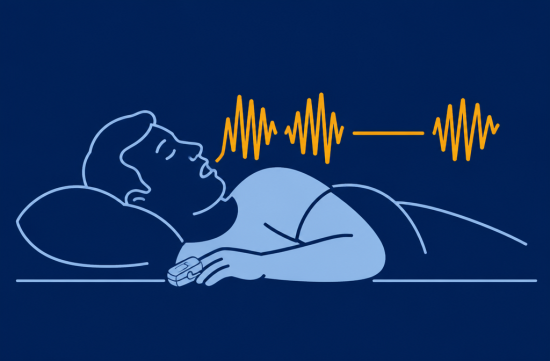
If you hear a train passing by every night, it might not just be a laughing matter. These days, when people talk about snoring, discussions about sleep apnea often follow.
At first, I thought snoring was just a habit caused by being tired. However, I found out that it's a signal that should be taken much more seriously than I initially thought.
The National Heart, Lung, and Blood Institute (NHLBI) identifies frequent loud snoring, pauses in breathing during sleep, and waking up gasping for air as key symptoms of sleep apnea. Feeling drowsy during the day, waking up with headaches, and having a dry mouth are also common symptoms.
Interestingly, the person snoring often doesn't realize it. The NHLBI explains that family members or bed partners usually notice it first.
However, not all snoring indicates sleep apnea. A proper diagnosis requires a sleep study, which can be done in a hospital or through home testing.
This information has been known for a while. What has changed is the treatment aspect.
On December 20, 2024, the FDA approved Eli Lilly's Zepbound (active ingredient tirzepatide) as a treatment for moderate to severe obstructive sleep apnea in adults with obesity. This is the first time a prescription medication has been approved for sleep apnea.
Zepbound was originally approved for weight management in November 2023. I hope there's no confusion since the same ingredient, Mounjaro, is only approved for treating type 2 diabetes.
This means that saying an obesity drug has become a treatment for sleep apnea is partly true but should be approached with caution. The target group is adults diagnosed with moderate to severe sleep apnea who also have obesity.
Moreover, it's not just about taking the medication; it's intended to be used alongside a reduced-calorie diet and increased physical activity. This means it's not a magic solution that ends everything with just one injection.
The approval was based on two clinical trials called SURMOUNT-OSA. The results were published in the medical journal NEJM.
The severity of sleep apnea is typically assessed using the AHI, or the number of times breathing stops or becomes shallow per hour. A higher number indicates that the body struggled to breathe throughout the night.
In a study of participants who did not use a CPAP machine, the AHI decreased by an average of about 25 times per hour after one year. The placebo group only saw a reduction of about 5 times.
In a study of participants using CPAP, the AHI decreased by about 29 times per hour, while the placebo group saw a reduction of about 6 times. The difference is quite clear in numbers, which surprised me a bit.
According to Lilly's announcement, among participants who received the highest dose, 43.0% and 51.5% met the criteria for disease resolution set by the study. However, it's worth noting that this is based on criteria defined by the company.
Side effects were primarily gastrointestinal symptoms like nausea, and most were reported as mild to moderate. Still, since there's no one-size-fits-all medication, it's important to monitor one's health closely.
Realistically, the biggest concern is insurance coverage. Medicare Part D typically does not cover medications intended for weight loss, but following the approval for sleep apnea, CMS has stated that coverage for this purpose is possible under existing Part D regulations.
However, plans may require prior authorization. This means they want to confirm that it's genuinely for treating sleep apnea.
Thus, the results of a sleep study become more important than expected. You need a diagnosis record to even start discussing insurance.
Workplace insurance or marketplace plans also have varying formularies, meaning the list of covered medications and conditions differs. The quickest way to find out how Zepbound is handled for sleep apnea is to call the number on the back of your insurance card.
For reference, other oral medications for sleep apnea treatment are also under review. Apnimed's AD109 had its new drug application accepted by the FDA in July 2026, with a decision expected by February 28, 2027.
Since it's still pending approval, it's best to keep expectations modest. It's good news that options may expand in the future.
Seeing this news made me realize that I need to change my attitude toward snoring. Sleep is like fuel for getting through the day.
Just as listening to a favorite song every day makes the rhythm ingrained in your body, waking up frequently disrupts sleep and accumulates fatigue. For those who start their day feeling heavy every morning, it might be worth checking out.
If I were to take action, I would start by asking my family if I stop breathing at night, then consult my primary care physician about a sleep study, and once I have a diagnosis, I would consider treatment options and insurance together.
What works—CPAP, lifestyle changes, or medication—varies from person to person. If considering medication, I hope you discuss it with your doctor or pharmacist before making a decision.
It seems that the days of dismissing snoring as a joke are gradually coming to an end. How about paying a little more attention to each other's breathing sounds tonight?
 CrystalPeak86


 daddyyo |

 Top Beaches |
 Diana Blues |

 Dragon Lee |

 Churros Train Conductor |

 coolriver |

 swiftlane |




 Watch for possible danger |
 northpeak |
 Far East Movement |
 Light of the World |
 mariashin |
 lavender |
 Bridgo |
 Tamfa Fan |
 Sunny Sunday |
 mini hometown |
 torvia |
 Chichiki Chicago Train |
 Univ Student |
 See It |
 Con Cheese |
 softmoony |
 Breaking Bad Drama |
 New York Queens Native Blog |
 Shinbaram Dr. Blog |
 vivavida |