
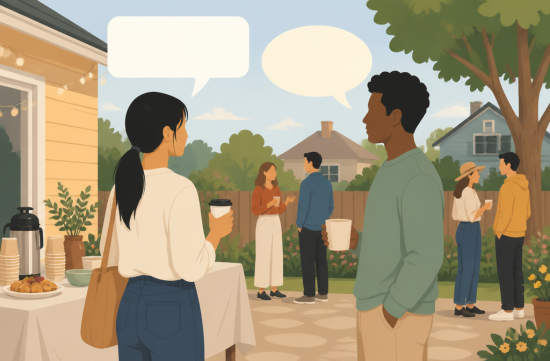
Recently, while chatting with a neighbor I met for the first time at a community event, I found myself almost asking, "So, what do you do for a living?" but suddenly hesitated.
The atmosphere was pleasant, and the conversation was flowing easily, but for some reason, I was reluctant to bring up that one question.
Have you ever had a similar experience? A question that used to come out naturally now feels oddly cautious.
I'm not alone in this. Nowadays, in America, there's definitely a sense that asking someone about their job when you first meet them can be somewhat rude.
In fact, for a long time in the U.S., asking "What do you do?" was a very natural way to introduce oneself at a first meeting. There was a time when a person's job was seen as a key indicator of who they were.
However, these days, with the rise of freelancers, side jobs, and remote work, the question itself has become somewhat ambiguous. There are many more people who find it difficult to summarize their work in one sentence.
When I looked into why this is happening, the reasons became quite clear. It can give the impression of defining a person by just one job, and the conversation can quickly turn into a measure of income or social status.
To be honest, I used to throw that question out there as a casual greeting. But given the current atmosphere, I realize it might be a heavier question than I thought.
In 2025, it was reported that U.S. companies announced over 1.2 million layoffs. This is a 58 percent increase from 2024 and the largest number since the pandemic in 2020.
So, when you ask someone about their job now, the response is likely to be much less lighthearted than before. They might have recently lost their job, be preparing to change jobs, or be in the process of finding a new path.
Moreover, in the U.S., when you leave a job, your health insurance is also cut off. So losing a job isn't just about a decrease in income; it can shake up your entire life.
In fact, a survey found that more than half of American workers reported increased stress due to job insecurity. Job issues have become a significant factor affecting a person's entire life.
In this context, asking about someone's job is not just small talk; it can touch on their most painful points.
I personally don't think this trend is necessarily bad. A conversation that seeks to understand a person without ranking them by income or title seems healthier to me.
Everyone goes through tough times with work, and having to explain your job in front of someone you just met can be more burdensome than it seems.
Instead, these days, I've found myself naturally shifting to questions like, "How have you been lately?" or "What do you usually do on weekends?"
And when I actually changed my questions, the conversations became richer. Instead of talking about jobs, we could easily transition to discussing parenting, hobbies, or recent movies.
Of course, with close friends or in a natural context, we still talk about jobs. However, throwing that out as the first question when meeting someone new doesn't seem to be as common a courtesy as it used to be.
I initially thought it was just a trend, but in this era of job insecurity, it seems that this could be a way of being considerate to each other.
Especially during times when jobs are unstable, fostering a culture of not hastily judging each other's situations seems increasingly important. Everyone goes through tough times at some point.
The next time you meet someone new, it might be nice to ask a different question instead of about their job. That way, you can hear stories that are much more true to who they are.




 lavender |
 logger |
 Conflite Teacher |
 Unknown Dog Walk blog |
 Khan Film Blog Production |
 fantastic |
 Investment Beginner Company Information Encyclopedia |
 Northeastern |

 Supplemental Security Income (SSI) Information |
  Sams Market |
  ansdal |
  VVV 80 |
  BIODOCTOR NEWS |
  Gold Bar |
  Tamfa Fan |
  Jenny's Mom blog |
  Karina's Blog |
  Best Frozen Yogurt |
  Victory 1988 |
  Coding Elf |
  Infinite Style |
  Mr Cleveland |
  Sugar Cream Door Bulletproof Noodles |
  novapixel |
  macan 08 |
  Goroke Geureoke News |
  colo colo |