

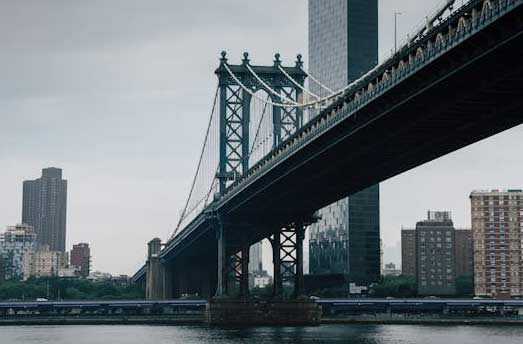
When talking about Brooklyn, many people think it has the same weather as Manhattan, but living there reveals that it is one of the areas where you can most vividly experience New York's distinct four seasons. Influenced by the maritime climate close to the Atlantic Ocean, seasonal changes are pronounced, with hot and humid summers and cold, snowy winters typical of the northeastern United States.
Winter lasts from December to February. The average high temperature in January is about 38°F (3°C), while the low can drop to around 25°F (-4°C). Compared to winter in Seoul, South Korea, it is a bit less cold, but the strong sea winds can make it feel significantly colder. The annual snowfall is about 19 inches (48 cm), mostly concentrated in January and February. There are years with heavy snowfall, but recently there has been a trend of decreasing snow compared to the past.
Spring officially begins in March. The average high temperature in April rises to about 58°F (15°C), and flowers start to bloom in parks and streets. Brooklyn's parks are particularly beautiful during this time. However, spring often brings frequent rain and significant temperature fluctuations, so outerwear is essential.
The average monthly temperature, precipitation, and snowfall in Brooklyn, New York, are as follows:
- January: Average high temperature 38°F (3.1°C), average low temperature 25°F (-3.9°C), average precipitation 3.17 inches (80.5mm), average snowfall 6.1 inches (153.7mm)
- February: Average high temperature 39.6°F (4.2°C), average low temperature 26.2°F (-3.2°C), average precipitation 3.02 inches (76.7mm), average snowfall 6.1 inches (154.1mm)
- March: Average high temperature 48°F (8.9°C), average low temperature 34°F (1.1°C), average precipitation 3.59 inches (91.2mm), average snowfall 3 inches (75.6mm)
- April: Average high temperature 58.3°F (14.6°C), average low temperature 42.8°F (6°C), average precipitation 3.9 inches (99.1mm), average snowfall 0.2 inches (4.9mm)
- May: Average high temperature 67.6°F (19.8°C), average low temperature 52.3°F (11.3°C), average precipitation 3.8 inches (96.5mm), average snowfall none
- June: Average high temperature 77°F (25°C), average low temperature 61.9°F (16.6°C), average precipitation 3.65 inches (92.7mm), average snowfall none
- July: Average high temperature 82.8°F (28.2°C), average low temperature 68.2°F (20.1°C), average precipitation 3.8 inches (96.5mm), average snowfall none
- August: Average high temperature 82°F (27.7°C), average low temperature 67.3°F (19.6°C), average precipitation 3.41 inches (86.6mm), average snowfall none
- September: Average high temperature 75°F (23.9°C), average low temperature 60.1°F (15.6°C), average precipitation 3.3 inches (83.8mm), average snowfall none
- October: Average high temperature 64.8°F (18.2°C), average low temperature 49.3°F (9.6°C), average precipitation 2.88 inches (73.2mm), average snowfall 0.01 inches (0.3mm)
- November: Average high temperature 53.8°F (12.1°C), average low temperature 40.5°F (4.7°C), average precipitation 3.65 inches (92.7mm), average snowfall 0.38 inches (9.7mm)
- December: Average high temperature 42.6°F (5.9°C), average low temperature 30.6°F (-0.8°C), average precipitation 3.42 inches (86.9mm), average snowfall 3 inches (76.7mm)
On average:
- Average high temperature: about 61.3°F (16.3°C)
- Average low temperature: about 46.8°F (8.2°C)
- Annual precipitation: about 42.6 inches (1082.4mm)
- Annual snowfall: about 18.8 inches (477.1mm)
Interestingly, Brooklyn is not an area that receives more rain than the U.S. average. The annual precipitation is about 1,080mm, relatively evenly distributed. Unlike some western regions where certain months see heavy rain and others see almost none, Brooklyn experiences a similar amount of rain throughout the year. Therefore, there are no distinct wet or dry seasons.
In summary, Brooklyn is an attractive city for those who want to experience distinct four seasons. You can see snow in winter, flowers blooming in spring, enjoy the vibrant city atmosphere in summer, and admire the beautiful fall foliage in autumn. The ability to enjoy both the unique urban life of New York and the seasonal changes of nature is the greatest feature of Brooklyn's climate.






 moo moo |
 ultron78 |
 garlic bread |
 Sugar Cream Door Bulletproof Noodles |
 urbanmint |
 Starbucks Reserve Roastery Closure |
 Encyclopedia of New York and Surrounding Areas |
 Softember |

 Franco Family |
  US Embassy |
  Korean Mom |
  My NYC |
  Mr Oh |
  forevergee |
  festival |
  manchester |
  constant |
  Leapfrog Move |
  vibranto |
  Tora Tora |
  yellowbutter |
  Dolly |
  NYC saladbar |
  Finding Superfoods |
  lightyear |
  song bang |
  vexomo |
  Indiana Jones |