
Temperature difference, as everyone knows, refers to the difference between the highest and lowest temperatures during a day.
For example, based on a 24-hour day, if the lowest temperature during the day is 65 degrees Fahrenheit and the highest temperature is 85 degrees Fahrenheit, the temperature difference for that day is 20 degrees. Although there are variations across different regions in the U.S., a temperature difference of around 21 degrees (Celsius 12 degrees) is common, and sometimes it can approach 30 degrees. Depending on the region in the U.S., temperature differences of about 40 degrees can occur, and such drastic temperature differences mainly happen during the cold winter and early spring seasons.
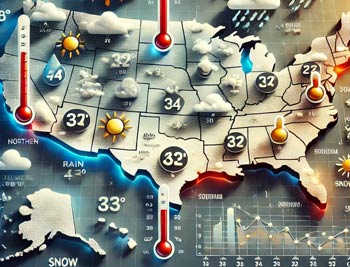
As explained above, drastic temperature differences typically occur in the U.S. during February and March. It is not uncommon for temperature changes exceeding 50 degrees to happen in winter and spring. In winter, temperature differences dropping from 60-70 degrees to 10-20 degrees within a few hours are related to strong Arctic cold waves. These powerful cold waves start in the Arctic regions of Canada and move rapidly southward across the western highlands, causing a rapid drop in temperature.
There are areas where temperature differences exceeding 50 degrees occur.
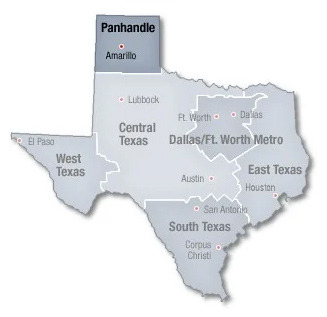
The Panhandle Plains region, where the northern border of Texas and the western border of Oklahoma protrude like a pot handle, sometimes experiences temperature differences exceeding 40 degrees in a single day. Due to its higher elevation compared to surrounding areas and its proximity to the Rocky Mountains, various factors such as dry air masses contribute to this region showing some of the most extreme temperature changes in the U.S.
In this region, the northeastern cold waves can only move southward due to the Rocky Mountains. These cold waves can cause temperatures to drop by about 40 degrees in just a few minutes. Such cold waves occur on clear days without snow or rain. Local residents refer to this dramatic drop in temperature as a "Blue Norther" because the weather can change from clear and mild to cold in an instant due to the northern winds.

A Blue Norther is a fast-moving cold front that brings a rapid drop in temperature, strong winds, and dark skies to the Great Plains and parts of the Midwest. The term is also known as a Texas Norther.
It brings to mind the image of the goddess of the refrigerator winds rushing in with the northern winds under the blue sky.
Moreover, in this highland area, temperature differences exceeding 50 degrees can occur even without cold waves in early spring. Very dry air flows down from the southern Rocky Mountains to the highland area, causing temperatures to rise during the day and drop very quickly at night. In the morning, temperatures may be in the 30s, but by afternoon, they can reach 90 degrees. However, due to the high latent heat of water, such dramatic temperature differences do not occur in the humid summer.
In fact, extreme temperature differences exceeding 50 degrees are rare occurrences in the U.S. In 2008, the Panhandle Plains region in Amarillo, Texas, experienced temperature differences exceeding 50 degrees for four days, matching the record set in 1950.

As mentioned above, Blue Northers occasionally occur in the winter in the Texas Panhandle Plains region. A very cold northern wind blows in while the sky is clear and blue, causing temperatures to drop suddenly. This sudden cold can surprise those who are not accustomed to it, dropping by more than 40 degrees in just a few minutes.
So far, the highest recorded temperature difference in Oklahoma is a maximum temperature of 83 degrees and a minimum temperature of 17 degrees. A remarkable temperature difference of 66 degrees (Celsius 37 degrees) occurred. If you think in Celsius, this translates to a temperature difference of about -8 degrees in the morning and 28 degrees in the afternoon. This means that in the morning, one could go sledding, and by midday, it would be warm enough to wear short sleeves and shorts.
Of course, while this is a rare case of extreme temperature differences that are record-breaking, it must have been remembered by local residents as a deadly temperature difference.





 Weekend Movie Blog |
 Beauty, Health, Lifestyle Blog |

 coloradoman |
 Superman Cat Blog |
 novapixel |
  Tonky |
  viroma |
  cookie |
  Live and that's it |
  Alright Twain |
  eatontown blog |
  HAWAII Korean Church News |
  Amore |
  linex |
  Balancework |
  laro90 |
  MEDBIO American Doctor Blog |
  SWAT TEAM BLK |
  DREAM BIG |
  frostbite |
  330 Forever My Love |
  El Dorado |
  dralix58 |
  Gorama Round |
  Skydiving |