
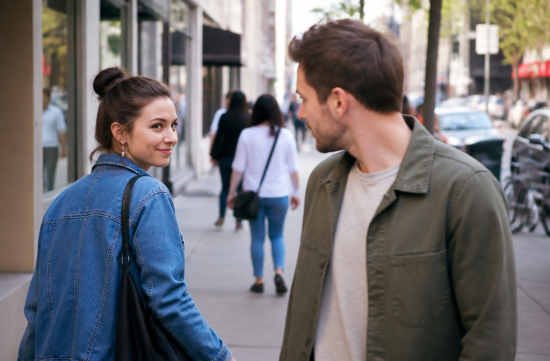
Do you know what one of the most surprising moments was when I first came to America? It was when I made eye contact with a complete stranger on the street, and that person smiled at me.
I was taken aback, thinking, "Wait, do I know this person?" But no, they were just a passerby.
This wasn't a one-time occurrence. It happened repeatedly, whether in an elevator, at the grocery store checkout line, or while taking a walk, and now I find myself smiling first.
But when I think about it, it's a bit strange, isn't it? We don't know each other's names and we're unlikely to see each other again, so why do we smile?
This curiosity has actually been taken seriously by scholars. It's a topic that has been studied in cultural comparative psychology for quite some time.
In 2006, a researcher named Maria Arapova conducted a survey with 130 college students from the U.S., Germany, the U.K., and Russia.
The question was simple: What would you do if you made eye contact with a stranger at a bus stop or in front of an elevator?
There were three options: smile and then look away, just look away, or continue staring before looking away.
The results were quite stark. Ninety percent of respondents from the U.S., Germany, and the U.K. chose to smile and then look away.
In contrast, only 15 percent of Russian respondents made the same choice.
I had no idea the difference would be this significant.
This concept was already outlined by sociologist Erving Goffman in his 1971 book. He referred to the act of briefly making eye contact with a stranger and then looking away as "civil inattention," a polite form of disregard.
He explained that ignoring someone completely or staring at them openly is both considered rude, so people choose a middle ground. In America, this is often accompanied by a brief smile, adding a touch of friendliness to polite indifference.
What's even more interesting is why this gap exists. In Russian culture, smiling at a stranger is interpreted as a sign of special affection.
This means that smiling at just anyone can lead to being seen as strange. Conversely, in the U.S. and Western Europe, this smile is more of a formal courtesy.
This can lead to misunderstandings. An American might perceive a non-smiling Russian as unfriendly or angry, while a Russian might find an American's smile to be insincere.
There's another explanation for these differences. Psychologist Thomas Talhelm and his research team found that in societies with many immigrants and mixed languages, smiles are used more frequently.
The logic is that when people struggle to communicate verbally, they rely more on facial expressions as a common language, which aligns with observations that countries like the U.S. and Canada, with long histories of immigration, tend to smile more at strangers.
The key point here is that this smile is not an expression of emotion but rather a kind of signal.
It's a very brief message saying, "I am not a threat to you." This is communicated without a single word.
Facial expression researchers categorize smiles into two types. The genuine smile, which involves the muscles around the eyes, is called a Duchenne smile, while the smile that only raises the corners of the mouth is different. The smile exchanged with strangers is usually closer to the latter.
There's supporting research as well. In 1979, Robert Kraut and Robert Johnston from Cornell University conducted an experiment in a bowling alley.
The idea was quite clever. They observed the moments when people were looking at the pins after getting a strike versus when they turned to face their companions.
When standing in front of the pins, meaning when they were alone celebrating, only 4 percent smiled. However, as soon as they turned to face friends or family, that number jumped to 42 percent.
This result clearly indicates that laughter is not merely a reflection of joy but is more like a social switch that turns on when we face someone.
The smile that emerges when making eye contact with a stranger operates on the same principle. It's an automatic signal that activates the moment we recognize the other person's presence.
Looking back, in Korea, it seems more common to quickly avoid eye contact with strangers. This isn't out of rudeness but rather a way of respecting each other's privacy.
Personally, I find this approach quite practical. When two people with no information about each other meet, it's not feasible for one to set the rules.
Ultimately, we have to exchange small signals of trust, and a smile serves that role very cheaply and efficiently. I don't think there's any reason to dismiss it as merely formal.
Of course, there are exceptions. In crowded and weary places like the New York subway, people often don't smile even when they make eye contact.
Even within the U.S., I've noticed variations depending on the city or situation. So, I tend to smile first in relaxed neighborhood alleys, while I don't make an effort in crowded subway cars.
However, it can be problematic if one misinterprets this as genuine affection. I've often seen international students new to America misinterpret a stranger's smile as personal interest, leading to awkward situations.
So, the next time someone makes eye contact and smiles at you in America, just think of it this way: that person is sending me a safety signal, and that's all there is to it. A light smile in return is all that's needed.
I find it fascinating that such social calculations are embedded in what seems like a trivial smile. Next time you make eye contact with a stranger, try to observe it consciously.
 CandySmile








 AH LALA |
 Victory 1988 |
 Panorama Kstar |
 Giant Squid and Sweet Potato Soup |
 Lol Life |
 lightyear |
 glimmer |
 river9 |
 newyorker 101 |
 wishi |
  Conflite Teacher |
  Silent Sea |
  Franco Family |
  coloradoman |
  lumora |
  Valley Bang |
  pravix22 |
  Cohesive Kong |
  werehere |
  problemo |
  galaxy88 |
  breezelove |
  Minnesota Sonata N |
  hazelnut |
  Korean News American Blog |
  Savion |
  pintos |
  Good Good |