

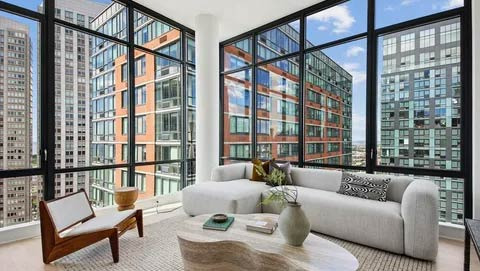
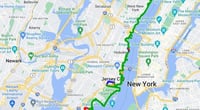
Just across the Hudson River from Manhattan is Jersey City.
As a result, many people working in New York wonder, "Manhattan is too expensive; should I consider moving to New Jersey?" This is true for many Korean Americans as well.
However, one thing becomes clear when you start looking into Jersey City: there aren't many neighborhoods that can still be considered affordable.
When comparing the cost of living index with the U.S. average set at 100, Jersey City is reported to be in the high 140s. While it is definitely less burdensome than Manhattan, it is still quite expensive compared to most cities in the U.S.
The biggest factor is housing.
These days, if you want to find a decent one-bedroom in Jersey City, you should expect to pay around $3,000 a month, and prices are much higher in new buildings or areas close to PATH stations, like downtown or Exchange Place. For two-bedrooms, it's common to see listings over $4,000.
So, if you're moving from places like Texas or Georgia, you might be shocked by the rental prices. Even if you want to buy a home, the median price is around $600,000 to $700,000, which is certainly not easy to manage.
Despite this, the main reason people are drawn to Jersey City is transportation.
Taking the PATH train, you can get to the World Trade Center very quickly. Depending on the starting station, it takes about 10 to 20 minutes to reach Manhattan, so you don't necessarily have to live in New York City while working there. It's also relatively convenient to live without a car.
From a Korean perspective, there are also interesting aspects.
The Korean population in Jersey City itself isn't very large. Based on recent census data, the Korean residents number around 2,000, making up less than 1% of the total population, which is a small community.
However, the overall Asian population is quite significant. There are many residents of Indian and Filipino descent, among others, making it easy to find Asian food and groceries.
And if you drive north, the situation changes completely. There are Korean communities in Bergen County, including Fort Lee and Palisades Park, where you can easily access Korean food, markets, hospitals, and churches. While there isn't a huge Koreatown in Jersey City, it's not far from Korean living areas either.
The cost of living for groceries is also higher than the national average, and for a family of four, it's realistic to budget over $1,000 a month just for food. On top of that, you have to add electricity, gas, internet, cell phone, and transportation costs, and if you have a car, parking fees and insurance cannot be ignored.
If you have children, you'll also need to consider schools. Jersey City has varying school ratings by neighborhood, so it's not easy to decide on a home based solely on commuting to Manhattan. This is why Korean families that prioritize school districts often compare it with areas in Bergen County.
Ultimately, the appeal of Jersey City seems to be less about being "cheaper than New York" and more about being able to live "next to Manhattan with a bit less financial strain."
With a commute of around 20 minutes to work in Manhattan and a diverse population, you can also access the northern New Jersey Korean community if needed.
However, if a family of four is considering moving to Jersey City, they shouldn't make a decision based solely on rent. You need to calculate everything: housing prices, food costs, transportation, and schools. Compared to the national average, Jersey City is definitely a city with a high cost of living.
 HoneyWalker
 JerryPayCard





 Valley Hong |

 Mr Oh |

 ollege Mom |

 Helpful Life Stories |
 prixon74 |
 loverun |
 Living in New Jersey blog |

 hoosierdaddy |
 oneonly |
 Brighto |
 racuse |
 Total Beauty |
 crystal |
 Good Hotels |
 raspberry7 |
 Que que |
 Well Done Sir |
 dance dance |
 sweetpepe |
 vegas mom |
 Olivia's Blog |
 cathywhite |
 heartbreaker |
 Giant Squid and Sweet Potato Soup |
 The Gelaton |
 Twist Kim |
 berlon93 |