
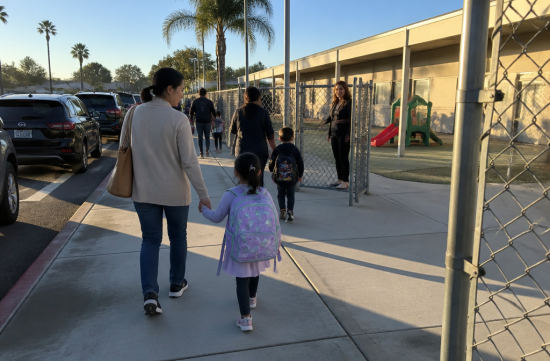
These days, there's a common question that comes up in parent meetings: "Our child is now four years old; should we send them to TK or keep them in the preschool for another year?" Having worked in education for a long time, I get this question quite often.
To put it simply, there's no right answer. However, understanding the system can make your decision much easier. Today, I'll explain this step by step.
California TK (Transitional Kindergarten) has gradually expanded its birthday eligibility starting from the 2022-23 school year. Finally, in the 2025-26 school year, it will be fully implemented, meaning universal TK.
The criteria are straightforward. Any child who turns four by September 1 of that school year can attend public school TK. It doesn't depend on family income, and there are no tuition fees.
So, who will be eligible for the next enrollment? For the 2027-28 school year, it will be children born between September 2, 2022, and September 1, 2023. If a birthday falls on the boundary, be sure to check directly with the school district.
For reference, children must be five years old by September 1 to enter kindergarten. So, you can think of TK as the year spent in public school just before kindergarten.
And there's something important to note: TK is not mandatory. Schools are required to provide a spot, but parents are not obligated to send their children.
What I appreciated most about this system was the classroom standards. According to the law, TK classes cannot exceed an average of 24 students per school.
There are also set adult-to-child ratios. Originally 1 to 12, this will be reduced to 1 to 10 starting in the 2025-26 school year, with the state budget reflecting this cost. This means there will be additional support staff alongside the lead teacher.
I also looked into teacher qualifications. TK teachers must have a teaching credential along with requirements in early childhood education or child development. This is intended to ensure that four-year-olds are not treated like elementary school students.
So, is TK necessarily a good option? Not exactly. The most common concern I hear is about timing. TK class schedules vary by school, and for dual-income families, the dismissal times can feel awkward.
This is often filled in with after-school programs. The state's ELO-P (Expanded Learning Opportunities Program) serves children from TK through 6th grade, with a ratio of one staff member for every ten children in TK and kindergarten.
However, each school has different operating methods and availability. Before registering, be sure to ask, "Is there an after-school program? Do you accept TK children?"
Another factor is the change in environment. Some children may struggle during the first few weeks due to the unfamiliarity of large school buildings, buses, and playgrounds with older siblings.
On the other hand, preschool has clear advantages. There are familiar teachers and friends, and many places offer full-day programs or vacation care. If your child still needs naps, this can be a significant difference.
However, there are costs involved. Private preschool tuition varies greatly by location, so you'll need to compare directly. If your family meets income criteria, state-supported programs like the California State Preschool Program are worth exploring.
So how should you decide? I recommend considering the following in order:
First, check your child's birthday. Even within the same TK class, there can be nearly a year's difference between a September birthday and one born the following summer.
Second, assess how independent your child is with basic tasks like using the bathroom or getting dressed. TK classrooms will help, but the pace of group living is generally faster than in preschool.
Third, consider whether your pickup route and work hours align. If they don't, even the best program can become exhausting for parents.
Fourth, visit the school. During a tour or open house, check if the TK classroom has play areas and whether the teacher interacts with the children at their level.
Don't forget about registration timing. Many school districts start accepting applications for the next school year around the spring semester. The most reliable way to find exact dates and documents is to check your local school district's website.
Some Korean parents rush into TK due to concerns about English. I completely understand that feeling. In fact, early exposure to an English environment is one of the advantages of TK.
However, there's no need to reduce the use of Korean at home. Children with a strong foundation in their native language tend to absorb a second language better, as we often see in educational settings.
To add a personal opinion, I believe universal TK is a truly meaningful policy. It aims to give all four-year-olds the same starting line, regardless of family circumstances. This is exactly what public education should be doing.
Of course, I've heard that finding teachers and securing classrooms can be challenging in practice. That's why it's even more important for parents to ask questions, verify information, and raise their voices when necessary.
What would I do? If my child enjoys group activities and the pickup issue is resolved, I would lean towards TK. The fact that it's free and legally mandated classroom standards are significant advantages.
However, if my child is still very shy or needs full-day care, spending a year in preschool is also a perfectly good choice. Ultimately, the best path for our child is the one that suits them best. For those who are contemplating, I'm here to support you.
 AnchovyHelmet






 Round and Round Children's Song Kingdom |

 new sugar |

 Way to easy |

 Magic Cabbage School of Martial Arts |

 Vacation on Hawaii |

 Toaster Pizza Magic Show |

 Agenda Center |

 Baguette Blog |


 Story Bank |
 Brighto |
 racuse |
 Total Beauty |
 crystal |
 Good Hotels |
 raspberry7 |
 Que que |
 Well Done Sir |
 dance dance |
 sweetpepe |
 vegas mom |
 Olivia's Blog |
 cathywhite |
 heartbreaker |
 Giant Squid and Sweet Potato Soup |
 Valley Hong |
 The Gelaton |
 Twist Kim |
 berlon93 |
 Physical Laws and Science |