
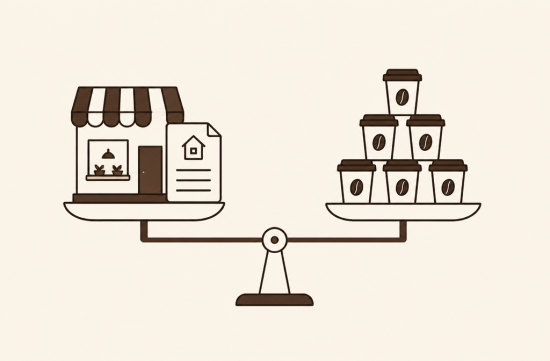
These days, I often meet friends who are seriously considering starting a coffee shop. The first question they all ask is how many cups of coffee they need to sell each day to cover the rent. While they may imagine customers lining up, the reality can be quite different when they receive the rent bill.
Let's start with the industry standards. For small cafes, the general guideline is that rent should not exceed 5 to 10 percent of total sales. Experts often recommend aiming for a lower percentage, around 5 to 8 percent, for safer operations.
The rent itself can vary significantly by region. In the southern areas of LA, retail space rents range from $2.50 to $4.50 per square foot, with additional common area maintenance costs adding about $0.75 to $2.00 per square foot. Combining these, a reasonable estimate would be around $3.25 to $6.50 per square foot.
Data shows that small coffee shops typically have a store size of about 600 to 900 square feet. If we calculate using a median size of 750 square feet at $4 per square foot, the monthly rent would be approximately $3,000. Assuming we want to keep rent at 8 percent of sales, the required monthly sales would be $3,000 divided by 0.08, which equals $37,500.
Dividing this by 30 days gives a daily sales target of $1,250. The challenge lies in the price of a cup of coffee. As of the first half of 2026, the national median price for regular hot coffee is $3.75, but in the LA area, it is significantly higher at around $4.99.
Calculating with the LA price of $4.99, to reach $1,250 in daily sales, you would need to sell 250 cups. I was quite surprised when I first calculated this number. Selling 250 cups means that customers would need to be continuously coming in during the hours the shop is open.
Breaking down those 250 cups into hourly sales makes the burden feel even heavier. If the shop is open for 10 hours a day, that means selling 25 cups per hour, or one cup every 2 minutes and 24 seconds. Even if there is a rush in the morning, maintaining that flow for the rest of the day is no easy task.
One important point to note is that this calculation only covers rent. It does not include employee wages, costs for ingredients like coffee beans and milk, insurance, or equipment financing. To actually turn a profit, you would need to sell significantly more than this.
Therefore, actual cafe operators do not rely solely on coffee sales. They often add side items like pastries or sandwiches to increase the average amount spent per customer. When the average transaction value increases, the number of customers needed to achieve the same sales decreases.
Of course, customers do not only buy coffee. If we assume that the average transaction value rises to around $7 with pastries or sandwiches, the number of transactions needed drops to 1,250 divided by 7, which equals 179 transactions. This means that even with the same rent, the number of customers needed can vary greatly depending on the side menu offerings.
Reducing the size of the shop is also a practical approach. Operating with a focus on takeout and limited seating rather than spacious seating can significantly lighten the rent burden. As the square footage decreases, the number of sales needed to break even also decreases.
The differences in rent by region are another variable that cannot be ignored. Even within California, there is often a significant difference in rental rates per square foot depending on the area. It is essential to compare the rental rates per square foot of several potential locations before signing a lease.
It is also important to develop the habit of estimating the expected sales-to-rent ratio before signing a lease. I have seen several business owners who signed leases based on vague expectations and then found themselves struggling to pay rent each month. If it were me, I would first calculate the daily target number of cups before signing a lease and assess whether that number is realistically achievable in that neighborhood.
 BlueStone91






 moname |
 mapsina |
 Mr. Largo |
 Victory 1988 |
 Infinite Style |
 Fun Flex Life |
 Gongs Blog |
  MacMorningBlog |


 Gleeee |
  ASURA |
  Elastico |
  shaket |
  vionoo |
  chocolate |
  Whisper |
  Star Voyager |
  InDiGo |
  Rocky Mountains |
  Whoever It Is, I Don't Know |
  Why Not Me |
  Plastic Rose |
  Rice Shop Uncle BLOG |
  Gook Rule |
  Rowland Mama |
  Coco and Lulu |
  Baguette Blog |