
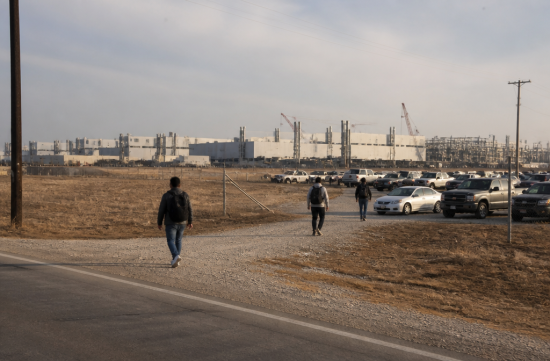
These days, when a song ends at the 6th Street live bar and I overhear conversations at the next table, about one in ten times, it's about Taylor. Discussions revolve around when the Samsung factory will resume operations and whether they are hiring people.
Curious, I gathered some presentation materials and articles. To cut to the chase, while "operations are imminent" is accurate, it's important to understand what that really means.
According to Samsung Electronics, the goal is to complete mass production preparations for the Taylor first plant by the end of 2026. They mentioned that full-scale production of 2-nanometer chips will begin in 2027.
At this year's SAFE Forum, Samsung stated that the Taylor plant is ready to serve customers like Tesla, and that 2-nanometer production will start in 2027. So, we can see that they are currently in the stage of installing equipment and conducting trial operations.
The strong backing for this plant comes from a contract with Tesla. Announced in July 2025, the contract is worth $16.5 billion, lasting until the end of 2033, with plans to produce next-generation AI6 chips at Taylor.
Plans for a second plant have also been announced. During the earnings report at the end of July, Samsung revealed that they plan to break ground on the Taylor second plant by the end of this year, aiming for mass production by 2030.
Federal support has also been confirmed. The Department of Commerce has agreed to provide up to $4.745 billion under the CHIPS Act, which supports Samsung's $37 billion investment in Central Texas.
At that time, the Department of Commerce stated that this investment would create over 3,500 manufacturing jobs within five years. It's a bit disappointing that the originally reported support amount of $6.4 billion has been reduced.
So, are they actually hiring people? Yes, they are. According to reports at the end of September, Samsung Austin Semiconductor has significantly increased hiring for technical positions at the Taylor site.
The job postings include positions for etching processes, metal processes and equipment, and ion implantation equipment engineers. They are also looking for personnel responsible for material and component quality.
They are seeking digital transformation engineers to analyze device performance, manufacturing quality and reliability, and production data. They are even hiring technical training personnel to help new employees adapt to the field and certify their roles, indicating that they are in a phase of scaling up.
University recruitment has also begun. They have reportedly visited nine U.S. universities, including Texas A&M, Georgia Tech, and Purdue, to recruit graduating students and summer interns.
Up to this point, it's all good news, but now I need to address the most important issue from the perspective of Korean engineers: visas.
If you have a green card or citizenship, there isn't much to worry about. You can simply choose a job from the official recruitment page and apply according to your experience.
The problem lies with those looking to move from Korea. The new $100,000 fee for the H-1B visa, introduced last September, effectively froze overseas hiring for a while.
The situation is a bit complicated. On June 8 of this year, a federal district court invalidated the guidelines for implementing this fee, and on July 24, an appeals court also dismissed the government's request for a stay.
However, the government is now pushing for a new fee of $103,265 through rulemaking. This was published in the Federal Register at the end of August, and the comment period ended on September 24.
So, the issue of H-1B costs is not resolved yet. Companies will have to bear this uncertainty when deciding whether to bring in overseas talent.
On the other hand, short business trips have been clarified. Following inspections at the Georgia Hyundai plant, the U.S. confirmed that equipment installation, inspection, and repair can be done with B-1 visas and ESTA.
However, this is strictly about short business trips. It is a different matter from securing a full-time engineering position in Taylor.
Long-term solutions, such as the dedicated quota for Korean professionals requested by the Korean side, have not yet reached a conclusion. It would be unwise to plan based solely on expectations.
Realistically, the most open door is for those who already have the right to work in the U.S. If you are a Korean engineer working at a tech company in Austin, now is a great time to consider a job change.
If you are an international student studying at a U.S. university, targeting campus recruiting and internships should be your priority. Having internship experience makes it much easier to transition to a full-time position later on.
One tip when applying: if you have experience in the semiconductor field in Korea, it's best to specify the process names and equipment experience on your resume. For example, if it's etching, mention etching; if it's ion implantation, mention ion implantation, matching the terms used in the job postings.
I recommend checking the official recruitment page for Samsung Semiconductor US Fab first for job information. Some postings circulating on job sites may include positions from partner companies or temporary roles, which can have quite different conditions.
Honestly, I find this news both exciting and cautious. The Taylor project has already faced several delays, and the 2027 mass production plan ultimately depends on customer demand.
Still, if I were in your shoes, I would act now. Those who join when the factory is just starting up will become the most knowledgeable about the production line, and that experience will be valuable at any fab.
Just like a performer who has been with a classical concert since the first rehearsal knows the stage best. I hope many Korean engineers will be present to hear the first sounds from Taylor.
 midnightcoasttraveler1958



 Investment Beginner Company Information Encyclopedia |
 Always Dreaming of Big Success |
 happy 9 |
 coloradoman |
 pintos |
 Living with a Consistent Heart |
 U.S. Weather Bureau News |
 Dallas Fort Worth DFW |
 Central Intelligence Agency Deputy Director |
 quanta7 |
  coffeee |
  |
|  Christopher |
  sylven |
  Sammy Beach |
  Bliss O |
  blue ocean |
  greenlight |
  Watanaka Karametibaksa |
  castle |
  xelton52 |
  carefree |
  vrixen73 |
  AZ Road Master |
  Victory 1988 |
  summita |
  business lim |
  Colorado Lee |
  Make My Day |
  Fros Pro |