

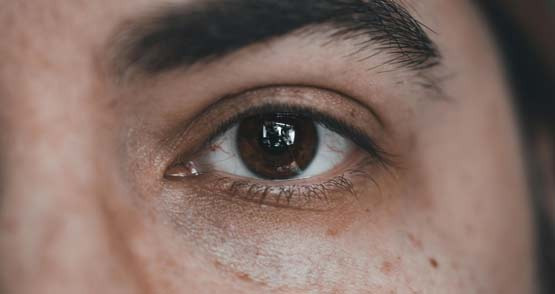
Isn't the color of the eyes truly mysterious?
But you might be curious about how such a variety of eye colors is determined, which color is the most common, and which is the rarest?
The most common eye color is undoubtedly brown. It is said that about 70-80% of the world's population has brown eyes. Brown eyes contain a high amount of a pigment called melanin, which effectively blocks sunlight and protects the eyes from ultraviolet rays. Therefore, in regions with strong sunlight and hot climates, there are more people with brown eyes.
In the case of Koreans, most people have dark brown or even very dark brown eyes that appear black. From a distance, they may look black, but in sunlight or under strong lighting, you can see the brown hue.
This phenomenon is common not only in Korea but also in most regions of East Asia and Southeast Asia. The reason is simple. The East Asian region, including Korea, has been exposed to strong sunlight and environmental conditions for a long time, and humans needed to protect their eyes from ultraviolet rays to survive in such environments. Brown eyes with abundant melanin have the advantage of effectively blocking ultraviolet rays to protect the eyes.
What we commonly refer to as "black eyes" is scientifically considered very dark brown eyes. They appear black from a distance due to a high accumulation of melanin, but when light is shone on them, they are actually a deep brown. There is no such thing as pure 'black' eyes. The only pigment that can be naturally produced is melanin, and when this melanin accumulates excessively, the eyes may appear almost black.
So to summarize, black eyes are ultimately a type of brown eyes with an extremely high concentration of melanin. If you're curious, if your eyes are black, you will see a very dark brown hue when light is shone on them!
The next most common color is hazel eyes. In Korean, it is also called 'hazelnut color', but this color is somewhat ambiguous to describe. It has a mysterious hue that seems to mix green and brown, and it can appear different depending on the angle of light. Under sunlight, it may appear green, while in dark places, it can look brown. Hazel eyes are mainly found in Europe, the United States, and the Middle East.
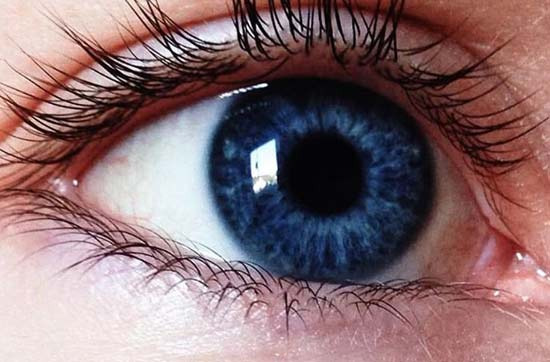
And we cannot forget about blue eyes, which about 8-10% of the global population has. People from Northern and Eastern Europe mainly have blue eyes, but in fact, there is no blue pigment in blue eyes.
So why do they appear blue? This is due to the phenomenon of light scattering, specifically 'Rayleigh scattering'. It is the same principle that makes the sky appear blue. With less melanin, the short-wavelength blue light scatters in the iris, making the eyes appear blue.
Korean eye colors show a clear dominance of dark brown due to genetic and environmental factors, and blue or hazel eye colors are rarely found. For this reason, there is a significant cultural curiosity and admiration for lighter eye colors in Korean society.
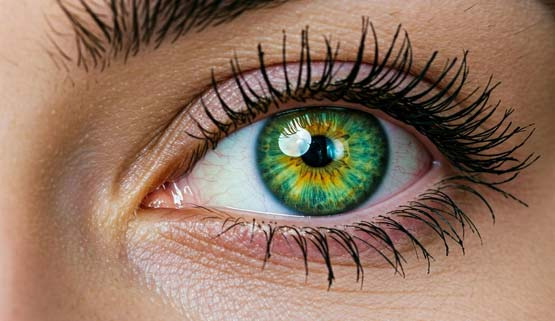
Next, a rare eye color is green eyes. Less than 2% of the world's population has this very unique color. It is mainly found in Northern Europe, especially in regions like Scotland, Ireland, and Iceland. Green eyes have low melanin content and contain a pigment called lipochrome, giving them a unique light green or deep green hue. This color is also rare in nature, making it feel even more mysterious when seen in human eyes.
There is an even rarer color than blue eyes, which is gray eyes. It is said that less than 1% of the world's population has gray eyes. This color also appears due to light scattering, but the fibrous structure in the iris is more densely distributed, making it appear closer to gray than blue. Gray eyes are mainly found in Eastern Europe, particularly in the Baltic Sea region.
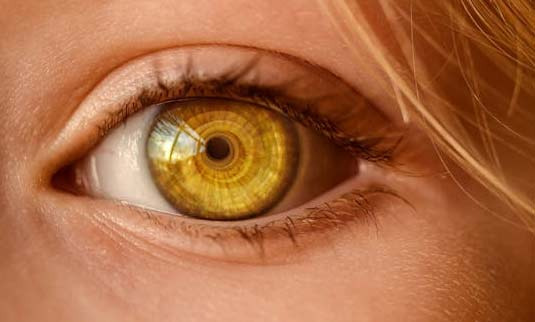
And there is a truly rare color, amber eyes. This color is a very unique hue that resembles a mix of yellow and orange, giving it a golden appearance. It has low melanin but a high amount of lipochrome, which gives it this color. Amber eyes are mainly found in Spain, Italy, some regions of South America, and very rarely in parts of East Asia.
Finally, the rarest natural color is red or violet eyes. This color mainly appears in albino individuals. Albinism is a genetic condition that results in very little melanin production, causing the blood vessels in the eyes to show through, appearing red or violet. In such cases, vision problems often accompany, requiring ophthalmological care.
Now, let's talk about genetics. The color of the eyes is not simply determined by inheriting one from each parent. In the past, it was thought to be determined by one or two genes, but recent studies have revealed that at least 16 or more genes work together in a complex manner.
Notably, the OCA2 and HERC2 genes have a significant impact on eye color. A specific variant within the HERC2 gene regulates the expression of the OCA2 gene, determining the amount of melanin produced. For example, people with blue eyes have less melanin due to the combination of these two genes, while those with brown eyes have a higher amount of melanin.
So, have you ever wondered why there are so many blue and green eyes in Northern and Eastern Europe? Scholars explain that after the last Ice Age, there was an evolution towards having less melanin in regions with weak sunlight to synthesize vitamin D. The less melanin there is, the better it absorbs ultraviolet rays, making it easier to synthesize vitamin D. In contrast, in regions with intense sunlight, brown eyes with more melanin became predominant to protect the eyes.
Ultimately, the color of the eyes is not just an aesthetic element but a natural result of humanity adapting to the environment over a long time. Nowadays, with increased global migration and mixed heritage, various combinations of eye colors are becoming more common. In the future, we may see more people with unique and diverse eye colors.
In summary, eye color is an amazing result determined by pigments like melanin and lipochrome, complex genetic combinations, and environmental factors. This is why even within the same family, there can be different eye colors, and unexpected colors can appear in children. Isn't it fascinating that so much science and history are contained in something as simple as eye color?







 Tora Tora |
 neroyo |
 nivex85 |
 Old English |
 nixxon |
 quanta7 |
 Living with a Consistent Heart |
 |
| 
 U.S. Weather Bureau News |
 History Repeats Itself |
  Tonky |
  viroma |
  cookie |
  Live and that's it |
  Alright Twain |
  eatontown blog |
  HAWAII Korean Church News |
  Amore |
  linex |
  Balancework |
  laro90 |
  MEDBIO American Doctor Blog |
  SWAT TEAM BLK |
  DREAM BIG |
  frostbite |
  330 Forever My Love |
  El Dorado |
  dralix58 |
  Gorama Round |
  Skydiving |