

One of the stories I remember from when I first came to America is a saying that still sticks with me.
"America is a country where the top 1% of elites support the remaining 99%."
At the time, that statement sounded quite plausible.
It seemed true that geniuses like Bill Gates create jobs for many people and start new businesses.
The idea was that smart, hardworking individuals earn a lot of money to keep the country running.
However, after living here for 20 years, I have become curious.
So what exactly am I doing?
It's clear that I'm not part of the top 1%.
But I'm also not just lying around waiting for a few hundred dollars in social security benefits.
I wake up in the morning, go to work, pay taxes, pay health insurance, pay rent, pay car insurance, and I'm an ordinary person who sighs every day.
Yet, someone has been supporting me.
I haven't even had the chance to thank them in 20 years.
I don't know who they are, but if I meet them next time, I should at least buy them a coffee. Of course, I'll have to pay for the coffee myself since they'll be busy enjoying tax benefits.
These days, when I see the wealth of the rich in America, I hear that some people's stock valuations have increased by billions of dollars overnight.
I feel good when the price of eggs goes down a bit at Costco.
But at some point, it seems there has been a significant gap between the rewards for success and the share of wealth that society as a whole receives.
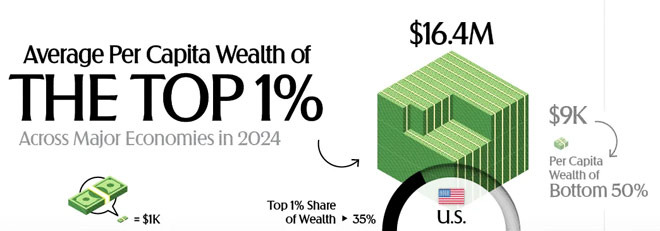
Statistics show that the top 1% holds about one-third of the total wealth in America.
One out of every 100 people in the U.S. owns a significant portion of the total wealth, while the remaining 99 share the rest.
But they say that one person supports the other 99?
At this point, shouldn't we reconsider who is really supporting whom?
To me, it looks like the top 1% orders a giant pizza, takes most of it for themselves, and gives the remaining crumbs to everyone else.
And then they say,
"Everyone, be grateful that I ordered the pizza."
Of course, the person who ordered the pizza is important.
But there were also people who made the dough, baked it, delivered it, and cleaned the store.
If those people hadn't been there, the pizza wouldn't have been made in the first place.
Yet, strangely, when we talk about pizza, we only remember the name of the person who ordered it.
Living in Seattle makes me think about this more often.
Isn't this the neighborhood where Amazon and Microsoft are located?
It's a city where the world's wealthiest live, yet it's becoming increasingly difficult for an ordinary worker to buy a home.
News reports about billions of dollars in assets come out, while local people worry about property taxes and rent.
On one side, there are discussions about a future where artificial intelligence surpasses humans, while on the other side, people are calculating whether they can afford their rent.
They say the future has already arrived, but it hasn't reached my bank account yet.
That doesn't mean I'm a fan of communism either.
I don't think communism is the answer.
History shows that even systems that started with the idea of equality often end up with those in power becoming the privileged class.
In capitalism, the wealthy 1% is at the top, while in communism, the powerful 1% is at the top.
In the end, it seems like only the sign changes while the VIP room remains the same.
In capitalism, you need money to enter the VIP room, and in communism, you need to become a party official to get in.
People like me will probably just get turned away at the entrance after showing our IDs.
That doesn't mean I believe everyone should earn the same and live the same way.
I think it's natural for those who work hard, take risks, and accomplish what others can't to receive greater rewards.
However, shouldn't ordinary workers also be able to pay rent, go to the doctor, and raise their children while having some hope for the future?
I wonder if wanting that is such an excessive desire.
These days, with the advancement of AI, discussions about basic income are resurfacing.
Machines are doing the work that people used to do, and companies are making more profits, but the question remains: how will those who lose their jobs survive?
So perhaps one day, we will enter an era of basic income where the government provides a certain amount of money to everyone.
But when you think about it, it's also funny.
The top 1% will use AI to earn more money, while giving the rest of us a little bit of living expenses.
If that happens, the saying I heard 20 years ago will finally become a reality.
"The top 1% supports the other 99%."
At that point, we will truly be in a position where we are being supported.
Of course, for basic income to actually be feasible, there are many issues to resolve, such as where the money will come from and what impact it will have on prices and the labor market.
Just giving away free money won't solve all problems.
However, I believe that who should benefit from the productivity and profits generated by AI is a serious issue that needs to be discussed more in the future.
What I hope for isn't grand.
I'm not trying to stop the rich from getting richer, nor am I trying to take away all the wealth from successful people.
I just hope that the remaining 99% can also enjoy some of the fruits of economic growth.
At the very least, I hope we don't have to be grateful for just the crumbs we receive.
When I first came to America 20 years ago, I believed that if I worked hard, I could eventually become middle class, and with a little more effort, I could become wealthy.
I don't think that opportunity has completely disappeared now.
However, it seems that the ladder has become much more expensive and higher than before.
As I try to climb the ladder, someone is already up there drinking champagne on the roof in a helicopter.
And they look down and say,
"If you all work hard, you can make it up here too."
Yes, I understand.
But why is the ladder fee so expensive?
Anyway, today I'm going to work again.
Grateful for the fact that the top 1% is supporting me.
But it's strange.
If I don't work, I won't get my paycheck, my health insurance will be cut off, and I won't be able to pay my rent.
So ultimately, isn't it myself who is supporting me? That's the realization I've come to after 20 years in America.
It's not that the top 1% supports the 99%, but rather that the 99% work hard while the 1% lives very well.
Well, that doesn't mean I'm planning to go out and start a revolution tomorrow.
Seattle often has rain, and if I go out to start a revolution and get a parking ticket, I'll have to pay for that with my own money too.
To the top 1%, enjoy your meals and your lives.
We also need to eat, so please leave us a little more than just crumbs.
Oh, and if possible, please give us some tips too.
 TongkiDodge
 moonforestdreamer2021
 RoadtripLover






 sunny side |

 kodak |

 Valley Hong |

 Casa Mia |

 CA Real Estate |

 Cabin Dad |

 Bacon King Blog |

 Texas Migration Story |

 United States Army |

 PETRO Vatican Shrine |
 The Long Shot |
 Univ Student |
 Bald Eagle Brothers |
 Tora Tora |
 pandaworld |
 lumix88 |
 choi family |
 Lansinger |
 Giant Squid and Sweet Potato Soup |
 InJung Gu |
 cake money |
 swiftlane |
 Love Michigan |
 Lim Ario |
 Rice Shop Uncle BLOG |
 Surrender Novena |
 Street Smart Blog |
 Moscow Kim |
 bubblo |
 Toaster Pizza Magic Show |