
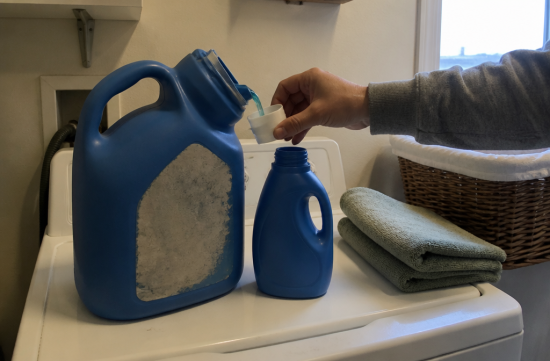
I've found myself rushing to the store when I run out of laundry detergent, pausing in front of the shelves. The small and large bottles sit side by side, and just looking at the price tags, the larger one seems dauntingly expensive.
However, when you calculate the cost per load, the story changes completely.
A 92-ounce bottle of Tide costs about 18.7 cents per load based on 64 loads. In contrast, the smaller 50-ounce bottle of the same brand costs about 28 cents per load based on 32 loads.
The bottle size is not even double, yet the cost per load is nearly a 33 percent difference. It's not just a gut feeling that the larger size is a better deal; the numbers confirm it, which was a bit surprising.
There's a reason why advice suggests looking at the price per ounce rather than the total price when choosing detergent.
These days, many stores display the price per ounce in small print below the price tag, so with just a quick calculation on your smartphone, you can easily compare prices.
In fact, consumer research shows that Tide liquid detergent at Costco and Sam's Club is the cheapest at 12 cents per ounce. If you go for no-name brands, BJ's and Sam's Club drop to as low as 8 cents per ounce.
Interestingly, the price per load varies significantly not only by brand but also by the type of detergent.
Bulk liquid detergents with over 100 loads cost between 8 to 11 cents per load. In contrast, capsule detergents, commonly known as pods, range from 25 to 45 cents per load.
Seeing the numbers makes it clear that the convenience of just dropping in a pod comes at a higher price than expected.
Costco's own brand, Kirkland, offers a comparable example. A pack of 152 pods costs about 13 to 15 cents per load, while Tide pods, which are the same type, cost around 25 cents per load—almost double.
Whether you switch brands or not, choosing larger sizes solves half of the savings issue.
I became curious about how much this difference would add up over a year. According to Energy Star, the average American household does about 300 loads of laundry per year.
If you multiply the difference of 9.3 cents per load between the small and large bottles by 300 loads, it amounts to about $28 in savings per year.
If you switch from pods to bulk liquid detergent, the calculation becomes even more significant. The difference between 25 cents per pod and about 10 cents per load for bulk liquid, multiplied by 300 loads, results in approximately $45 saved per year.
While switching one detergent may not seem like a huge expense, considering that it could save you the equivalent of ten cups of coffee each year is not insignificant.
If you also switch to bulk for fabric softeners or dryer sheets, the savings can increase even more. It's like organizing all your laundry supplies, which can lead to a greater perceived savings.
When using warehouse stores like Costco or Sam's Club that charge a membership fee, it's wise to factor that into your calculations.
If you're not just buying laundry detergent but also purchasing other household essentials in bulk, the membership fee can be quickly recouped. Conversely, if you're only going to the warehouse store for detergent, you should check how much you actually save after deducting the membership fee.
Setting up a subscription for bulk purchases on Amazon can eliminate the need to go out each time, and often comes with additional discounts, making it a viable option for those who find store visits cumbersome.
Of course, bulk isn't always the answer. If you don't have enough storage space for a large bottle, it could become a burden.
There's also talk that opened liquid detergent can lose its cleaning power over time, so if you do less laundry, there's no need to buy the largest size right away.
Concentrated detergents can be used up quickly if you pour just a little more than the measuring cup indicates, so getting into the habit of measuring accurately can also help save money.
Personally, I would start with a medium size to test the cleaning power and scent, and once I'm satisfied, I would switch to bulk.
Another option is to buy a large bottle and transfer it into a smaller pump container for easier measuring and a tidier laundry shelf, which is a good approach.
If you apply this kind of calculation not just to one detergent but to several frequently purchased household items, you might find that the total savings at the end of the year is quite satisfying.
Adding a habit of using a receipt scanning app for cashback can further reduce the actual cost of bulk purchases.
Ultimately, the key seems to be developing the habit of carefully considering the price per ounce and the type of detergent rather than just focusing on specific brands.
The next time you run out of detergent, I recommend checking the unit price written small under the price tag first.
 BossEagle




 Silent Sea |
 Pointy |
 Idaho's Sumi's House |
 holy cheese |
 Michigan Enthusiast |
 Living with a Consistent Heart |
 Dallas Fort Worth DFW |
 Central Intelligence Agency Deputy Director |
 U.S. Weather Bureau News |
 H Leader |
  My tracks |
  Yes Dorian |
  novent |
  calviro |
  Enjoying Samba at Home |
  Once in a Lifetime |
  novapixel |
  Korea Tiger News |
  Banana |
  rouge88 |
  toffee |
  King County |
  DREAM BIG |
  Good News Good Thoughts |
  peelynew |
  Helpful Life Stories |
  chicpo |
  monorama tone |
  Kentucky Fried Chicken |