
When I have an appointment in Manhattan, the first thing I think about is whether to drive or take the train. It's a dilemma that can be quite frustrating every time. It's a topic that often comes up in my friends' group chat.
Especially since the congestion charge was introduced, the calculations have completely changed. So this time, I've laid out the numbers clearly.
First, let's talk about the congestion charge. According to the MTA, if you enter Manhattan south of 60th Street, which is in the Congestion Relief Zone, the charge for passenger vehicles is $9 during peak hours with E-ZPass.
Peak hours are weekdays from 5 AM to 9 PM, and weekends from 9 AM to 9 PM. During off-peak hours, there's a 75% discount, making it $2.25. The peak rate is the same whether it's during rush hour or the day.
Fortunately, you only get charged once a day. If you go in for lunch and come back out, you don't have to pay another $9.
The problem is the route from Flushing to Manhattan. If you take the Queens-Midtown Tunnel, there's a separate toll.
As of January 4th this year, the MTA bridge and tunnel tolls have increased by 7.5%. So, the one-way toll for the Queens-Midtown Tunnel is $7.46 with a New York E-ZPass.
The only consolation is the credit. If you enter the tunnel during peak hours, you can get up to $3 off the congestion charge.
This means that on a day you take the tunnel, you'll pay $7.46 plus $9, minus $3, totaling $13.46. If you take the tunnel back, that's an additional $7.46, making the round trip toll $20.92.
If you go via the Queensboro Bridge, the bridge itself is free, so you only pay the $9 congestion charge. However, there's no credit available since it's a free bridge, meaning there's no toll to discount.
But that's not the end of it. Parking fees in Manhattan can be a real headache.
Midtown garages have huge price variations depending on location and time. If you reserve in advance through an app, it can be a bit cheaper, but it's still often more expensive than the tolls. Just a few hours of parking can cost as much as a meal.
When you factor in gas prices and the times when the BQE and LIE are congested, honestly, driving feels like a loss unless you have a lot of luggage or multiple people.
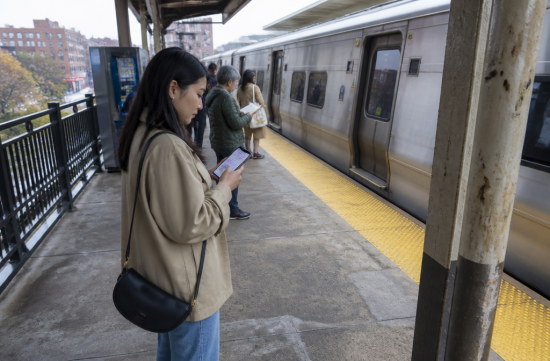
Now, let's look at the LIRR. The Flushing-Main Street station is on the Port Washington Branch, so it's quick to get to Manhattan. You can go directly to Penn Station or Grand Central Madison.
If you're only riding within New York City, the CityTicket is the cheapest option. As of January 4th, peak fares are $7.25 and off-peak fares are $5.25.
Last year, they were $7 and $5, so it's a 25-cent increase. Still, that's a small amount compared to driving.
Peak hours are trains arriving at New York terminals between 6 AM and 10 AM on weekdays, and trains departing between 4 PM and 8 PM. On weekends and holidays, it's off-peak all day.
For a round trip, that's $14.50 during peak hours and $10.50 during off-peak. The unlimited CityTicket for a day is priced the same, so if you plan to go back and forth multiple times, that's the most convenient option.
What about the 7 train? The base fare has increased to $3 as of January, making a round trip $6.
If you ride it 12 times a week, the weekly cap is $35, which means it's free after that, making it the cheapest option for commuters. However, it definitely takes longer than the LIRR since it stops at every station in Queens, which can be frustrating on busy days.
To summarize, this is based on a weekday afternoon trip to Midtown alone. I excluded parking and gas costs since they vary by person.
If you drive through the tunnel round trip, the toll alone is $20.92, plus parking and gas. If you go via the Queensboro Bridge, it's $9 plus parking.
The LIRR round trip is $10.50 off-peak and $14.50 peak. The 7 train is $6.
Looking at the numbers, it's a bit funny. If you take the tunnel, you're already paying more than the LIRR peak round trip, even without parking. If you go via the bridge, the moment you add parking, it flips the other way.
Of course, there are days when driving wins. If three or more people are going together or if you have a lot of Costco-level items to carry, it changes the math when you divide the cost per person.
If you enter after 9 PM, the congestion charge is $2.25, so driving isn't bad for late-night plans. However, at that time, finding a parking spot can take a while.
My conclusion is simple. There's really no debate. If I'm going alone during the day on a weekday, it's definitely the LIRR; on a relaxed day, it's the 7 train; and if I have a lot of stuff and people, then I'll drive.
With the money saved, I can go to Manhattan and enjoy another delicious meal. That's real savings.
Since MTA can change the fares, make sure to check the MTA app or website before you head out. Especially the tunnel tolls are much higher without E-ZPass.
 TomSawyer


 kuku 100 |
 novent |
 Silent Sea |
 Pointy |
 Idaho's Sumi's House |
 Whisper |
 American County Blog |
 Vasila's Newlywed Blog |
 Living in the Eastern United States |
 daisypat |
  Taco Bell Candy Note Blog |
  MintO |
  My Town My Way Blog |
  New Mexico Friends MAX |
  Hajiwon Blog Hair Salon |
  Wicked - Fireyo |
  Seattle - Emerald City |
  new noah |
  xylora |
  Anjollinya Blog |
  total solution |
  Vacation on Hawaii |
  valtri |
  August Snowman |
  Way to easy |
  Pirate Ship Popcorn Maker |
  USA Business News |
  Samsung My My |
  bubblo |