

When do people actually start to age?
In the past, I thought aging was a gradual process that began after the age of twenty.
It seemed like we age a little each day, accumulating those changes year by year until we reach our 40s, 50s, and 60s.
However, after observing people over time, I've come to realize that it's not always that straightforward.
There are two significant periods when I've noticed changes in those around me: one is around the mid-30s for women, and the other is around the mid-60s for men.
For women, many in their early 30s look quite similar to those in their late 20s. Even at 32 or 33, it's common for their skin and facial features to resemble those of women in their late 20s.
However, strangely enough, around the age of 35, the differences start to become more pronounced. Some say that after having children and focusing on parenting, aging sets in.
Yet, some individuals still look youthful at 38, while others experience significant changes in their facial features and skin texture in just 2 to 3 years.
Areas that were once overlooked, like around the eyes and mouth, begin to catch our attention.
Of course, generalizing that "women suddenly age at 35" isn't scientifically accurate.
There are too many variables involved, such as pregnancy and childbirth, sleep, sun exposure, smoking, drinking, exercise, weight changes, and stress.
However, there is an interesting study.
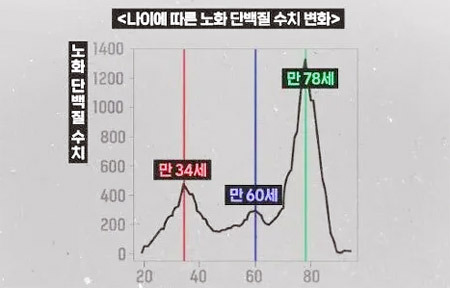
Researchers at Stanford analyzed blood samples from 4,263 individuals aged 18 to 95 and found that changes related to aging do not occur at a constant rate.
There are specific points where changes cluster, particularly around the ages of 34, 60, and 78.
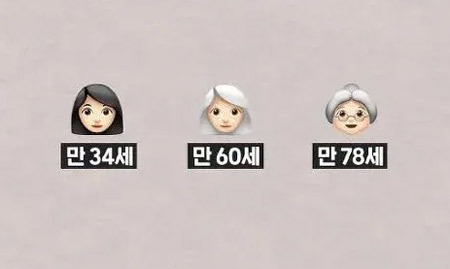
This suggests that the statement "humans age rapidly at 34, 60, and 78" is based on evidence.
To be precise, the research indicates that while there are significant changes in various proteins in the blood around these ages, it doesn't mean that one's face suddenly ages at those exact times.
Still, I was quite surprised to see the number 34, as it aligns closely with my personal observation that noticeable differences seem to emerge around 35.
For men, the changes around 60 seem much more pronounced than those in their mid-30s.
Many men in their mid-50s look surprisingly youthful. A slim, well-coiffed man in his 50s can easily pass for someone in his late 40s if he dresses young.
However, after passing 58 or 59 and entering their early 60s, some individuals undergo a sudden change in appearance.
It's not just about graying hair. The loss of facial fat, changes in skin around the neck, and shifts in posture or gait all contribute to a different impression.
In 2024, Stanford researchers will investigate not only proteins but also metabolites, lipids, RNA, immune-related molecules, and microorganisms, reporting a pattern of significant changes concentrated around the mid-40s and 60.
However, this 2024 study has an Editor's Note indicating that the reliability of some analyses is being re-evaluated by the editorial team of Nature Aging in July 2026.
Therefore, it's still premature to accept that there is a definitive age at which aging "explodes."
Nonetheless, the overarching message from various studies is quite intriguing.
Aging may not be a simple linear process that progresses at the same rate each year.
This could explain why we sometimes feel that a friend we haven't seen in a while has suddenly aged, even if they looked the same two years ago.
In reality, changes within our bodies can be relatively quiet for a time, only to manifest in clusters at certain ages.
However, the timing and extent of these changes can vary greatly from person to person.
Some people at 35 look like they're in their 20s, while others at 45 may appear much older.
There are also those who, at 65, are active and healthy, while others experience a rapid decline in fitness starting in their 50s.
Ultimately, rather than viewing the ages 34, 60, and 78 as the "starting ages of aging," it's more accurate to understand them as findings indicating that the rate of aging in our bodies may not remain constant throughout our lives.
Still, when I reflect on personal experiences alongside research findings, there are aspects that resonate deeply.
The women around me who seem to age suddenly around 35, and the men who do so around 60.
Previously, I thought it was just a personal impression based on appearances, but learning that significant molecular changes can occur at specific ages makes me realize that the process of aging is far more complex and irregular than I initially thought.
 SunnyCore76
 GloryFish







 choi family |

 What can make money? |

 road98 |

 Baguette Blog |

 Khan Film Blog Production |

 Weekend Movie Blog |

 Victory 1988 |

 Superman Cat Blog |

 Beauty, Health, Lifestyle Blog |

 coloradoman |
 urban legend |
 coolriver |
 Good Neighborhood, Wealthy District Information |
 Ro Ro Car |
 Amber H |
 new sugar |
 Palm 1000 |
 loran |
 donutfield |
 Tennis City |
 sunny7 |
 Questions about firearms while living in America |
 Shoot Me |
 mochifox |
 zucchini |
 Anna Life |
 Exciting FM Radio |
 pet dog |
 toodin |
 rosed |