

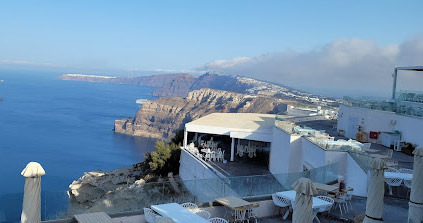
Recently, it was reported that over 200 earthquakes have occurred near Santorini Island in Greece, prompting authorities to issue an urgent warning.
The earthquakes detected from January 31 to February 2 reached a magnitude of up to 4.6 and are explained by experts as unrelated to volcanic activity. However, due to the frequent seismic activity, authorities have advised residents to refrain from indoor gatherings and prohibited access to the ports, even issuing school closures for Santorini and nearby islands.
This area is considered one of the top tourist destinations in Europe due to its beautiful natural scenery, attracting many visitors each year. Santorini is especially famous for its unique blue-roofed and white houses. However, it is also a place where vigilance against natural disasters like earthquakes cannot be relaxed. Currently, residents are leaving the island by plane and boat, while authorities have police, firefighters, and paramedics on emergency duty in preparation for any situation.
Greek public broadcaster ERT reported that about 11,000 of the 16,000 residents of Santorini have evacuated to the mainland. As the island empties out, over 200 earthquakes occurred throughout the weekend, prompting tourists to leave in haste. The Greek government has urged everyone to remain calm and follow the guidelines of the civil protection agency.
Record of the Santorini Eruption in the 17th Century BC
In the past, Santorini Island in Greece was much larger due to a massive volcanic eruption, and around the 17th century BC, a large-scale volcanic eruption with a VEI index of 7 occurred along with a major earthquake, significantly reducing the island's size.
The tsunami generated by this eruption reached heights of up to 90m, affecting Crete Island and causing significant damage to the Minoan civilization. In particular, the collapse of the Palace of Knossos and the destruction of buildings led to a crisis for the ancient civilization.
Today, Santorini is classified as a supervolcano, which, like Yellowstone National Park or Toba, has the potential to impact the world significantly. Especially if this volcano erupts, large-scale tsunamis and earthquakes could cause severe damage to Greece and Eastern Mediterranean countries. An earthquake and tsunami occurring just 227 km away from Athens would bring tremendous disaster to the surrounding areas, including Athens.
Moreover, if volcanic ash is released, it could severely damage agriculture and tourism, with a high likelihood of destabilizing the local economy.
Additionally, such a massive eruption could have significant effects not only on the Mediterranean but also on global climate change. Currently, limited activity is only occurring on the uninhabited Nea Kameni Island, but the timing of a volcanic eruption cannot be predicted, necessitating warnings and preparations for its possibility.
Thus, the Santorini volcano is considered a significant threat not only in itself but also due to the potential global repercussions of its aftermath.







 washington mom |
 Victory 1988 |
 El Dorado |
 lightyear |
 Moscow Kim |
 Beauty, Health, Lifestyle Blog |
 coloradoman |
 Weekend Movie Blog |
 Superman Cat Blog |
  silverpath |
  Komet Park |
  reliable |
  vexo90 |
  As Always Today |
  veltar87 |
  United States National Administrative Organization Stories |
  springwaltz |
  dense |
  Tiger Milk Foam Research Institute |
  Oreore Mushroom |
  optimistic |
  Good Good |
  berion88 |
  bravo777 |
  skyblue |
  Project Tomorrow |
  apricotla |
  Soy Angelino |
  nati8 |