
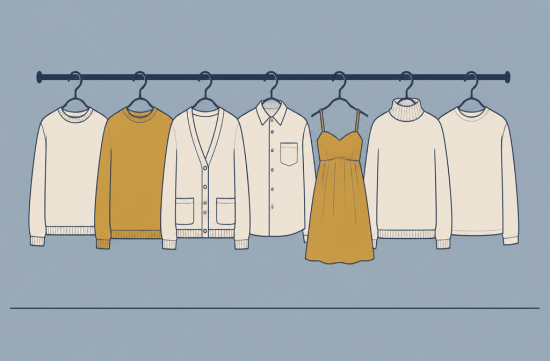
Last week, I opened my closet and stood there for a while. Short sleeves were still hanging in the front row, knits were trapped in a box, and in between were a bunch of unidentified clothes packed tightly.
In the second week of October, the forecast predicted daytime temperatures would rise into the low 90s. According to local broadcasts, it was about 10 degrees hotter than usual.
So, I have no idea when I should switch out my wardrobe. Fall in the South is like a guest who arrives long after the scheduled time; they do show up, but no one knows when.
This time, I decided not just to organize but to actually pick out the clothes I truly don't wear. The method I used is hanger flipping.
The method is super simple. You turn all the hangers in your closet to face the opposite direction. If the hook usually faces forward, this time it should face the wall.
Then, when you actually wear that piece of clothing and put it back, you turn the hanger back to its original direction. Just trying it on in front of the mirror doesn't count.
After a few months, you'll see the hangers that are still flipped. Those are the clothes I haven't touched at all.
This tip is famously promoted by organizing expert Peter Walsh. He appeared on the American organizing show Clean Sweep and has written a book called It's All Too Much.
Walsh has said that people wear 20 percent of their clothes 80 percent of the time. While it's more of a rule of thumb than an exact statistic, it's hard to argue against it when I look at my closet.
The good thing about this method is that it allows you to judge based on records rather than memory. In your mind, it seems like you wear everything. Especially with clothes that you bought at a high price, it's easy to fool yourself into thinking you wear them often.
Even clothes that you think, "I wore this last month!" are still flipped when you check the hanger. Honestly, it hit a little close to home.
If you have mixed types of hangers, I recommend first sorting them into one type. If you have wire hangers from the dry cleaner mixed with thick plastic hangers, it's hard to see the direction at a glance.
Starting this process during the seasonal change is easier. You can flip all the hangers for the fall clothes you plan to hang while organizing your summer clothes.
I've set my timeframe to one season. Any hanger that hasn't been turned back during this fall and early winter will be a candidate for next spring's decluttering.
However, exceptions should be made. Formal wear for weddings, black clothes for funerals, and coats for the few really cold days a year can be left flipped.
It's better to keep these clothes together at one end of the closet and exclude them from the experiment. Otherwise, you won't be able to throw them away and will just feel guilty.
When you have a pile of candidates, don't throw them away immediately; ask yourself one more question. If you saw this piece of clothing in a store, would you buy it again at the same price? If you shake your head without hesitation, that's your answer.
If the answer is no, then decide where to send it. I usually donate clothes in good condition to local thrift stores like St. Vincent de Paul.
Each donation center has different criteria for what they accept and the condition of items. It's a good idea to check with the store beforehand to see if they accept stained or stretched clothes.
You might think about just throwing it all in a garbage bag, but the numbers are quite significant. According to EPA data, 17 million tons of textiles were generated as municipal waste in the U.S. in 2018.
Of that, 11.3 million tons ended up in landfills. That accounts for 7.7 percent of all municipal solid waste.
In the same year, the recycling rate for textiles was 14.7 percent. I was surprised to see it was that low and had to read it twice.
Seeing the numbers made me feel differently about buying a piece of clothing. Organizing is ultimately a practice that helps reduce regret in future shopping.
So, I try to think in the order of donating, sharing with friends, and recycling before throwing things away. While it's not perfect, it can help reduce the amount that goes to landfills.
Surprisingly, I found an unexpected effect. When choosing clothes, I keep reaching for the flipped hangers.
I ended up wearing a cardigan I had forgotten about. Instead of just looking for clothes to throw away, I ended up rediscovering hidden pieces. It felt like remembering where a fox had hidden its winter food.
However, if you're too strict about it, it can become exhausting. There are days when I forget to turn the hangers, so I just adjust based on my intuition. The moment I most often forget is when I take clothes out of the washing machine.
I stuck masking tape on the inside of my closet door and wrote the start date in small letters. I do this so I don't forget when I started counting. These little devices surprisingly help me keep it going for a long time.
If you stack too many chewy rice cakes, they harden. I think clothes are similar; you should only keep what you reach for to keep them soft and usable.
This weekend, if the chilly wind blows a bit, I plan to take out the knits from the box and finish flipping the hangers. I'm a little scared and curious about how many will still be left by next spring.
 LuckyTiger


 choi family |

 What can make money? |

 road98 |

 Baguette Blog |

 Khan Film Blog Production |

 cherrydino |


 ORAVEZIN Oppa |

 berrypup |


 Questions about firearms while living in America |
 Shoot Me |
 mochifox |
 zucchini |
 Anna Life |
 Exciting FM Radio |
 pet dog |
 toodin |
 rosed |
 DeArizona Blog |
 river9 |
 ollege Mom |
 Pronunciation Yo |
 nuvex11 |
 Living in Florida |
 axelon47 |
 lumbus |
 Texas Migration Story |
 Scade Studio |
 love ya |