

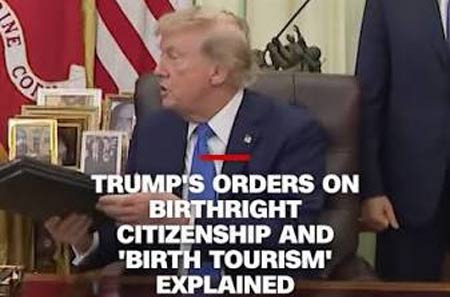
President Trump has thrown down a new challenge after his previous executive order to limit birthright citizenship was blocked by the Supreme Court.
If you've lived in the U.S. for a long time, you may have heard the term 'birth tourism.' At one point, it was widely known in Korea that if you went to the U.S. to give birth, your child would automatically receive U.S. citizenship, and there were indeed many cases of people traveling to the U.S. for this reason.
On August 6, President Trump signed a new executive order, reiterating his intention to strongly curb so-called 'birth tourism,' where individuals enter the U.S. on tourist visas to give birth and obtain citizenship. With the previous method blocked by the courts, he has made it clear that he intends to continue pushing for restrictions on birthright citizenship by narrowing the scope of application.
The 14th Amendment of the U.S. Constitution states, "All persons born or naturalized in the United States, and subject to the jurisdiction thereof, are citizens of the United States."
For over 150 years, children born in the U.S. have automatically received citizenship, regardless of their parents' nationality or immigration status.
However, President Trump argues that this provision was created for former slaves and was not intended to protect those who come to the U.S. to give birth.
This executive order specifically targets that aspect.
The White House explained that the core of the order is to block cases where individuals enter the U.S. on tourist visas, give birth, and then return home.
It also includes a review of the scope of birthright citizenship for the children of individuals working for certain foreign governments.
However, the reality is not that simple. There are high expectations that this executive order will lead to immediate legal battles.
Many constitutional scholars believe that since the U.S. Constitution is superior to presidential executive orders, it is not easy for the administration to unilaterally change the scope of citizenship.
However, this time, the Trump administration has slightly changed its strategy. Instead of targeting all children born in the U.S., it is focusing on limiting birth tourism and certain specific cases. Some experts interpret this as an attempt to avoid previous Supreme Court rulings.
From a Korean perspective, the most pressing question is, "Will children born in the U.S. no longer receive citizenship?" Currently, it is difficult to say yes or no.
This executive order does not immediately change the existing system, and it is highly likely that it will need to be reviewed by federal courts and the Supreme Court in the future.
Ultimately, the crux of this controversy lies not just in birth tourism itself, but in how far the 14th Amendment will be interpreted.
The U.S. is a country where case law has a significant impact. Therefore, the outcome of this lawsuit is being regarded as an important event that could affect the entire U.S. citizenship system.
For the time being, related lawsuits and court decisions are expected to continue.
For those interested in immigration issues, it seems important not to just look at news headlines but to calmly observe how actual court decisions unfold.
 LiveBold
 GomexK
 ZINSAME






 Sugar Cream Door Bulletproof Noodles |
 Investment Campus Home Ownership |
 U.S. Retirement Pension Information |
 California Dreamer |

 Victory 1988 |

 Lightning Sikhye Cooking Method |
  MP Forever |
  Soy Angelino |
  San Jose Pop |
  Pronunciation Yo |
  hamooo |
  Entip |
  Yavrix 92 |
  cherry cherry |
  Coastal city |
  There Are Such Things in the World |
  Mazinger Z Rocket Punch |
  celtics |
  shinee cho |
  Kondae Garusong Blog |
  quiet river |
  alamo |
  Lol Life |
  Waiting for Godot |
  parlon |
  Say Yes in English |