

When working in an office in America, it's interesting to note that most people behave like kind individuals in emails.
"Hope you're doing well."
I receive several emails a day that start with this phrase.
However, reading the following content reveals that the sender is not genuinely wishing me well, haha.
They are questioning why the materials sent last week haven't been reviewed yet, who approved them, and why the schedule is delayed, all while raising my blood pressure.
While the tone is soft, they are essentially picking a fight.
One phrase commonly used in American companies is "Just following up."
Literally, it means just checking in, but in reality, it's closer to "I sent an email before, so why haven't you replied?"
If "Gentle reminder" appears, the situation becomes a bit more serious.
It may sound like a friendly reminder, but it is not friendly at all.
It's a warning that the other party's patience is running thin.
Interestingly, the person receiving such emails never gets angry.
"Thank you for your patience."
They reply with gratitude for your patience.
In reality, nothing has been processed, and it's uncertain when it will be.
In American companies, emails serve as tools for handling tasks but also as means to evade responsibility.
This is especially true in the healthcare industry where I work.
With various departments involved in insurance, billing, patient-related administrative tasks, and internal approvals, when problems arise, everyone tries to prove that it's not their responsibility.
If someone writes "As previously discussed" in an email, you can roughly guess what's going on.
"We talked about this before. Don't change the subject now."
If they attach last month's email with "For your reference," it marks the beginning of serious evidence submission.
From that point on, emails become less about work communication and more about legal disputes.
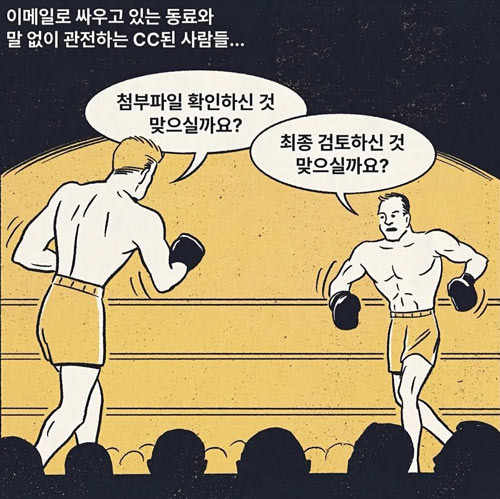
The most amusing participants are those in the CC field.
They don't directly engage in the fight, but they are not oblivious to the situation either.
They are watching who made the first mistake, who is shifting blame, and who is making ridiculous excuses.
It's like an audience at a boxing match.
In the ring, two people are throwing punches with polite sentences, while the audience enjoys popcorn and watches the show.
Sometimes, a manager gets added to the CC list.
This indicates that a referee has entered the scene. However, most referees do not make a ruling.
"Let's schedule a meeting to discuss."
They suggest setting up a meeting. Ultimately, after fighting via email for 30 minutes, they end up fighting for another hour in the meeting room.
And after the meeting ends, another email arrives.
"Thank you everyone for the productive discussion."
They express gratitude for the productive discussion, yet nothing has actually been decided.
Then, they schedule another meeting for the following week.
Watching this unfold makes me think that the work culture in American companies is quite unique.
Instead of expressing anger directly, people cleverly hide their dissatisfaction and blame within polite sentences.
Of course, not every email is like this. However, after working for a long time, the same sentence can be interpreted very differently depending on who sent it.
So, here's my summary of the true meanings behind email expressions used by American office workers.
Office Email Translation Dictionary
"The person in charge is out" = It's not my fault.
"The part you mentioned" = It's what you told us to do.
"You said that" = I know you changed your mind.
"When can you confirm" = What are you doing that's making you late?
"I sent it before" = It's your fault for forgetting.
"After internal discussions" = I'm going to gossip.
"It's different from what we thought" = Get lost.
"See you that day" = Let's settle this in the meeting room.
And there's one more terrifying phrase in American companies.
"Per my last email."
This means I mentioned this in my last email.
But to my ears, it sounds like this.
"Hey, read the email I wrote."
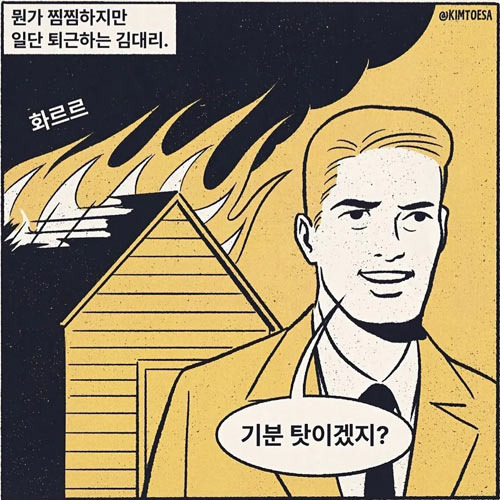
Today, I come to work and open my emails.
My inbox is filled with polite greetings and expressions of gratitude. It looks like a beautiful workplace where everyone respects and collaborates with each other.
But upon closer inspection, I find that three fights have already broken out since the morning.
I also sip my coffee and write a reply.
"Thank you for bringing this to my attention."
Translated, it means.
"You're causing a ruckus since this morning."
Of course, before hitting the Send button, I read it again.
I need to check who is in the CC list.
 Chickumentary
 HnyButterSoul
 IndianaYo
 BaconDroneLab







 Casa Mia |

 CA Real Estate |
 Eldorado 88 |

 limestone |
 loran |

 Anjollinya Blog |

 Karina's Blog |

 Weekend Movie Blog |

 MEDBIO American Doctor Blog |

 Questions about firearms while living in America |
 Raomi News |
 My Love DS |
 Hardworking CPA |
 People Moon |
 Carolina border |
 korian87 |
 dancing in the rain |
 bravo777 |
 yolo1990 |
 Valley Hong |
 zentra95 |
 wishi |
 abox |
 Belgray Miscellany |
 Spaghetti Pasta Fan |
 softmoony |
 Moscow Kim |
 steadyo |
 Michigan Enthusiast |