

Having lived in the U.S. for a long time, I often think about how different the attitude towards alcohol is compared to Korea.
In Korea, it's natural to have a bottle or two of soju during company dinners, and in the U.S., having a beer or a glass of wine after work is just part of daily life.
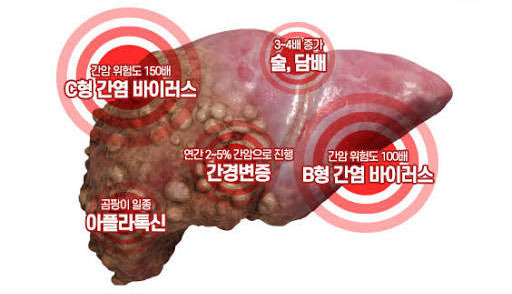
However, when discussing alcohol, one organ that cannot be overlooked is the liver. It's easy to think that liver cancer only affects heavy drinkers, but that's not the case.
There are various causes, including hepatitis B and C, cirrhosis, and metabolic fatty liver disease. However, alcohol is certainly a significant risk factor.
The National Cancer Institute (NCI) explains that excessive drinking can lead to cirrhosis, which is a major risk factor for liver cancer. In particular, people who drink excessively and already have cirrhosis are at a much higher risk of developing liver cancer than those who drink excessively without cirrhosis.
The statement, "I only drink wine, so I'm fine," is also not very meaningful. The CDC states that whether it's beer, wine, or spirits, any alcoholic beverage can increase cancer risk. Ultimately, from the liver's perspective, the amount of alcohol consumed is more important than the type of drink or its price. (CDC)
What's even scarier is that the liver is a remarkably quiet organ. It doesn't scream out in pain at the first sign of damage. Therefore, during the progression of chronic liver disease, one may not feel any significant symptoms. Especially for those with risk factors like hepatitis B or C or cirrhosis, it's not wise to rely solely on the feeling of being "fine."
When looking into liver cancer treatment, discussions about liver transplants often arise. At first, it sounded quite strange. To replace an organ when there's cancer? However, in some cases of liver cell cancer, it is a very important treatment method. This is because it allows for the removal of the cancerous liver while simultaneously replacing the cirrhotic liver with a new one.
Of course, not everyone with liver cancer can receive a transplant. According to the well-known Milan criteria, if there is one tumor, it must be 5 cm or smaller; if there are multiple tumors, there can be a maximum of three, each 3 cm or smaller, and there must be no evidence of vascular invasion or metastasis outside the liver. In reality, the criteria in the U.S. are much more complex, and patient conditions are evaluated together. Initially, even if a tumor is larger than the criteria, methods like embolization or radiation therapy may be used to shrink the tumor through downstaging, making it eligible for transplantation.
Liver transplant surgery itself is not a routine procedure. It involves the removal of the diseased liver and the transplantation of a healthy liver from a donor, and afterward, the patient must continue taking immunosuppressants to prevent the new liver from being attacked by the body. Continuous management of infections and rejection reactions is necessary, so the surgery does not mean that everything is over. Moreover, in the U.S., donor organs are limited, so transplant centers comprehensively evaluate the state of the cancer, liver function, and overall health.
Still, the significance of a liver transplant for liver cancer patients is considerable. For appropriately selected patients, it is one of the treatment methods that can aim for a cure.
As I pass the age of 45, discussions about health feel different than before. When I was younger, I only worried about having a headache the next day after drinking, but now I think about what that alcohol accumulates over 10 or 20 years does to my body.
The liver is an organ that tends to endure and hold on. The problem is that we can easily fall into the illusion that "my liver is strong." For those who drink heavily, rather than just looking at a few liver enzyme levels and feeling reassured, it's essential to properly assess one's drinking habits, the presence of hepatitis, and the risks of fatty liver and cirrhosis. While liver transplantation is an incredible medical technology, if possible, keeping my liver healthy for as long as I can is the best approach.
 MomsFund
 WheresMoney






 LIZ Legal Information Blog |
 Karina's Blog |
 Jimbeam 88 |
 Taco Bell Candy Note Blog |
 Splendid Mission |
 You Only Live Once |
 Sunshine Blog |


 Lando Mao |
  Cap Com |
  nixxon |
  kevin Kim |
  beerdreamer |
  Kims Spring |
  White bunny |
  Kansas City Representative Singer |
  shadow 007 |
  sun walker |
  Choco Choco Star |
  midnight blue |
  honeypot |
  summer |
  adventure77 |
  flexible |
  Shintongbangtong Shin Naerin James Park |
  truepixel |
  Kathy's Blog |
  Hae Naem |
  quatspace |