
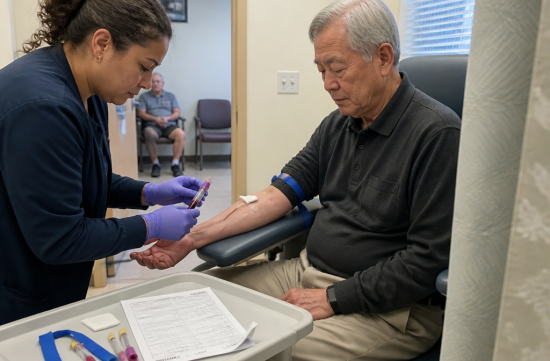
At a gathering, a discussion arose about a senior citizen over seventy who was not advised by their primary care physician to continue their annual PSA tests this year.
This person felt disappointed, while another attendee mentioned, "I still get mine every year." There are reasons for the differing reactions to the same test.
PSA is a test that measures the level of a protein produced by the prostate through a single blood draw. It's quick and the results come back fast. Because it's simple, the question of "how long should I continue to get tested?" can be confusing.
First, let's look at the guidelines from the U.S. Preventive Services Task Force (USPSTF). The current recommendations were established in 2018.
For men aged 55 to 69, the recommendation is a C grade, meaning they should discuss the benefits and risks with their doctor and make a personal decision. It's not a blanket recommendation to get tested; it's a matter of personal choice.
For those over 70, the recommendation is a D grade, indicating that routine screening is not advised. They believe the risks outweigh the benefits.
The statistics they cite are striking. For every 1,000 men aged 55 to 69 tested, it is estimated that over a 13-year follow-up period, PSA testing could prevent 1.3 deaths from prostate cancer.
Honestly, when I first saw this number, I was surprised at how small it was. Conversely, if that 1.3 were a member of my family, the situation would be entirely different.
So, what are the risks? The most significant one is false positives, where a high PSA level indicates cancer when there is none, leading to unnecessary additional tests and biopsies.
Another risk is overdiagnosis. Detecting a slow-growing cancer that would not have caused symptoms during a person's lifetime can lead to surgeries or radiation treatments, which may result in side effects like incontinence or erectile dysfunction.
For reference, the USPSTF is currently working on updating these recommendations starting at the end of 2023. However, as of the time of writing this article, no new recommendations have been finalized.
The American Cancer Society (ACS) has slightly different criteria. They first consider whether a man has a life expectancy of more than 10 years, rather than just age.
For average-risk men, they recommend discussing testing with a doctor starting at age 50. For African American men or those with a father or brother diagnosed with prostate cancer before age 65, testing should begin at age 45.
If there are multiple family members with such a history, testing should start even earlier, at age 40. It's important for those with a family history to keep this in mind, especially since many in the Korean community may not be aware of their family medical history.
The testing intervals also vary based on PSA levels. If the PSA is below 2.5, ACS recommends testing every two years; if it's 2.5 or higher, they suggest annual testing.
ACS clearly states that they do not recommend testing for asymptomatic men with a life expectancy of less than 10 years. The reasoning is that many slow-growing cancers make it difficult to see the benefits of testing.
The American Urological Association (AUA) suggests in their 2023 guidelines that a baseline PSA test can be done between ages 45 and 50. They recommend regular testing every 2 to 4 years for men aged 50 to 69.
After that, they advise adjusting the testing frequency or deciding to stop based on age, PSA levels, risk factors, and overall health in consultation with a doctor.
In summary, none of the three organizations draw a strict line at a specific age. They prioritize a person's health status and remaining life expectancy over the number 70.
Thus, even among those who are seventy, conclusions can differ. A person who plays golf daily and has no chronic conditions may have a different assessment than someone with heart disease taking multiple medications. Even if the age is the same, the health data is entirely different.
The cost aspect cannot be overlooked. Medicare covers PSA screening for men over 50 once every 12 months.
If the doctor accepts Medicare assignment, there is no out-of-pocket cost for the PSA blood test itself, and the Part B deductible does not apply.
However, the digital rectal exam (DRE) is separate. After meeting the Part B deductible of $283 in 2026, a 20% copayment on the approved amount will be required.
Just because it's free doesn't mean it's always the right choice. Even if the test itself is free, if the results are ambiguous, it can lead to MRIs and biopsies, bringing along time, costs, and anxiety.
Conversely, if someone in their 70s is healthy and has a family history, continuing testing may be reasonable. Ultimately, a decision that fits one's situation is necessary.
Before visiting the doctor, I recommend preparing a few questions. Knowing your last PSA level, whether it has been trending upward, and if there is a reason to continue testing based on your health status should be sufficient.
Whether to continue or stop testing should be discussed with your primary care physician or urologist. This article is for general information only and does not replace personal medical advice.
In my opinion, I would choose to "decide based on data" rather than "get tested every year just because it's free." Discussing trends in PSA levels and health status with a doctor is the most rational approach.
 TigerHeart



 LIZ Legal Information Blog |
 Karina's Blog |
 Jimbeam 88 |
 Taco Bell Candy Note Blog |
 Splendid Mission |
 You Only Live Once |

 Sunshine Blog |

 Lando Mao |
 explorer |
  dictionary |
  Mr Bull Jung |
  radiant |
  Georgia 88 |
  Great TOWN NEWS |
  Open Flex Mind |
  Hartford Blog |
  unified |
  Generation X |
  ringwinds |
  American Food Information & Calories |
  Hawaii Maui Kahului |
  calvorn |
  fernando park |
  newyorker 101 |
  coffeee |
  |
|  Christopher |
  sylven |