

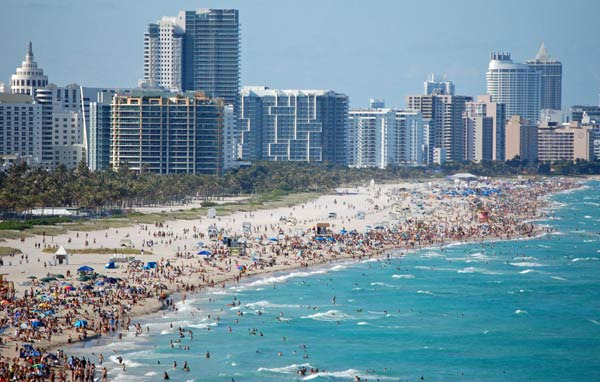
Once you stand on a Florida beach, you quickly notice that the feel of the sand is different from other states.
Compared to the coarse sand of California or the muddy texture of the Texas Gulf, Florida sand is much softer and finer. The sensation underfoot feels like slightly damp flour, and instead of a gritty feeling, it has a strong smoothness.
Famous beaches like Clearwater, Destin, and Siesta Key have sand that feels so white it's almost like fine powder. Often reflecting sunlight to the point of being dazzling, photos taken there look automatically enhanced. Thus, with the warm breeze and the thin spread of sea color, the white sand complements the entire scenery beautifully.
This white sand is mostly quartz-based. Sediments that flowed down from the north after the Ice Age have been washed and finely worn down by waves over a long time, resulting in the fine particles we see today. Therefore, when you hold it, it feels lighter than regular sand, and when wet, it clings tightly instead of becoming heavy. This is also why it feels 'soft' when walking.
One downside is that during the day, the hot sun can make the sand quite warm. However, quartz sand tends to release heat quickly, so as soon as the sun is slightly blocked, it cools down rapidly. Sitting with your feet buried in it quickly lowers the temperature, making it nice for a brief rest during a walk.
As you get closer to the waves, the texture changes again. The dry parts are light and powdery, while the areas touched by the waves are compacted, leaving clear footprints. Walking along this firm waterline is less tiring.
In areas where your ankles sink deeply, you quickly lose energy, but near the water, it rolls like a resilient dirt path, making it comfortable. On a quiet morning, walking alongside the waves on this firm sand line feels really nice. The smell of the sea, the humid breeze, and the screeching seagulls complete the Florida vacation experience.






 Rainbow Bridge to the Sky |
 Splendid Mission |
 Taco Bell Candy Note Blog |

 DREAM BIG |
  frostbite |
  330 Forever My Love |
  El Dorado |
  dralix58 |
  Gorama Round |
  Skydiving |
  dreamport |
  Yellow Snowman |
  Toaster Pizza Magic Show |
  velvetnom |
  Anytime Journey |
  Mrs. Duluth |
  jaxter |
  Atlanta Mama |
  Baguette Blog |
  Tan Sol |
  US Embassy |
  Korean Mom |
  My NYC |