
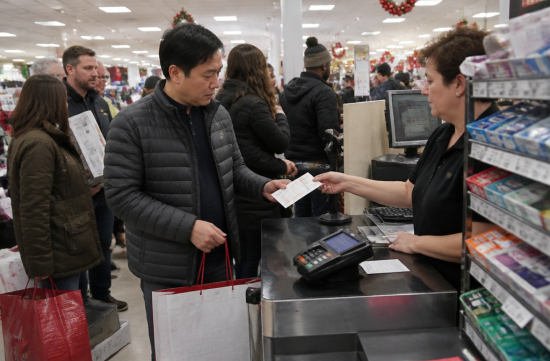
This happened last Black Friday. At the checkout, the clerk smiled and said, "If you sign up for our card today, you'll get an instant discount!"
There was a long line behind me, and the discount sounded pretty tempting. With just a few seconds to decide, it felt like a bit of pressure.
That day, I politely declined with a smile. Then I went home and did some research. This year's Black Friday is on November 27, so I thought it would be good to get organized now.
To cut to the chase, there are people who can take advantage of these offers and those who absolutely should not. The criteria for this division are simpler than you might think.
First, let's look at the interest rates. Bankrate surveyed 110 retail cards in 2025, and the average APR was 30.14%.
If we focus on store-specific cards, the average jumps to 31.64%. Co-branded cards with Visa or MasterCard had an average of 28.65%.
In the same survey, the highest rate was 35.99%, and there were 13 cards charging this rate. Honestly, I was a bit shocked by those numbers.
The overall average credit card rate according to Bankrate was 20.12%, meaning store cards are about 1.5 times that. The Consumer Financial Protection Bureau (CFPB) also reported at the end of last year that the average rate for store cards exceeds 30%.
Now, let's do some calculations. If you buy an item for $300 and get a 20% instant discount, you save $60, leaving you with $240.
If you pay off that $240 in full next month, you've effectively saved $60. Up to this point, there's no problem.
However, if you hold that balance at a 30.14% interest rate for a year, the interest alone would exceed $72. That's more than the $60 discount you received.
So the first criterion is this: Are you confident you can pay off the full amount by the due date? If not, the discount is essentially a trap.
The second thing to be cautious about is the term "no interest." When the clerk says, "No interest for 12 months," it often means deferred interest.
Deferred interest doesn't mean there's no interest; it means it's postponed. If you don't pay it off within the period, you'll be charged all the interest that has accrued from the purchase date.
The CFPB provided an example: buying a $400 TV with a store card and making monthly payments of $25, but still having $100 left after a year.
This person never missed a payment, yet when the period ends, they may still have to pay the interest calculated from the start. It's frustrating that someone who pays diligently can end up getting penalized.
In 2017, the CFPB advised retail card companies to consider offering true 0% interest options instead of these promotions. Following that, Walmart eliminated deferred interest promotions on its cards.
So when you hear "no interest," ask this: If I can't pay it off in time, will interest start accruing from the beginning? If the clerk hesitates, that's your answer.
There's one more thing. If the same card has both no-interest amounts and regular amounts mixed together, according to the CFPB, any payment exceeding the minimum payment usually goes toward the higher-interest balance first. This means the no-interest balance may take longer to decrease than you expect.
The third factor is your credit score. When you apply for a card, a hard inquiry is made.
According to myFICO, for most people, a single inquiry reduces the score by less than 5 points. The record stays for two years, but it only affects your FICO score for one year.
One inquiry isn't a big deal. However, if you plan to apply for a mortgage or car loan next year, it's best to avoid signing up for multiple cards on Black Friday.
On the flip side, there are definitely situations where it's okay to sign up. If you frequently shop at that store and have a habit of paying off your balance in full each month, it's a different story.
For example, the Target Circle card offers a 5% discount on every purchase with no annual fee. It's not a one-time discount but a benefit that accumulates, making it worthwhile for regular shoppers.
Still, these cards tend to have high-interest rates. Since discount terms and rates can change, be sure to check the store's official information before applying.
I've summarized it this way: How often do you shop at that store in a year? Can you pay off the balance by the due date? Is the no-interest actually deferred interest? If any of these three factors raise a red flag, I just pass.
If you do decide to get a card, I recommend setting up automatic payments for the full balance. If you only set up the minimum payment, the balance can quietly grow during the busy holiday season.
You don't need to respond immediately at the checkout. It's perfectly fine to read the terms at home, and if it's a card you truly need, you can apply then.
Just like a stream flows around a rock, taking a moment to pause at the checkout can ultimately be more beneficial. Let's wrap up this year's Black Friday fresh like a lemon, without worrying about interest!
 SilverStar




 havero70 |

 Grow Your Gut Bacteria Well |

 choi family |

 content |

 Carolina border |

 springw |


 E whisper |

 andrew park |

 Lemon Kim |
 Noodle Noodle |
 blueman |
 Alabama Bang |
 Soy Angelino |
 puddingcat |
 Coco Chanel |
 Nando Raldo |
 The 2000 |
 Mr Bull Jung |
 American Travel Cruise Information |
 vanillatop |
 namico |
 Karina's Blog |
 ASURA |
 Misstic M |
 parlon |
 Mrs New Mex |
 MBTI Detective Agency |
 ShyShy dating |