
Nicotine has no smoke or smell, so it's no surprise that it goes unnoticed by parents.
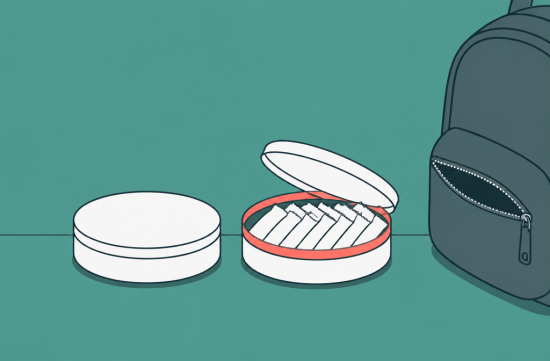
A while ago, a friend shared that they found a round container resembling a mint can in their son's pants pocket. Upon opening it, they discovered small white tea bag-like items lined up inside.
That's exactly what's being talked about among teens these days: nicotine pouches. Unlike e-cigarettes, which at least have a device and produce vapor, these leave no trace at all.
Looking at how they are used makes it clear why they are hard to detect. By placing a small pouch between the upper lip and gums, nicotine is absorbed through the oral mucosa.
There's no lighting up or exhaling smoke. This means that even sitting in class, a friend sitting next to you might not even notice.
The packaging is also an issue. The round can is smaller than a palm, making it hard to distinguish from mint or gum containers, and if it's tucked away in a front pocket of a bag, it can easily be overlooked.
So, how many kids are actually using them? I looked up the results from the National Youth Tobacco Survey conducted by the FDA and CDC for 2025.
Among U.S. middle and high school students, 1.7% reported using nicotine pouches in the past 30 days. This makes it the second most used tobacco product after e-cigarettes.
At first glance, that number may seem small. However, it's worth noting that this figure has more than doubled from 0.8% in 2021 over the span of four years, so it's not something to take lightly.
To be fair, compared to 1.8% in 2024, there hasn't been a significant change over the past year. The FDA has noted that while high school usage has increased since 2022, it has stabilized at a low level recently.
What concerns me more is another number. Among students using pouches, 26.3% reported using them frequently. This indicates that there are quite a few kids who have moved beyond just trying it out of curiosity.
Many parents are confused about a particular point. On January 16, 2025, the FDA approved the sale of 20 varieties of Zyn pouch products.
The approval was for 10 flavors, each available in two strengths: 3mg and 6mg. The reasoning was that existing smokers could use them as a less harmful alternative to cigarettes.
However, the FDA has clearly stated that this approval does not mean the products are safe or FDA approved. They also added that if youth usage increases significantly, they could revoke the approval.
This means that while sales are permitted as an option for adult smokers, it is by no means a signal that it's okay for kids to use them.
Legally, it's clear. Under federal law, tobacco and nicotine products cannot be sold to anyone under 21 since the end of 2019. High school students are generally not allowed to purchase these items.
California has gone a step further. The flavored tobacco sales ban was confirmed by Proposition 31 in the 2022 ballot, and most flavored nicotine pouches can no longer be sold in stores.
Starting January 2025, synthetic nicotine will also fall under regulation, and the state attorney general has established a system to manage a list of allowable unflavored products.
Yet, the reality is that kids are still getting their hands on pouches. Online orders, older friends, and stores with lax enforcement are not easily stopped by a few lines of legal text.
Honestly, I'm skeptical about continually expanding the list of banned items. I believe that restricting products that adults can legally choose is an overreach by the government into personal choice.
Instead, I think we must ensure strict enforcement against sales to minors. Ultimately, the ones who can keep the closest watch over their children are not the government, but the parents.
The reason this is a concern for child health is that the CDC explains that nicotine can affect areas of the adolescent brain responsible for concentration, learning, mood, and impulse control. Since their brains are still developing, they are more vulnerable to addiction.
So, what should parents look for? If you keep seeing small round cans that look like mint containers, it might be worth checking them out.
If one side of the upper lip is frequently swollen, or if the gums are swollen and sore, that could also be a sign. Increased irritability and anxiety without reason could be signs of nicotine withdrawal.
Korean mothers often want to start by checking their children's bags. I understand that feeling well. However, kids raised in America often shut down at that moment.
Instead of interrogation, start with questions. Asking casually if there are kids at school using things like Zyn can surprisingly lead to a lot of conversation.
If you find out that they are already using them, consult a pediatrician first. The methods of getting help vary depending on the level of nicotine dependence, so it's best to discuss with a doctor or pharmacist to determine the right approach.
If it were me, I would bring up this small container with my child this weekend. The harder it is to detect, the more parents need to be aware of it.
 TexasMan
 traveler87




 rissa |

 Gomo Nim |

 lattepop |

 Well Done Sir |

 butter 90 |

 Roman Pan |





 Until the Day It Gets Better |
 Hawaii Tourist Information |
 savannah choi |
 glimmer |
 Hot Seat Driver |
 Thou Thou |
 Supplemental Security Income (SSI) Information |
 Breaking Bad Drama |
 San Jose Pop |
 Gook Rule |
 UCLA Captain |
 Asparagus Blog |
 US Regional Information Local News |
 Joseon Dynasty Seal Enthusiasts |
 zestorbit |
 Lemon Kim |
 Noodle Noodle |
 blueman |
 Alabama Bang |
 Soy Angelino |
 puddingcat |