

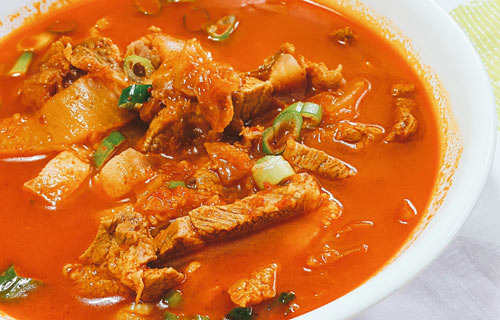
Kimchi stew looks easy to make, but when you actually cook it, it often doesn't have that rich and spicy flavor you get at restaurants.
After trying to make it several times, I think the key is the order of the ingredients rather than the ingredients themselves. Using pork belly makes it taste even better.
Pork belly has just the right amount of fat, and when you simmer it for a long time, the fat mixes with the kimchi broth, making the flavor very rich.
While pork shoulder or front leg meat is also fine, I think pork belly pairs best with spicy kimchi stew.
For 2-3 servings, prepare about 250g of pork belly and two cups of well-fermented kimchi.
Don't forget to add about half a cup of kimchi juice as well. Half a block of tofu, one green onion, half an onion, and one Cheongyang pepper are enough.
The key ingredient here is the kimchi. Kimchi that has been well-fermented in the fridge and is a bit sour is much tastier than freshly made kimchi.
It seems that using sour kimchi is essential for achieving the right flavor in kimchi stew.
First, put the pork belly in a pot and sauté it over medium heat. You don't need to add any cooking oil.
Once the fat starts to render from the pork belly, add the kimchi and sauté it together.
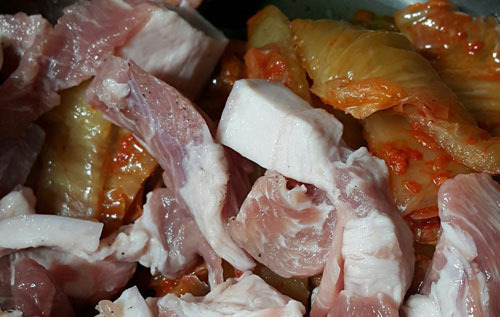
Sauté the kimchi for about 3-5 minutes until its sourness softens and the flavor changes as the pork fat infuses it.
Add one tablespoon of red pepper powder and sauté briefly.
I recommend using red pepper powder rather than gochujang. Adding too much gochujang can make the broth thick and heavy.
Now, add water. Pour in about 500-600ml and also add half a cup of kimchi juice.
Add about one tablespoon of soy sauce or tuna sauce and one tablespoon of minced garlic.
From here on, time will create the flavor.
Start by boiling it on high heat, and once it starts bubbling, lower the heat to medium-low and let it simmer for at least 20 minutes.
Kimchi stew tastes much better when simmered for a long time rather than just 5 or 10 minutes.
During cooking, taste the broth; if it's too sour, add just a tiny bit of sugar. About half a teaspoon is enough.
This isn't to make it sweet, but to balance the sharp sourness of the kimchi.
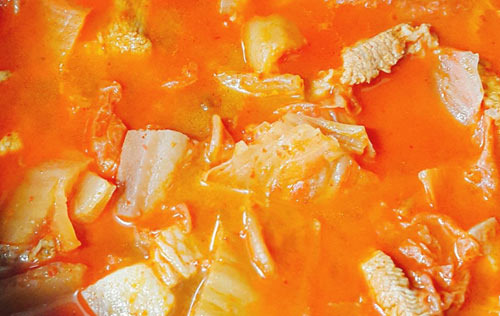
If you like it spicy, the last 5 minutes are crucial.
Add one chopped Cheongyang pepper and about half a tablespoon of red pepper powder.
Also, add the tofu, green onion, and onion at this time. If you want it spicier, a sprinkle of black pepper is also fine.
Finally, taste for seasoning. If it's bland, don't add salt right away; try adding soy sauce or tuna sauce gradually.
Since kimchi itself is salty, if you season it too heavily from the start, the broth can become too salty as it reduces.
Even if you turn off the heat and eat it right away, it's delicious, but letting it sit for about 10 minutes and then reheating it makes it taste even better.
The reason leftover kimchi stew tastes better the next day is similar.
Well-fermented kimchi, pork belly, red pepper powder, garlic, and Cheongyang pepper.
In fact, there are no special secrets. Just sauté the kimchi well in the pork fat, add the broth, and take your time to simmer it.
If you follow these steps, you won't be envious of most restaurant kimchi stews.
Serve a bowl of hot rice, scoop out some tofu, and top it with pork belly and kimchi, and you won't need any other side dishes.
Kimchi stew should definitely be spicy and flavorful to be at its best.
 CannesFest
 ShinRamen
 ZidaneFat







 Moscow Kim |
 Seattle - Emerald City |
 self-evaluation |
 Sandiego Auntie |
 Karina's Blog |
 Alpha and Omega World |
 Yellow Snowman |

 korvex93 |
 Fairfax Fox |
  novapixel |
  mortrix |
  ollege Mom |
  Esther 1983 |
  Arizona AZ Cowboy |
  fortbliss |
  My Two Way |
  toastyfox |
  FLORIDA Acus |
  tracker |
  TONTON COFFEE |
  sunrise |
  ultron78 |
  uplifted |
  Folding Instructions |
  same same life |
  USA Hyundai Kia |
  morvex37 |
  BOL SA RAM |