
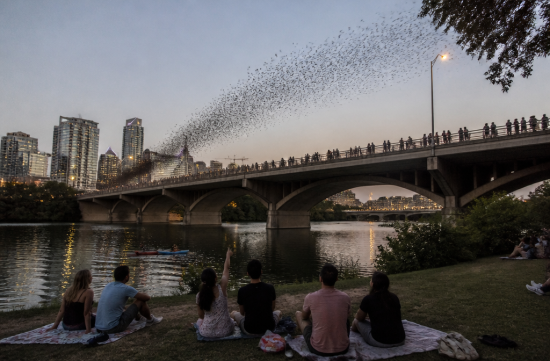
If you stand on the Congress Avenue Bridge in downtown Austin at sunset, you'll see a rather strange sight.
Hundreds of people are leaning over the railing, looking down at the river below. Tourists, locals who stopped jogging, and families with strollers all seem to be waiting for something, but at first, it's hard to tell what.
Then someone shouts, "There they go!" and a black cloud starts to rise from under the bridge. That's all bats.
The Mexican free-tailed bats that live under this bridge are estimated to number between 750,000 and 1.5 million each summer, according to Bat Conservation International.
It's referred to as the largest urban bat colony in the world. When I first heard that number, I honestly thought I had misread a zero.
However, these bats were not welcomed from the start. In fact, they were seen as a nuisance that the city wanted to eliminate.
The story begins with the bridge construction. Around 1980, the city rebuilt this bridge, creating narrow, deep gaps between the concrete structures beneath the deck.
To the human eye, it was just a seam, but to the bats, it was the perfect home. It was warm, snug, and difficult for predators to access.
The engineers who worked on the project didn't anticipate this outcome at all. They inadvertently built one of the largest bat apartments in the world.
As the bats moved in, residents were horrified. Rumors spread that they carried rabies, and petitions were circulated to have them removed.
Local newspapers at the time ran scary headlines about bats attacking the city. It seems funny now, but it must have been serious back then.
Enter bat ecologist Merlin Tuttle. In 1986, he moved his conservation organization, BCI, from Milwaukee to Austin.
According to his recollections, he thought that if a city was making such a fuss about bats, it would be the perfect place for an educational campaign. It was a bold idea.
What he did was simple. He kept explaining to the city council and residents that bats don't attack people, and as long as you don't touch them, there's really nothing to worry about.
He also informed them that these bats consume a tremendous amount of insects every night. For farmers and the city, they were essentially a free pest control team.
The initial response wasn't positive. In 1986, Texas Monthly awarded him the Bum Steer Award, a satirical prize given to the most ridiculous person of the year.
Still, he didn't back down, and eventually, public opinion shifted. The city decided to monitor the bats instead of driving them away.
Now, BCI reports that over 100,000 people come to see the bats each year. There's a designated viewing area next to the bridge, and bat cruises operate on the river.
BCI estimates that this bat tourism generates about $10 million in revenue annually. Other sources report lower figures, so the exact amount varies depending on the criteria used.
In 2006, the bridge was renamed. It became the Ann W. Richards Congress Avenue Bridge, named after the former Texas governor who passed away that year.
People in Austin even refer to their city as Bat City. An animal that was once targeted for extermination has become the city's nickname.
I think the best part of this story is right here. What was once feared and wanted gone has now become a source of pride.
Isn't that similar to how we treat unfamiliar beings? When we don't know, they seem threatening, but once we understand, they become neighbors.
Living as an immigrant, I sometimes feel that the bats' situation is not so different from my own. Initially seen with suspicion, over time, they become part of the community, and that process feels oddly familiar.
Coexistence isn't as easy as it sounds, but the fact that one scientist's persistent explanations changed city policy is quite hopeful. I believe that environmental issues often get resolved through accurate information and persuasion.
If you're thinking of going to see them, here's a tip: the bats come out from under the bridge at sunset. Depending on the weather, they might come out before or after the sun sets, so it's best to arrive early and secure a spot.
There are days when they don't come out if it's raining or the weather is bad. It can be disappointing to wait a long time and leave empty-handed, so be sure to check the weather before you go.
Most of these bats are females, and when it gets cold, they migrate south to Mexico. Since it's mid-October now, it's a good idea to hurry as the season is coming to an end.
Never attempt to touch the bats. If you find one on the ground, don't pick it up; just notify the authorities.
I would prefer to sit on the grass by the riverbank with a blanket rather than on the bridge. You can see the long line of bats flying into the sky much better that way.
Being on the bridge allows you to feel the sounds and smells as they pour out right below you, which is also fun in its own way. If you have kids, I recommend seeing them once from above and once from below.
Ultimately, it wasn't the bats that turned a nuisance into an attraction, but rather the change in people's perspectives. Standing on that bridge, you can really feel that shift.
 RainbowCitrus





 Peter Pan Pet |
 horse |
 Sunset Oregon |
 daisypat |
 Anjollinya Blog |
 |
| 
 U.S. Weather Bureau News |
 Living with a Consistent Heart |
 Dallas Fort Worth DFW |
 novent |
  Folding Instructions |
  same same life |
  USA Hyundai Kia |
  morvex37 |
  BOL SA RAM |
  TOUCHE NEWS |
  Small Business Information USA |
  draxen |
  gallery |
  milkyotter |
  Zoom Zoom Zoom |
  Minnesota Lakes and Clouds |
  noraro |
  tervox95 |
  vale vale |
  yentra |
  Golden life |
  andrew park |
  Balan |