
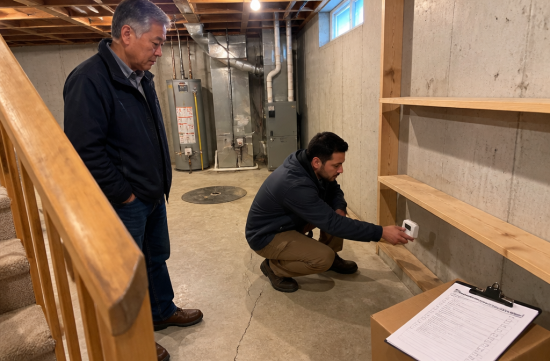
These days, when I receive consultation calls from people looking at homes, I always ask one important question: Did you include a radon testing clause in your contract?
Most people only think about home inspections and respond that they have never heard of radon. However, if you are buying a home in Utah, this is not something you can overlook.
First, let's clarify what radon is. It is a radioactive gas that occurs naturally from the decay of uranium in the ground, and it is colorless and odorless.
This gas seeps into homes through cracks in the basement floor or around plumbing. Since it cannot be detected by sight or smell, the only way to confirm its presence is through measurement.
The EPA estimates that radon causes about 21,000 lung cancer deaths in the U.S. each year. It is a serious issue, as it is the second leading cause of lung cancer after smoking.
According to the Utah Department of Environmental Quality (DEQ), one in three homes in Utah exceeds the EPA action level of 4 picocuries (pCi/L). I was quite surprised when I first saw this number.
More importantly, the results can vary significantly even between neighboring homes. Just because your neighbor's home is fine does not guarantee that yours is safe.
So why is it particularly important to address this before winter? The reason is that measurement values can change with the seasons.
The Utah state guidelines recommend that testing be done at least once during the winter. This is because radon levels tend to be higher in winter when windows and doors are closed.
When heating your home, warm air escapes from the top, causing the lower parts of the house to draw in more air from the ground. This can result in higher radon levels during winter in the same home.
Conversely, this means that measurements taken in late summer or early fall, when windows are open, may show lower levels than actual. This is particularly important for those signing contracts at this time of year.
Therefore, I recommend that if you are contracting in the fall, you think of it in two stages: conduct a formal test during the contract period and then check again during the first winter after moving in.
Many people overlook the testing conditions during the contract phase. According to EPA guidelines, short-term tests must be conducted for a minimum of 48 hours.
From 12 hours before the test starts until it ends, windows should remain closed, and doors should only be opened as needed. Fans that draw in outside air should also be turned off.
If the seller is still living in the home, it can be difficult to ensure these conditions are met. Therefore, it is better to hire a qualified professional testing company.
The Utah DEQ provides a list of certified testing and mitigation professionals at radon.utah.gov. Be sure to check this list before choosing a company.
You should also gather information from the seller. The Utah Seller's Property Disclosure includes questions related to radon.
However, the seller can only answer with yes, no, or unknown. If it says unknown, you should consider the possibility that they have never tested.
The DEQ advises that if the seller has previously tested, they should provide the results to the buyer. Be sure to ask your agent if there are any existing results and confirm the dates as well.
It is also important to note that in Utah, the buyer has a significant responsibility to verify this information. If issues are discovered after the due diligence period, there is much less room for negotiation.
If results exceed 4 picocuries, the EPA recommends mitigation measures. They also suggest considering mitigation for levels between 2 and 4.
The cost of mitigation work is typically under $1,500, according to DEQ guidelines. Compared to the price of a home, this is not a large amount and can be a negotiable item.
You can request the seller to install it, or you can receive a credit for that amount. Which option is better will depend on how the contract clauses are written.
If you already own a home, you can order a testing kit directly from the DEQ. The DEQ page lists the kit price as $11, including processing fees.
Even if you have installed a mitigation system, the DEQ recommends testing again every two years to ensure the system is functioning properly. This is an easy aspect to forget once it is installed.
Since contract conditions and interpretation of measurement results can vary from home to home, be sure to consult with your agent or a certified professional. In my experience, I have seen many cases where trying to save a few hundred dollars ended up costing much more later.
If I were contracting for a home right now, I would include a radon testing clause and solutions for exceeding the threshold right from the start. And I would test again during the first winter.
A home is a place where you spend a long time. I believe that leaving invisible risks in the contract is the most reliable way to prepare for them.
 CroquetteYa






 garlic bread |
 Sugar Cream Door Bulletproof Noodles |
 urbanmint |
 |
| 
 Premium Gas Camp |

 Enjoyable American Life Diary |

 USA Hyundai Kia |
  morvex37 |
  BOL SA RAM |
  TOUCHE NEWS |
  Small Business Information USA |
  draxen |
  gallery |
  milkyotter |
  Zoom Zoom Zoom |
  Minnesota Lakes and Clouds |
  noraro |
  tervox95 |
  vale vale |
  yentra |
  Golden life |
  andrew park |
  Peter Pan Pet |
  Balan |
  Cali M Law Group |
  neroyo |