
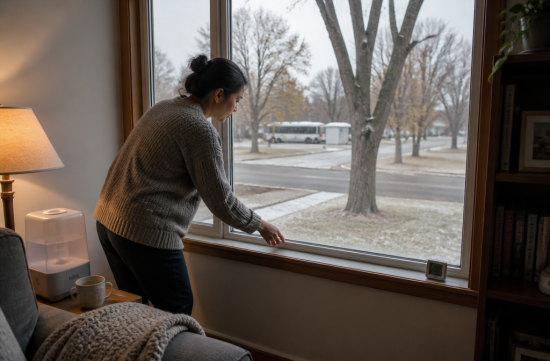
Last week, while waiting for the bus in the morning, I noticed my breath turning white for the first time. That night, I finally turned on the heating in my house. Just two days later, my hands started to feel tight and my lips began to crack.
Every time I touch the doorknob, static electricity starts to zap, which is typical for this time of year. When I wake up in the morning, my throat feels scratchy and my nasal passages are completely dry. Even though I experience this every year, it still surprises me like it's the first time.
This year, I decided not to rely on guesswork and to find out the facts. I read through materials from the U.S. Consumer Product Safety Commission (CPSC) and the Environmental Protection Agency (EPA), and the information was more detailed than I expected.
First, let's talk about the recommended numbers. The CPSC advises keeping indoor relative humidity between 30% and 50% if possible.
On the other hand, if it exceeds 60%, moisture can accumulate indoors and form droplets on surfaces. This is where bacteria and mold can take hold. It would be really unfortunate to create a damp environment only to encourage mold growth.
The tool used to measure humidity is called a hygrometer, and according to CPSC materials, you can buy one at your local hardware store. I also bought one and placed it on my living room bookshelf.
On the first night after turning on the heating, I checked it and found the number was much lower than I expected. It was well below the baseline. That's when I finally understood why my skin felt so tight.
However, there's a catch. In areas where it's very cold outside, simply raising the humidity isn't necessarily a good thing.
There's a recommended chart based on experiments from the University of Minnesota, which indicates that for homes with double-pane windows, as the outside temperature drops, the indoor humidity upper limit also decreases. When it's between 20-40 degrees Fahrenheit, it's recommended to keep humidity below 40%, and when it's between 0-10 degrees, below 30%.
When it's between -10 and 0 degrees, it should be below 25%, and between -20 and -10 degrees, below 20%. If it drops below -20 degrees, it's advised not to exceed 15%.
I was a bit surprised when I first saw this chart. A maximum of 15% in the middle of winter is almost desert-like.
The reason is the windows. The colder it is outside, the colder the inside surface of the window becomes, and if the indoor humidity is high, water condenses and freezes on it. This is how wood around the window frame can rot or mold can grow inside the walls.
So, in our area during winter, we need to consider both the general guideline of 30-50% humidity and the upper limits based on outside temperatures. I decided that if I see moisture at the bottom corner of the window, I would reduce the humidifier that day.
Now, let's talk about humidifiers. According to EPA materials, ultrasonic and impeller, commonly known as cool mist humidifiers, tend to disperse the most microorganisms and minerals into the air.
In contrast, evaporative humidifiers that moisten the air with a filter and steam humidifiers that boil water release much less of these substances. However, if there's a tank where water sits, bacteria can grow regardless of the method used.
Many of you may have noticed white dust settling on furniture when using ultrasonic humidifiers. The CPSC explains that this is minerals from tap water coming out with the mist and settling down.
Therefore, the CPSC recommends using distilled water or demineralized water and advises against using tap water. If the device comes with a mineral removal cartridge or filter, it should be used as well.
There are also clear guidelines for maintenance. It's advised to change the water daily if possible and to completely empty the tank before adding new water.
During the heating season, it's recommended to clean it frequently and thoroughly. Always unplug the device before cleaning.
If you've cleaned with bleach or disinfectants, it's important to rinse thoroughly. You don't want to inhale any remaining chemicals.
If you see a thin film or something sticky on the water surface or tank walls, it's a sign that bacteria or mold are growing. After reading this, I immediately went to the bathroom to check last year's humidifier.
In fact, the machine isn't the only solution. Hanging laundry indoors or leaving the bathroom door open after a shower can also raise the humidity a bit for a while.
I often leave the lid slightly open while cooking as well. However, these methods also need to be monitored with a hygrometer. You need to stop when you start seeing condensation on the windows.
Gathering a few potted plants in the living room also feels nice. However, I couldn't find any official data on how much this actually raises humidity. So, I hope you don't have high expectations.
To summarize, start by getting a hygrometer. Aim for 30-50% humidity under normal conditions, but lower it according to the outside temperature chart in the middle of winter.
Fill the humidifier with distilled water, change the water daily, and clean it frequently throughout the heating season. If you see droplets on the windowsill, reduce the humidity that day.
If it were me, I would choose an evaporative humidifier over a cool mist one this winter. My biggest desire is to be free from the task of wiping away white dust.
These days, I can see the trees outside the bus window changing to yellow day by day. Soon, frost will form on that window too.
Before that, I want to take care of the air in my home. I hope this winter I can grab the doorknob without static electricity.
 OliviaHotBar


 dermoon |
 hoosierdaddy |
 sun walker |
 Let's Be Like a Salt-like City Person |
 Springs Korea |
 North Dakota Ragdoll Cat Owner |


 anchor |

 reliable |
  maryland park |
  persiste |
  conte |
  blueman |
  Going Once |
  Eldorado 88 |
  cherrydino |
  garlic bread |
  middlekick |
  Moscow Kim |
  nivex85 |
  quanta7 |
  Tomato Health Club blog |
  horse |
  Egg Steamed Pot |
  Helpful Life Stories |
  UNI Lover |
  zen zeng |
  oh my salami |
  wendra |