
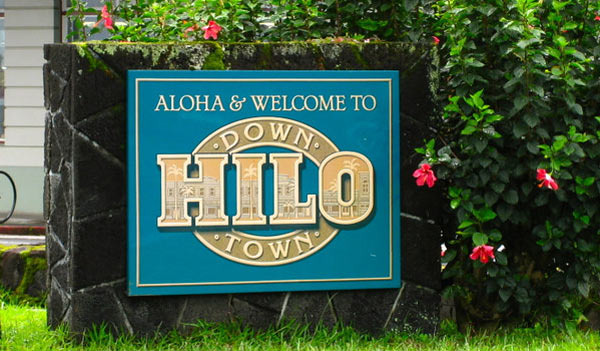
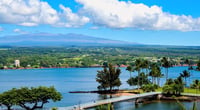
Hilo, the central city of Hawaii's Big Island, has many tourist attractions, but they all have a natural and peaceful atmosphere rather than a flashy or artificial feel.
It might be more appropriate to say that it is a place to 'live and rest' rather than just travel, as it is great for leisurely walks.
One natural attraction that cannot be missed is Rainbow Falls. This waterfall, which is only a 5-minute drive from downtown Hilo, is quite large, with a height of about 24 meters and a width of 30 meters. As the name suggests, around 10 AM on clear days, sunlight filters through the mist of the waterfall, creating a spectacular rainbow.
Another must-visit place is Liliuokalani Park and Gardens. Established between 1917 and 1919, it is the largest Japanese garden outside of Japan. The ponds, bridges, stone paths, and pavilions are decorated in the Edo style, making you feel as if you have entered a garden in Kyoto, Japan.
Moreover, Hilo is a city that remembers the pain of natural disasters alongside its natural beauty. The Pacific Tsunami Museum records the damage Hilo suffered during the 1946 Aleutian Islands earthquake and the 1960 Chilean earthquake.
It was established to raise awareness of the dangers of tsunamis and the importance of preparedness, and it also features exhibitions related to the 2004 South Asian earthquake. The exhibits, which include testimonies from actual survivors, photographs from that time, and materials related to the reconstruction process, provide a profound impact beyond mere tourism.
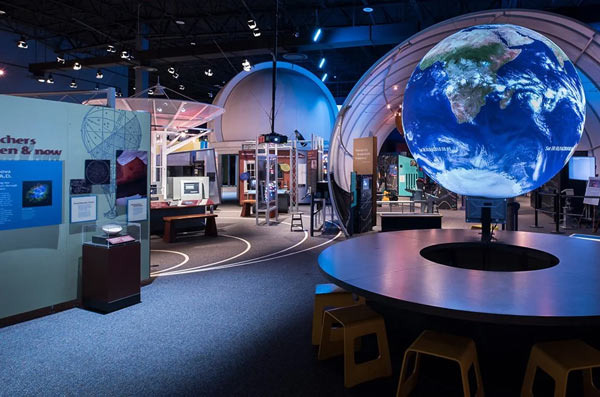
One of Hilo's prides is the ʻImiloa Astronomy Center, an astronomy and cultural education center that opened in 2001 in Hilo, Hawaii's Big Island, located within the University of Hawaii Hilo campus.
This unique space allows you to experience Hawaii's night sky and traditional navigation culture together. The 120-seat planetarium offers vivid views of the universe, constellations, and the movements of galaxies, and the star program conducted in Hawaiian is a special highlight.
The exhibition hall features astronomical observation equipment, navigation tools of Hawaiian natives, and scientific content related to the Mauna Kea Observatory, making it a beloved educational space where science and tradition harmonize. It is designed as an interactive exhibition that can be enjoyed by everyone from children to adults, making it popular among family travelers.
With a 120-seat planetarium where you can learn about the history of Hawaiian astronomy and experience the mysteries of the universe, it is very popular among family travelers. Not only astronomy but also the traditional star navigation techniques of Hawaiian natives are exhibited, providing a unique experience where science and tradition meet.
Lastly, we cannot forget the Panaʻewa Rainforest Zoo. This zoo is the only one in the United States located within a rainforest. It showcases over 80 species of animals, surrounded by more than 40 species of plants, flowers, and trees, giving the feeling of walking through a jungle.
Admission is free, making it a frequent destination for family travelers, and the humid air and dense greenery of the rainforest wash away the fatigue of travel. Thus, Hilo is a quiet yet rich travel destination where astronomy, waterfalls, gardens, museums, and zoos all come together.
For those who want to hear the sounds of birds and the wind rather than the noise of the city, Hilo becomes a 'healing journey' in itself.




 Hakuna Matata |
 Hilo Cat |

 Tonky |
  viroma |
  cookie |
  Live and that's it |
  Alright Twain |
  eatontown blog |
  HAWAII Korean Church News |
  Amore |
  linex |
  Balancework |
  laro90 |
  MEDBIO American Doctor Blog |
  SWAT TEAM BLK |
  DREAM BIG |
  frostbite |
  330 Forever My Love |
  El Dorado |
  dralix58 |
  Gorama Round |
  Skydiving |