
A friend was about to undergo shoulder surgery and felt reassured after checking the hospital's website for in-network status, but two months later, a bill arrived with several hundred dollars added under the anesthesiologist's name.
While the hospital was indeed part of the insurance network, the anesthesiologist who came that day was not affiliated with the hospital but was part of an external contracting group.
This situation arises because the hospital and the doctors working within it are not always the same contracting entity; anesthesiologists, emergency room doctors, and radiologists are often part of separate external physician groups.
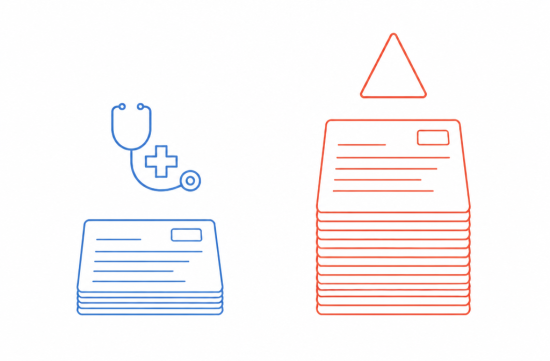
According to a Kaiser Family Foundation study, one in six patients admitted to in-network hospitals receives out-of-network bills, indicating that simply being in-network is not a guarantee of avoiding unexpected costs.
To break down the cost structure, in-network care typically has a patient responsibility rate of around 20%, while receiving the same care out-of-network can often increase that to 40% to 60%.
A study comparing outpatient department fees found that out-of-network bills averaged $1,041 more than in-network bills, which is a 110% increase, meaning that the same facility and treatment can cost more than double based solely on contract status.
The figures for anesthesiology are even more striking, with out-of-network anesthesiology bills averaging 802% of Medicare rates, while in-network bills averaged 367%.
Since hospitals and physician groups set their own billed charges, there can be a significant gap between negotiated prices and these charges.
The most extreme example is air ambulances, where bills can reach 4.1 to 9.5 times the Medicare payment rate, and less than a quarter of commercial insurance transports are in-network.
Seeing the average balance bill of $19,851 made me question my eyes for a moment.
It's also good to be aware of the hospital's chargemaster, as research shows that commercial insurance negotiators typically pay about 58% of the chargemaster prices.
In other words, the chargemaster prices are roughly 1.7 times higher than what negotiators pay, and out-of-network bills are likely to be closer to these chargemaster prices.
The emergency room is no exception, with studies showing that one in five emergency room visits for privately insured patients also results in out-of-network bills.
A 2011 study in New York found that the average out-of-network emergency room bill was $7,006, with insurers paying $3,228, leaving patients responsible for the remaining $3,778.
Recent studies have shown that this average has dropped to around $600, indicating that there have been some regulatory improvements in the meantime.
Thanks to the No Surprises Act implemented in 2022, patient costs for emergency situations or when encountering collaborating medical staff in in-network facilities are limited to in-network levels.
However, ground ambulances are excluded from this law, and patients who sign a consent form and choose an out-of-network hospital may also fall outside the protection scope.
There are complaints from the hospital industry about increased administrative burdens, while consumer groups point out that there are still many loopholes, and both sides have valid points.
Still, from a consumer perspective, the outcome suggests that this law provides a better safety net than having no law at all.
The reason it's crucial not to skip verification steps just because a law exists is precisely due to these exceptions.
If you are facing surgery or a procedure, it's safer to ask about the hospital, the attending physician, the anesthesiologist, the radiology department, and the lab individually.
After confirming with the insurance company's app or website provider lookup tool, it's wise to double-check by phone, and keep the representative's name and reference number for future disputes.
You also have the right to request a good faith estimate before elective procedures, so it's better to take advantage of that.
If you've already received an out-of-network bill, you can dispute it with the CMS No Surprises Help Desk or your state's insurance department.
Personally, I would choose to verify not just the hospital but also all the individuals who will be treating me within it.
 HyundaiKia








 Silent Sea |
 Pointy |
 Idaho's Sumi's House |
 holy cheese |
 Michigan Enthusiast |
 Encyclopedia of New York and Surrounding Areas |
 babybay |
 Another Eden Channel BLOG |
 charmee |
  Let's Be Like a Salt-like City Person |
  Belgray Miscellany |
  sweetvan |
  Augusta Univ |
  Round and Round Children's Song Kingdom |
  butter 90 |
  Lando Mao |
  Washington Denzel DJ |
  LIZ Legal Information Blog |
  vegas mom |
  Sandiego Auntie |
  Premium Gas Camp |
  Things to know |
  TEXAS Fishing Boat |
  AUTO OK |
  aaoaa |
  Florida King |
  Study Abroad Life Know-How Tips |
  Conflite Teacher |