
If you've been to school, you probably remember the class president elections at the start of the new school year. The awkward scene of standing in front of the blackboard and raising your hand to receive votes surprisingly sticks with you.
However, American schools do not have the position of class president at all.
When I first heard this, I was a bit puzzled. I wondered who would line everyone up and who would run errands.
To put it simply, the American answer is different. Instead of having one class president, there are multiple roles that students take turns fulfilling.
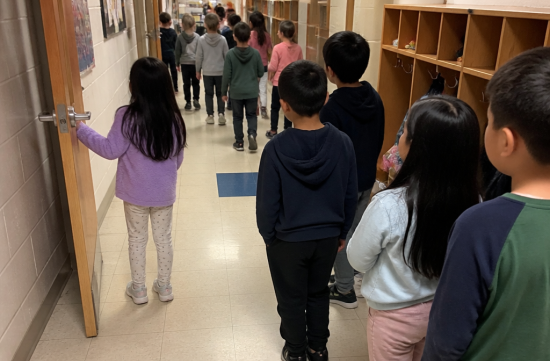
In American elementary school classrooms, there are what are called 'Classroom Jobs.'
These include roles like line leader who guides classmates at the front of the line, door holder, a student who looks after the back of the line, a child who hands out papers, a student who helps with attendance, and even one who waters the classroom plants, among others.
Typically, classrooms that use these classroom jobs have about ten to fifteen positions as a reasonable standard.
The naming conventions for these roles are also quite varied. There are fun names like banker for managing class supplies or allowances, store clerk for overseeing a corner like a classroom store, and positivity patrol for looking after friends.
The key point is that these roles are not fixed to one person.
Usually, students take turns on a weekly basis, with everyone in the class participating in order.
So, this is more of a system of 'sharing responsibilities' rather than 'electing a leader.'
Interestingly, the term 'class president' in Korea was not originally used. During the Japanese occupation, it was referred to as 'class leader,' and it wasn't until after liberation that the term 'class president' became established.
Even now, some schools use the term 'president' instead of 'class president,' indicating that even the name itself has not been a fixed tradition from the beginning.
The reasoning behind this setup is likely to avoid situations where only certain students are always in the spotlight while others are merely spectators. Thus, the popularity contest that is familiar in Korean classrooms does not exist in American elementary classrooms.
That said, it doesn't mean that there are no elections or leadership positions in American schools.
There are separate student councils and student council president positions that represent the entire grade or school.
The roots of this student governance date back quite a while. In 1893, an educator named Bernard Cronson started a self-governing system called 'school city' in a public school in New York, which is considered an early form.
By the 1920s, in an atmosphere that viewed schools as the center of youth life, student councils became a significant part of high school culture.
If you trace back the current national student council organization, it leads to 1931. A high school student from Oklahoma named Warren Shull gathered student council presidents from across the country to form an organization.
Warren Shull was originally the student council president of Sapulpa High School in Oklahoma. A year before the national organization was created in 1930, he had already organized a meeting for student council presidents at the regional level.
The following year, in 1931, he met with the president of the American Educational Association in Los Angeles, which officially launched the predecessor of the National Association of Student Councils (NASC), and since 1943, the organization has been operated by the National Association of Secondary School Principals.
In summary, the class president role is more about classroom management, while the student council president position is more of a political role representing the entire grade or school.
Perhaps that's why the process of electing a student council president feels much more like a 'real election' compared to class president elections in Korea. It involves speeches with promises, posters, and slogans, all structured around a designated voting day.
However, many schools only allow posters to be hand-drawn or printed from home printers. There are even regulations stating that they should not look like professional prints.
This seems to be an attempt to prevent candidates from mimicking politicians too convincingly, which I found quite amusing.
That said, not all student council elections are this elaborate. In smaller schools, it's common for there to be only one or two candidates, making it more of a formality.
Ultimately, American schools have chosen a structure that cultivates 'occasional politicians' instead of nurturing a 'daily leader.'
The advantages of this approach are clear. It structurally reduces the side effects of specific students monopolizing positions.
Of course, there are downsides as well. There are ongoing criticisms that student councils tend to be dominated by popular and well-connected students.
For parents sending their children to American schools, it might be worth taking a look at the classroom jobs chart. Just asking what role your child has this week can create a conversation starter.
Personally, I have more faith in the classroom jobs system that shares responsibilities weekly. It feels practical that everyone gets a chance to take on a role at least once, rather than focusing solely on results.
Positions like sports team captains or club presidents can also be seen as extensions of this distributed leadership model.
It's hard to definitively say which system is better. The two systems are fundamentally designed to teach different things.
While the Korean class president system trains students to concentrate responsibility and trust in one person, American classroom jobs are more about giving everyone a chance to take on a role. Sometimes I think I might miss our class president, and other times, this system seems more comfortable. Still, if I had to choose one, I would lean towards the rotating responsibility model.
 HideChips
 JustCurious





 Florida King |
 AH LALA |
 Victory 1988 |
 Panorama Kstar |
 Giant Squid and Sweet Potato Soup |
 newyorker 101 |
 International Court |
 Living with a Consistent Heart |
 Things to Do to Buy a House |
 Encyclopedia of New York and Surrounding Areas |
  French fries |
  Rynex |
  Caribbean |
  Let's Be Like a Salt-like City Person |
  Belgray Miscellany |
  sweetvan |
  Augusta Univ |
  Round and Round Children's Song Kingdom |
  butter 90 |
  Lando Mao |
  Washington Denzel DJ |
  LIZ Legal Information Blog |
  vegas mom |
  Sandiego Auntie |
  Premium Gas Camp |
  Things to know |
  TEXAS Fishing Boat |
  AUTO OK |
  aaoaa |