
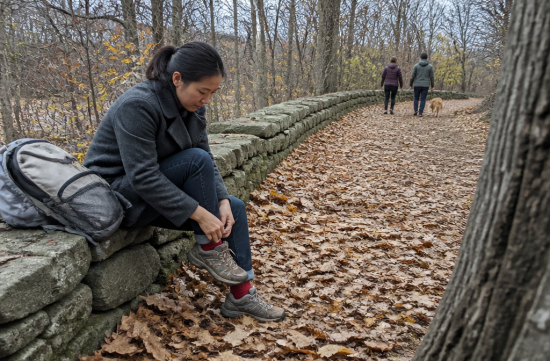
These days, I often walk the wooded trails in Westchester on weekends to hear the sound of crunching leaves. When the weather turns cool enough to pull out my coat, I usually stop worrying about ticks. I believed that bugs were just a summer issue.
However, I was a bit surprised when I dug into some official data this time. What I believed was almost the opposite.
The tick that carries Lyme disease is the blacklegged tick, commonly known as the deer tick. According to data from the TickEncounter at the University of Rhode Island, these ticks are active from October to May. The only condition is that the daytime temperature must not be below freezing.
So, November is not the month when ticks disappear; it's actually when adults are out and about. After hearing this, I started to see the piles of leaves a bit differently.
The CDC explains the same thing. They note that adults are most active in early spring and fall. They also mention that on days when temperatures rise above freezing in winter, they can bite people.
Of course, this isn't just to scare you. There is a specific time when the risk is highest.
Ticks in their nymph stage, which are most active from April to July, are considered more dangerous. They are about the size of a poppy seed, making them numerous and hard to spot. It makes sense that reports of Lyme disease cases peak in the summer.
Adults are about the size of a sesame seed, so they are easier to see. The CDC also states that while adult female ticks can transmit the disease, they are more likely to be found and removed before that happens.
The problem is that finding them isn't free. It's the season when we wear long sleeves and thick socks, which makes us less vigilant about checking our bodies. I, for one, used to check thoroughly in the summer but would just wash up and go to bed in the fall.
The Westchester County Health Department also states that tick-borne diseases like Lyme disease, anaplasmosis, babesiosis, and Powassan virus are continuing to spread. This isn't just about Lyme disease.
However, I haven't checked the numbers for Westchester this November. So, I won't make any definitive statements about local figures. Nationwide, the CDC reports that there are over 80,000 reported cases of Lyme disease each year.
This number isn't the whole story. Estimates based on insurance claims suggest that around 476,000 people receive treatment each year. However, the CDC also notes that this could be an overestimate.
So, when can we relax and when should we be cautious? The first thing to remember is the time a tick is attached.
The CDC explains that in most cases, the bacteria are transmitted only after a tick has been attached for more than 24 hours. The county health department notes that the risk of transmission is highest after 36 to 48 hours of feeding. Regardless of the wording, the conclusion is that the sooner you find it, the better.
So, it's a good idea to have a routine after returning from wooded trails or a backyard full of leaves. As soon as you come in, take a shower within two hours. This is the timeframe recommended by both the CDC and the county health department.
Dry your clothes in a hot dryer for 10 minutes while they are still dry. You should also check your coat, backpack, and even your dog. They could bring ticks inside that later transfer to people.
Be sure to check areas like your armpits, behind your knees, and between your legs. Ticks tend to look for thin-skinned areas like around the ears. If you have children, check their bodies the same way.
I can't help but mention my red socks here. The female adult deer tick has an orange-red body with a black back. It's quite ironic that the color of my favorite socks is almost the same.
So, when I go to the mountains, I plan to give my red socks a break. Wearing white or light-colored socks and tucking my pants into them might not look as good, but they will be much easier to spot. I can always worry about style when I get home.
You can use a 0.5% permethrin product on your clothes and gear. For your skin, choose an EPA-registered DEET or picaridin product. If you've put away the bug spray for November, it's time to bring it back out.
The path you walk on is also important. The CDC advises walking in the center of trails and avoiding tall grass and leaf piles. I felt a bit guilty since I often step off the path to take pictures of leaves.
Your backyard is no exception. It's said that ticks are less commonly found in well-maintained lawns that are away from bushes. This month's leaf cleanup is not just about aesthetics.
However, if you do find a tick, don't panic; just remove it immediately. Use fine-tipped tweezers to grasp it as close to the skin as possible and pull straight out with steady pressure. Don't twist or yank it.
Home remedies like using Vaseline, nail polish, or burning it off are not recommended. They can irritate the tick and cause infected fluids to enter your skin. It's best to remove it first rather than waiting until you can get to a doctor.
After removal, clean the area with soap and water or alcohol. Also, make a note of the date and where you've been. This is important information to share with your doctor if symptoms arise.
For the next few weeks, keep an eye on your body. Lyme disease rashes typically appear between 3 to 30 days after a bite, with an average of around 7 days, and occur in 70-80% of infected individuals. It may not always be a target shape, so if you're only looking for that, you might miss it.
Fever, chills, and fatigue can also occur without a rash. In November, these symptoms can easily be mistaken for a cold, which is why I was particularly concerned about this point.
In such cases, don't rely on your own judgment; consult a doctor or pharmacist. According to the CDC, most cases are effectively treated with a few weeks of antibiotics. Depending on the type of tick and the duration of attachment, preventive antibiotics may also be considered.
This information is based on the CDC, county health department, and TickEncounter data as of the publication date. I would check for ticks on warm winter days just like I do in summer. I can't give up the trails, so I'm just willing to compromise on sock color for a bit.
 PhoPoseidon



 United States Army |

 premium |

 The Emperor Must Grow |

 squidogame |

 daddyyo |

 luido |




 Delicious Food Finder |

 beerdreamer |
 Chino Min |
 ness 6 |
 Min's blog |
 American Politician Community |
 Sarah's Blog |
 james choi |
 solvix18 |
 Massachusetts |
 clouds 09 |
 Dr. Kelso |
 You Turn Me On |
 seouljung |
 Project Tomorrow |
 meadow |
 compass |
 Roman Pan |
 citrus pop |
 DO Main TODAY |
 korvex93 |