
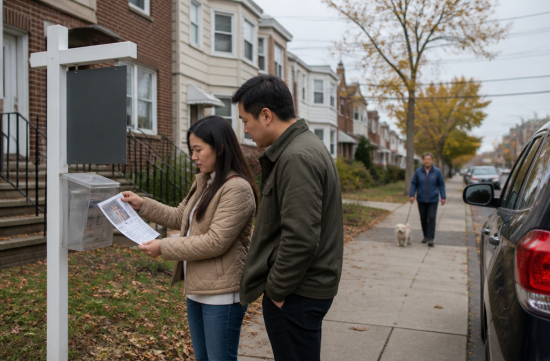
These days, the first question people looking at homes ask is, "I heard asking prices have dropped, so does that mean homes are cheaper now?" Looking at the numbers for Palisades Park, this question is not as straightforward as it seems.
Let me clarify the criteria first. The most recent neighborhood statistics available at the time of writing are from September, and the October figures have not yet been released.
So, I will refer to the inventory, home prices, and rents based on September statistics, while using the interest rates from October 29. The sources are Realtor.com research data (zip code 07650), Zillow's public index, and Freddie Mac.
Let's start with the inventory. There were 27 active listings in September, which is down from 31 in August but higher than the 24 from September last year.
There were 14 new listings. Compared to 8 in August and 6 in September last year, this is quite an increase.
However, since it's a small neighborhood, even a few transactions can significantly affect the percentages. Therefore, it's better to focus on the actual numbers rather than the growth rate.
The time homes are staying on the market has increased. The median days on market in September was 45 days, compared to 32 days in August and 36 days in September last year.
Now, regarding prices. The median asking price in September was $849,750, which is 20.6% lower than the $1,070,000 from September last year.
When I first saw this number, I was shocked. A drop of one-fifth in asking prices in just a year is not something you typically see in this neighborhood.
However, the Zillow Home Value Index (ZHVI) for the same month is $993,684, which is actually a 9.9% increase from last year's $903,867.
So, one figure is down by 20%, while the other is up by nearly 10%. Why is there such a discrepancy?
The two figures measure different things. The median asking price reflects the homes available on the market that month, while the ZHVI estimates the value of all homes in the neighborhood.
Thus, asking prices can fluctuate significantly depending on which homes are listed. Back in May, the median asking price was $1,150,000, and it has dropped to this level in just four months.
If we look at the asking price per square foot, the picture changes again. In September, it was $539, which is almost the same as last year's $532.
However, this value has been consistent over the past few months, and the September data even has a data check mark. So, take it with a grain of salt.
Therefore, I wouldn't read it as "home prices have dropped by 20%." I would first suspect that the composition of the listings this month has changed.
Let's compare it to the surrounding areas. The ZHVI for Bergen County is $780,357, which is up 7.1% over the past year, while Fort Lee is at $592,784, up 7.9%.
For rents, I looked at the Zillow Rent Index (ZORI). In September, it was $3,320, compared to $3,177 in August and $3,069 in June.
The $251 increase over three months is a bit concerning to take at face value. This neighborhood's index has been available since January of this year, and there were gaps in April due to a small sample size.
Since there are no values from last year, a year-over-year comparison isn't possible. However, looking at the surrounding areas, Bergen County increased from $2,811 to $2,895, a 3.0% rise, while Fort Lee went from $3,692 to $3,792, a 2.7% increase.
This index does not break down by room size. I couldn't verify reliable data for one-bedroom and two-bedroom rentals in the neighborhood this time, so I haven't included those numbers.
The interest rate, according to Freddie Mac, is 7.24% for a 30-year fixed mortgage as of October 29. This is down from 7.32% a week prior, while the 15-year fixed rate is at 6.60%.
A year ago, the 30-year fixed rate was 6.17%. If you were to borrow $800,000, the monthly principal and interest would range from $4,884 to $5,452, a difference of $568. This is my calculation excluding taxes and insurance.
At this point, you might be wondering, "Should I rent or buy now?" The rent index of $3,320 and the principal and interest of $5,452 are not values for the same home, so you need to recalculate based on the home you are considering.
If you are looking to buy a home, there are three things to check. First, look at the actual sale prices instead of asking prices. I couldn't verify the median sale price for the neighborhood this time, so make sure to get the transaction history for similar homes from the last three months.
Second, check if the listings have been on the market for more than 45 days. If a home has been sitting for a while, it might be worth asking if there is room for negotiation.
Third, don't settle for just one interest rate quote. When the average rate is in the 7% range, comparing several options can save you money on your monthly payment.
If you are a tenant, compare several similar listings before renewing your lease. The most accurate way to find out if rent increase restrictions apply to your building is to ask your borough office directly.
If you are a landlord, I recommend looking at the prices of similar buildings and neighboring blocks before raising rent based solely on the $3,320 figure. The sample size is too small to set rent based on just one month's index.
Personally, I wouldn't rush to make a move with interest rates in the 7% range right now. Once the October statistics are released, I will check if asking prices and inventory continue to move in tandem, and in the meantime, I will quietly look into homes that have been on the market for a while.
 ChzPotatoFae







 silents |
 Choco Choco Star |
 gentle |
 neapolis |

 moo moo |

 Margarine Daebimama |

 whispering |

 postcard |

 choi family |
 eatontown blog |
 beerdreamer |
 Chino Min |
 ness 6 |
 Min's blog |
 American Politician Community |
 Sarah's Blog |
 james choi |
 solvix18 |
 Massachusetts |
 clouds 09 |
 Dr. Kelso |
 You Turn Me On |
 seouljung |
 Project Tomorrow |
 meadow |
 compass |
 Roman Pan |
 citrus pop |
 DO Main TODAY |
 korvex93 |