
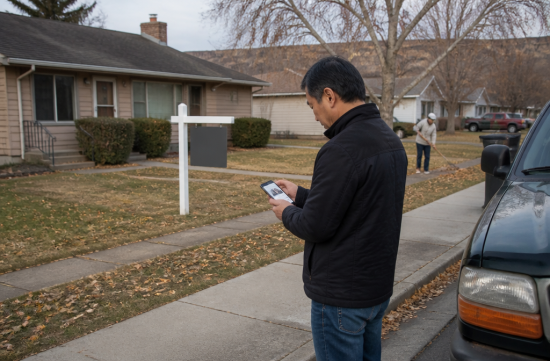
This fall, the Billings market can be summarized in four points: interest rates have risen, inventory has increased, asking prices have dropped, and rents have gone up slightly.
First, it's important to note that I couldn't find the October sales statistics for Billings in publicly available data at the time of writing this article. Therefore, I will include the closest reference points for each item.
Montana is a non-disclosure state, meaning it does not publicly record sales prices. As a result, home price figures can vary depending on the sample used by the reporting agency.
The biggest variable has been interest rates. The average 30-year fixed rate from Freddie Mac rose from 6.76% on September 10 to 7.40% on October 8 and 15.
On October 29, it dropped slightly to 7.24%. However, this is still 1.07 percentage points higher than the 6.17% from a year ago on October 30, 2022.
To put this into perspective, if you buy a $389,900 home with 20% down on a 30-year fixed mortgage, your principal and interest payment would be $2,125 per month. If the interest rate were 6.17%, it would be $1,904, resulting in a $221 difference each month.
Inventory has steadily increased. According to Realtor.com, there were 896 active listings in the Billings metro area in September, which is 60 more than the 836 listings from September of last year.
This marks seven consecutive months of increases since February's 612 listings.
Asking prices have decreased from their summer peak. The median asking price in the same data dropped from $497,000 in June to $469,900 in September, a decline of $27,100 over three months.
It is common for asking prices to decrease in the fall. However, the drop from August to September last year was only $3,200, while this year it was significantly larger at $19,777. While it's too early to draw conclusions from just one month, this is not a number to overlook.
The speed of sales is similar to last year. The median days on the market in September was 59 days, nearly the same as last year's 58 days, and 14 days longer than May's 45 days.
What about actual sale prices? According to recent data from Resideline as of October 3, the median sale price for 245 homes in Billings was $389,900.
The median price per square foot is $190, with half of the transactions falling between $158 and $232. Even within the same city, there is a wide range of prices.
According to data compiled by Stacker using Redfin data, the average median sale price in the metro area from January to June this year was $399,463, a 1.6% increase from the previous year.
KTVQ reported that last year's median sale price in Yellowstone County was $379,000, which is the same as in 2024. While the samples differ, the trend indicates stability without significant spikes or drops.
Rental prices vary significantly depending on the source. Zumper reported the median rent for October at $1,345, a 3% increase from the previous year.
RentCafe estimates the average rent as of October 30 at $1,589, up 4.62% from last year's $1,519. Both sources indicate a gradual increase.
For two-bedroom units, Zumper reports $1,262, while RentCafe lists $1,650. When assessing rent, it's more accurate to compare actual listings in the same neighborhood rather than relying solely on averages.
There are also notable differences by neighborhood. According to Zumper, West End rents for $1,520, Heights for $1,295, and South Side for $1,047.
This season's hot topic is property taxes. The Yellowstone County Treasurer's Office has announced that the deadline for the first installment payment will be December 3 this year, instead of the usual November 30.
This year, the tax rate structure has also changed. According to the state tax department, residential homes and long-term rentals will be taxed at 0.76% for market values up to $378,000, and 0.90% for values up to $756,000. Second homes and short-term rentals will have a flat tax rate of 1.90%.
For a $400,000 home, the taxable value would be $3,070.80 for the former and $7,600 for the latter. The actual tax amount will depend on the local mill rate, so the same home can have significantly different tax bills based on its classification.
To qualify as a long-term rental, a tenant must reside for at least 28 consecutive days and 7 months per year, and there must be no outstanding property tax payments. Registration for the 2027 tax year is due by March 1 of next year.
If homeowners did not receive the residential exemption this year, it may be worth checking if they qualify for the 2026 Property Tax Refund from the state tax department. Eligibility varies based on individual circumstances, so it's safest to confirm directly with the tax department.
So how should we interpret these trends? As rents rise gradually, the burden of interest rates has increased significantly, reducing the urgency for tenants to rush into buying.
For actual homebuyers, there is now room for negotiation. It may be worthwhile to attempt price or closing cost adjustments on homes that have been on the market longer.
For rental investors, the calculations are tighter. Assuming the previous home is a three-bedroom, with an average rent of $2,157 from RentCafe, paying $2,125 leaves only $32 remaining. After accounting for taxes and insurance, it results in a loss.
I would recommend watching how much more inventory accumulates this winter. While there are currently no signs of a significant drop in home prices, it appears that sellers are beginning to adjust their prices.
When the October figures are released, please check the active listings from Realtor.com first. The number of listings compared to last October's 798 will be the first checkpoint.
 SquidSpinKill






 Dr. Kelso |

 silents |

 Choco Choco Star |

 gentle |
 neapolis |

 velion |

 Childbirth Drabble Blog |

 tarvion |

 rockets |
 Smile Face |
 Polaris |
 Should we begin? |
 kodak |
 Lifestyle Information Search USA |
 yenne |
 beerdreamer |
 Chino Min |
 ness 6 |
 Min's blog |
 American Politician Community |
 Sarah's Blog |
 james choi |
 solvix18 |
 Massachusetts |
 clouds 09 |
 You Turn Me On |