
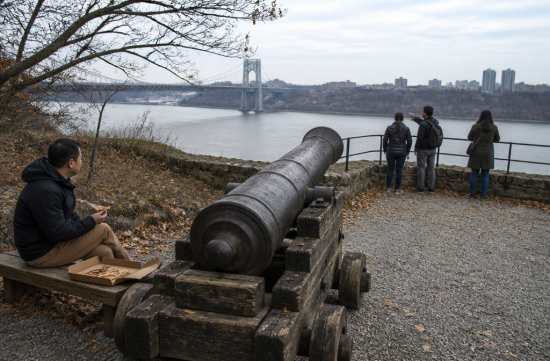
A few days ago, I sat on a bench at Fort Lee Historic Park with two leftover slices of pizza from lunch. Uptown Manhattan was just across the river, and cars were endlessly flowing over the George Washington Bridge.
While chewing on my pizza, I suddenly looked at the calendar and realized that on the 20th of this month, it will be exactly 250 years since the U.S. military hurriedly retreated from here. It felt a bit strange to think about that while walking along the peaceful trail.
"These are the times that try men's souls." You may have heard that phrase before, referring to the times that test the human spirit.
It's the first line from Thomas Paine's 'American Crisis,' and this very cliff is mentioned in that text. Paine wrote that he was with the troops at Fort Lee and marched all the way to the Pennsylvania border.
The fort itself began construction in July 1776. Its original name was Fort Constitution, and it was renamed Fort Lee in late September of that year after General Charles Lee.
Across the river in Manhattan was Fort Washington, which served as its counterpart. Together, they formed a defensive position guarding the lower Hudson River.
However, on November 16, British forces and Hessian mercenaries attacked Fort Washington. I was momentarily stunned when I read that 2,800 American soldiers were captured.
With the fall of Fort Washington, Fort Lee was left isolated. The reasons and strength to defend it vanished.
On the night of the 19th to the 20th, Cornwallis's troops crossed the river from the north. The landing point is believed to be Huyler's Landing, formerly known as Lower Closter Landing, although it had long been mistakenly referred to as Upper Closter Landing on the Alpine side.
The number of troops varies by source. The American Battlefield Trust estimates 2,000 American troops and 4,000 British troops, while some sources report 5,000 British troops.
Paine's account is the most vivid. He wrote that an officer ran to inform him that the enemy had landed with 200 boats 7 to 8 miles upstream.
The problem was the terrain. Fort Lee was situated on a narrow strip of land between the Hudson River and the Hackensack River, meaning that losing the bridge would trap them.
According to Paine's calculations, the Hackensack River bridge was 6 miles from the fort and 3 miles from the enemy. Just looking at those numbers gives you a sense of the desperate race.
General Nathanael Greene immediately ordered a retreat. Washington, who was in Hackensack, arrived in 45 minutes, according to Paine, and led the troops toward the bridge.
As they left, they reportedly abandoned tents, tools for digging trenches, cannons, and a large amount of food. Since people tend to feel more secure when they have enough to eat, I find this part particularly painful.
Interestingly, Paine's narrative states that most of the ammunition, light artillery, and supplies had been moved in advance, and only the items that could be loaded onto wagons were taken, with the rest left behind.
It's hard to say which side is lying. However, while later accounts describe a frantic retreat, Paine depicts it as an orderly withdrawal.
The troops crossed the river at New Bridge after passing Hackensack and reached Acquackanonk Bridge on the 21st. They stayed in Newark for four days.
Next, they moved through New Brunswick and Princeton, reaching Trenton on December 2. It reportedly took five days for the troops and supplies to cross the Delaware River.
Paine wrote that this route involved crossing four rivers over nearly 100 miles in almost three weeks. Considering they walked this path at the onset of winter, I think I wouldn't have lasted a day.
The piece was published under the pseudonym Common Sense. There are records stating it first appeared in the Pennsylvania Journal on December 19, 1776, while others note December 23, so the dates vary slightly.
It is said that Washington had this piece read to the soldiers before crossing the Delaware. They would go on to win at Trenton on December 26 and at Princeton on January 3 of the following year.
The same piece also mentions "summer soldiers and sunshine patriots," a phrase that mocks those who are only soldiers in good weather and patriots only when the sun shines.
What draws me to this piece is that it was not written after a victory. It acknowledges that this is the hardest time, even as everything is being lost.
Of course, since it was written to rally people again, one could argue that it contains embellishments. Still, I read it as a testament to the fact that the phrase has endured for 250 years because it does not hide defeat but confronts it head-on.
The park spans 33 acres and features a restored battery, soldier huts, and a river overlook. According to the park's information, the visitor center is open from Wednesday to Sunday from 10 AM to 5 PM, while the outdoor areas are open from 8 AM until sunset.
However, it also advises checking by phone as hours may vary, and some sources indicate it is closed in January and February. The phone number is 201-461-1776, which is amusing since the last four digits are 1776.
The Retreat Weekend reenactment event was held on November 23-24 in 2019. I couldn't confirm the schedule for the 250th anniversary this year, so if you're interested, it's best to check njpalisades.org/fortlee first.
The nearby Monument Park is also worth a visit. It was created by the Daughters of the American Revolution (DAR) in 1908, and a statue of Rebelmen stands in the center.
If it were me, I would choose a nice day around the 20th and bring two large pizzas. Eating a slice on the cliff while thinking of the soldiers who left their food behind that day wouldn't be a bad way to commemorate it, would it?
 KTVWave


 Glow Yo |
 Michigan Enthusiast |
 xylora |

 Tan Zoo |

 hot chocolate |

 runningon |

 butterfly |

 The Yellow |



 james choi |
 solvix18 |
 Massachusetts |
 clouds 09 |
 Dr. Kelso |
 You Turn Me On |
 seouljung |
 Project Tomorrow |
 meadow |
 compass |
 Roman Pan |
 citrus pop |
 DO Main TODAY |
 korvex93 |
 tacobunny |
 B.I.G. Victor |
 Conflite Teacher |
 cyvera80 |
 Springs Korea |
 Runner Kim |