
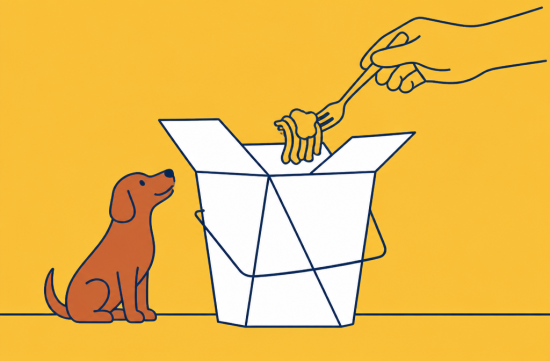
Every time I ask to have leftovers packed up at a restaurant, I wonder why Americans call it a doggie bag.
Even households without dogs come out with doggie bags, and ultimately, it's people who eat what's inside the next day. It's rare to see a term and its actual use diverge so much.
When I first heard this term after immigrating, I thought it was a joke. I couldn't help but laugh at the image of Korean adults at a barbecue restaurant packing up rib bones for their dogs.
So I looked it up, and it turns out there's a reason why the word includes "dog." However, the origin isn't neatly organized.
The habit of taking home leftovers is much older. In ancient Rome, guests would wrap leftover food in napkins to take home for the next day.
There were even people who resold those leftovers, showing that Romans had a better business sense than I do. I only focused on taking home leftover ribs.
So when did dogs come into the picture? The modern doggie bag seems to have emerged around the 1940s.
During World War II, as food shortages became common, there was a strong push to reduce food waste, and pet food was scarce. It's said that the name originated during this time, but that's just speculation.
The earliest specific record is from 1943 in San Francisco. Cafes there provided customers with boxes called Pet Pakits.
These boxes were meant for taking home leftovers, and the intention was to prevent animal cruelty. The name was clearly aimed at pet owners.
From this record, it seems that it was initially a product meant for dogs. At least, that was the justification.
French sources also mention that during the war, people were encouraged to give leftover food to dogs, and there were restaurants that provided bones and leftovers to customers. However, there's no exact year attached to those stories.
What's interesting is what comes next. In my view, this name has survived longer thanks to human pride rather than dogs.
In English-speaking countries, there's an interpretation that sees this term as euphemistic. It's as if I'm pretending to give it to my dog when I'm actually going to eat it myself. The desire not to appear stingy is embedded in the word.
As a fisherman, I understand this psychology very well. When I catch a tiny fish and pretend I'm going to give it to my cat, it's really the same as me grilling it for myself. That's just the pride of an inland fisherman who rarely gets to see the ocean.
This term became widely used thanks to etiquette columns in newspapers during the 1970s. This suggests that it was an awkward topic worthy of separate discussion in the press.
The restaurant responses are amusing too. Some restaurants would fold leftover food in aluminum foil into the shapes of swans or seahorses. They'd come out with a swan while claiming it was for the dog.
What about now? The term doggie bag has fallen out of fashion in the U.S. Nowadays, if you ask for a box, that's all you need.
It's just the terminology that has changed; taking home leftovers has become completely normal. Many servers now ask if you'd like a box first. There's no need to make excuses about dogs anymore.
Other countries have had different experiences. In the UK, asking for a doggie bag was considered an American expression and a rare request until 2010.
In France, the law has even changed. The 2016 food waste prevention law strongly encouraged this service, though it wasn't mandatory.
Then in 2018, the law changed to require restaurants and beverage vendors to provide containers to customers upon request starting in 2021. Asking for a box has become a customer's right.
The names are interesting too. In France, they have various terms like gourmet bag or waste prevention box. They've replaced "dog" with "gourmet," showing they know how to market it well.
For Koreans, this is more about saving face than anything else. Since American portions are so large, for immigrants, asking for a box is often the first English phrase they learn.
There's one thing to note about the food you take home. According to CDC guidelines, leftovers should be refrigerated within 2 hours, and in hot places like a car over 90 degrees Fahrenheit, within 1 hour.
When reheating, they recommend bringing the internal temperature up to 165 degrees Fahrenheit. I've been judging it by how it looks, but that's something I need to reconsider.
After leaving the restaurant and stopping by the grocery store and fishing supply shop, 2 hours can pass quickly. If I've taken a box, I should head home first.
To summarize, is the doggie bag really meant for dogs? Based on the 1943 record, the justification does involve dogs, but the exact origin of the name remains speculative.
Still, I believe the reason this term has lasted so long is more about people than dogs. Taking home leftovers has been done since Roman times, and there's no reason to be ashamed of it.
I will continue to confidently ask for a box. Someday, even if I ask to take home leftover lobster from a seaside restaurant, I won't make excuses about dogs.
 DreamTrail91



 Glow Yo |

 Michigan Enthusiast |
 xylora |

 Tan Zoo |

 hot chocolate |

 Kentucky Fried Chicken |

 Cahty Chung |

 Lightning Sikhye Cooking Method |

 skyblue |
 james choi |
 solvix18 |
 Massachusetts |
 clouds 09 |
 Dr. Kelso |
 You Turn Me On |
 seouljung |
 Project Tomorrow |
 meadow |
 compass |
 Roman Pan |
 citrus pop |
 DO Main TODAY |
 korvex93 |
 tacobunny |
 B.I.G. Victor |
 Conflite Teacher |
 cyvera80 |
 Springs Korea |
 Runner Kim |