
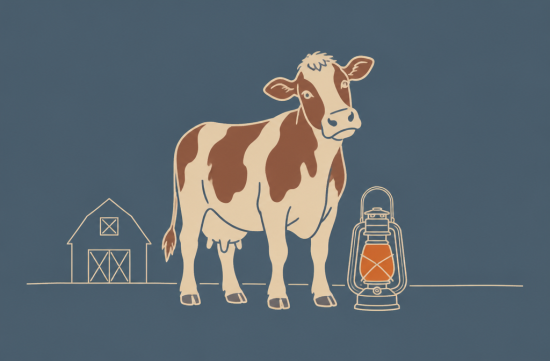
There's a story that anyone living in Chicago has likely heard at least once. The Great Fire of 1871 supposedly started when Mrs. O'Leary's cow kicked over a lantern.
When I first heard this story after moving to the U.S., I thought it was just a funny local legend. However, learning that a real person was involved and that she faced blame for her entire life changed my perspective.
The fire broke out on the night of October 8, 1871. The starting point was a barn behind the home of Patrick and Catherine O'Leary on DeKoven Street.
That year, Chicago was particularly dry, and many buildings were made of wood. With strong winds, the fire spread across the river and into the city center.
According to Britannica, over 17,000 buildings were burned. A third of the city was left in ruins, and nearly a third of the population lost their homes overnight.
The exact number of casualties is still unknown. Many bodies were never recovered, and numerous people vanished without a trace.
So where did the cow story come from? Immediately after the fire, newspapers published articles claiming that "the cow kicked over the lamp while Mrs. O'Leary was milking in the barn," and competing newspapers repeated this.
The problem is that there was no evidence to support this claim. The couple testified that they were already in bed that night.
The city authorities also formed an investigative committee. The handwritten testimonies alone filled 1,100 pages, but the conclusion was that while the fire started in the barn, they could not pinpoint the cause.
However, the story that had spread did not stop. The combination of a cow, a lantern, and an Irish immigrant woman was a narrative that people wanted to believe.
Here's a bittersweet point. At that time, Irish Catholic immigrants in Chicago faced prejudices of being poor, fond of alcohol, and dirty.
When a massive disaster struck, society needed someone to blame, and Catherine O'Leary fit that role perfectly. From the perspective of fellow immigrants, this part of the story feels particularly unfair.
Later, a journalist named Michael Ahern admitted that they had fabricated the cow story to make the article more entertaining.
However, this confession is not entirely clean. The timing of the confession varies across sources, and other journalists also claimed to be the original source.
Still, the core is clear. The story of the cow kicking over the lantern was born in the newspapers without any witnesses or evidence.
Catherine O'Leary passed away in 1895. It is said that she avoided journalists and refused to be photographed.
A twist occurred a century later. A man named Richard Bales began to meticulously match land records and testimonies from that time.
Interestingly, he was not a professional historian but worked in real estate, specifically in title matters. His expertise in reading land boundaries and building layouts made him particularly skilled at overlaying old maps and registration records.
Bales focused on Daniel Sullivan, the neighbor who claimed to have discovered the fire first. He raised questions about whether Sullivan, who had a prosthetic leg, could have reached the barn in such a short time and whether he could see the barn from where he was.
Of course, suggesting that Sullivan was the cause is just one hypothesis. The Chicago historical community has mixed opinions, and the actual cause remains a mystery.
Nevertheless, Bales' research achieved a significant outcome. He officially confirmed that there was no evidence to hold Mrs. O'Leary and her cow responsible.
In 1997, the Chicago City Council's Police and Fire Committee adopted a resolution proposed by Alderman Edward Burke. It stated that Mrs. O'Leary and her cow would be forever exonerated from all blame.
This came 126 years after the fire. Ironically, she had been gone for over 100 years by then.
The city council did not point to any other culprit either. They left the unknown as unknown, which I believe is the most honest conclusion.
Today, the site of that barn is home to the Chicago Fire Department Training Academy. It's quite symbolic that firefighters are trained at the place where the fire started.
Reflecting on this story, I realize one thing: when a major incident occurs, people often look for "the likely suspect" rather than evidence.
Thinking back to the scrutiny faced by Asian Americans during COVID, 1871 doesn't feel like such a distant past. So, I hope you develop the habit of verifying sources and considering who gets easily stigmatized when you read the news.
For those living in Chicago, next time you pass by Roosevelt Road, take a moment to check out the Fire Academy. That's where the story of exoneration took 126 years to unfold.
 urbanrivercreator1924







 SEVEN SEVEN |
 Korean Mom |
 novapixel |
 Peter Pan Pet |
 horse |
 Khan Film Blog Production |
 Illinois Mom |
 Rice Shop Uncle BLOG |
 allstar realty |
 Enjoyable American Life Diary |
  Hodong Prince Over Flex |
  Mist inn |
  citrus pop |
  Onion Ring |
  phoenixia |
  viewtop |
  loverun |
  Kim Do Sun |
  yentra |
  Make My Day |
  Victory 1988 |
  Tonky |
  viroma |
  cookie |
  Live and that's it |
  Alright Twain |
  eatontown blog |
  HAWAII Korean Church News |
  Amore |