
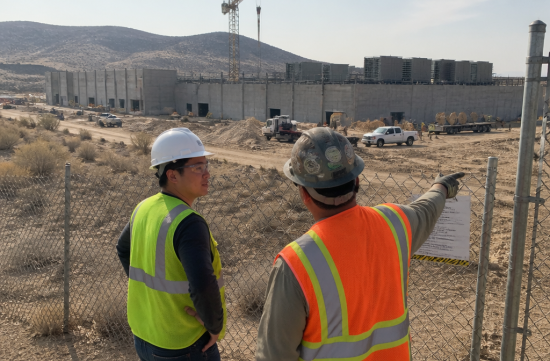
These days, if you drive east on I-80, you'll notice a lot of construction trucks. They're all heading towards data center construction sites.
This is about the Tahoe-Reno Industrial Center, abbreviated as TRIC, where the Tesla Gigafactory is located. I often hear people say, "There are plenty of jobs there," but I wanted to check the numbers first.
To cut to the chase, construction jobs and permanent positions are completely different matters.
First, let's talk about the atmosphere. TRIC is in Storey County, where companies like Apple, Switch, and Google have already secured land for data centers.
A company called Novva is launching a 60MW data center in the area in July 2025. They announced that additional capacity will open in 2026.
Amazon is also working on a project within Switch's Citadel campus. On March 9 of this year, they even held a hiring event at TMCC.
The positions being recruited were engineers, data center technicians, and installation technicians. Governor Lombardo emphasized that many construction and skilled trade jobs would be created. However, it's important to remember that this statement focuses on construction period workers.
At this point, it sounds like a boom, right? But if you look at the state tax incentive documents, the picture changes a bit.
In November 2024, the state's Economic Development Department (GOED) approved a tax incentive of $19,274,000 for Vantage Data Centers' expansion project in Storey County. The investment amount was $254 million based on equipment.
However, the number of jobs they promised to create within five years was only 10. The average hourly wage is about $64. I looked over the documents twice.
The Colovore Reno 1 project, approved in August this year, is similar. With a $30 million investment, the tax incentive was $4,076,970, and they promised 10 jobs with an average hourly wage of $59.
Honestly, I was a bit surprised when I first saw it. With an investment of over $200 million, the number of permanent employees is less than that of a half-classroom.
This isn't something companies are hiding either. The conditions for Nevada data center tax incentives require at least 10 full-time employees residing in Nevada within five years and a cumulative investment of over $25 million.
Wages must be above the state average. The baseline stated in the Colovore documents was an hourly wage of $31.57.
So, while there are few data center jobs, the pay is quite high. This is because servers are run by cooling and power, not people. There's no need to have people at every line like in a factory.
It's fair to consider the opposing argument as well. Supporters say that during the construction period, there's a high demand for electricity, plumbing, and steel, and that tax revenue will come from equipment investments.
In fact, GOED expects over $16.84 million in new tax revenue from just Colovore over the next 10 years. Looking at the numbers, that's greater than the tax incentive amount.
The problem is verification. According to a report by Nevada Independent, GOED is not tracking whether the data centers are delivering the promised effects.
That's why there's a lot of talk in the political arena. On September 17, Governor Lombardo signed Executive Order 2026-005.
New data centers applying for incentives can no longer receive exemptions from the Local School Support Tax, which is school funding. They also have to sign a promise not to pass on water and electricity costs to regular ratepayers.
However, existing approved incentives will remain unchanged. Attorney General Ford, Lombardo's opponent in the gubernatorial election, is advocating to halt new incentives until the audits are completed.
This seems more like a numbers issue than an ideological one. The government needs to show through data what an appropriate amount of tax incentive is for every 10 jobs created.
And one more thing. The detailed criteria for this executive order are to be determined by GOED by November 6, so the outcome could change depending on the election results.
So where are the realistic opportunities for people like us? I see three paths.
The first is electrical technicians and trades like HVAC. During the ongoing construction, this demand is the most certain.
The second is data center technicians. Many job postings prioritize hardware experience or certifications over degrees, so it's worth considering community college programs to get in.
The third is existing manufacturing jobs. Tesla reportedly hired over a thousand people at this factory for semi-truck production in 2025. In terms of numbers, factories still dominate.
If I were in your shoes, I wouldn't just focus on one permanent data center job. I believe it's better to build experience in trades during the construction boom and keep the path open to transition into technician roles.
The boom is real. However, it has yet to be proven how many people it will sustain for a long time.
 RiverWave







 loran |

 DeArizona Blog |

 Swift Falcon |
 Tonky |

 My NYC |

 zoryan |
 Nevada Teppanyaki |

 elion |

 Two LaLa World |

 cortiva6 |
 aerion99 |
 Golado |
 Maximum Pro |
 Joyce blog |
 Atlanta Business Information |
 Ansaso |
 Soft Feeling That Feeling |
 assa man |
 Yugo Girl I'm So Hot |
 nexaro |
 Experiences Living in America |
 arsnack |
 Nebraska Center Director TOP |
 Florida Gario |
 menmo |
 Arizona AZ Cowboy |
 springw |
 Woooooah |