
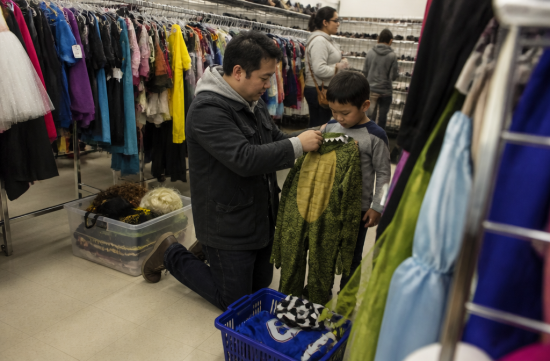
With just over a week until Halloween, it seems fewer people are buying new costumes this year. Instead, many are rummaging through their closets, swapping outfits, and visiting thrift stores.
At first, I thought it was due to budget constraints, but looking at the numbers, it appears to be a trend.
According to a survey by the National Retail Federation (NRF) released in September, total Halloween spending is projected to reach $13.5 billion this year, up from last year's record of $13.1 billion.
The expected spending per person is $115.14, nearly the same as last year's $114.45. Of this, $4.4 billion is expected to go toward costumes, meaning people are spending more on outfits than on candy.
Interestingly, the same survey revealed that 52% of respondents reuse more than half of their costume items each year.
For households with children, this percentage rises to 60%. I wondered how they could recycle kids' costumes, which often get outgrown after just one wear, but there are indeed ways to do it.
The first method is passing costumes down to siblings. For example, the older child wears a dinosaur costume one year, and the younger sibling wears it the next, while the older child moves on to a new character.
One family I know has even created a dedicated Halloween box. They wash and store costumes on November 1st, and when they open it the following October, half the problem is already solved.
The second method is swapping costumes with neighbors. By posting sizes and characters in local Facebook groups or parent chat rooms, you can find matches surprisingly quickly.
Since no money is exchanged, there's no pressure, and returning the borrowed costume wraps things up neatly. Honestly, this seems like the smartest approach.
One thing to keep in mind is that children's sizes change quickly, so when swapping, it's helpful to include height and weight to avoid mismatches.
The third option is thrift stores. In this area, the Goodwill on Kansas Expressway sets up a large costume section specifically for Halloween.
A store manager mentioned in a 2021 KY3 report that you could put together a full set for three kids and one adult for under $30. Since that was a few years ago, it's best to check current prices directly at the store.
Additionally, there are other thrift stores like Plad Door, Salvation Army, and Red Racks, where you can find wigs and hats among other accessories.
The fourth method involves creating costumes from existing clothing, which I find the most fun. Families who enjoy sports have a particular advantage.
Wearing a Chiefs jersey with a helmet instantly becomes a player costume. Pairing black pants with a striped shirt and a whistle completes a referee look.
Kids with baseball uniforms can just carry a glove, and the neighborhood adults will recognize them right away. The costumes were already in the closet.
According to the NRF survey, 34% of respondents choose items that can be reused elsewhere. They mentioned boots that could also be worn to concerts as an example.
This is a key point. Instead of buying clothes just for Halloween, purchase items you can wear regularly and combine them into a costume.
The same goes for adults. If you need to attend a company Halloween party but don't want to spend money, wearing a workout outfit with a headband and wristbands can easily give you that 80s aerobics instructor vibe.
The fifth method is for those who enjoy crafting. Classic items like box robots, sheet ghosts, and paper crowns are often favorites among kids.
The process of making these costumes can be a fun weekend activity for parents, so there's no downside. Even if the quality isn't perfect, the photos tend to turn out much funnier.
According to the NRF survey, spending on children's costumes alone is estimated at $1.5 billion, with pet costumes at $920 million. I was surprised to see so many families buying new outfits for their dogs.
Of course, there are downsides. Thrift store costumes may have broken zippers or Velcro, so it's essential to check them before purchasing.
For swapped costumes, it's best to wash them according to the care label before dressing your child. If they'll be out at night, don't forget to add a strip of reflective tape to dark clothing for safety.
By the last week of October, the costume sections at thrift stores are usually picked over. This weekend is essentially the last chance to find something.
Conversely, many stores start clearing out seasonal items in early November after Halloween. Families looking to buy for next year often target this time to stock up. It's a way to finish costume planning for the entire year in advance.
In summary, the order of operations is as follows: first check what you have at home, then swap with neighbors, and if that doesn't work, visit thrift stores.
Buying new should be the last resort. Spending dozens of dollars on an outfit that will only be worn once and then stored in a box seems wasteful to me.
If it were me, I would definitely pull out a jersey this year. The walk to collect candy would feel as refreshing as heading to the stadium.
I hope everyone has a Halloween where they spend less and capture more memories in photos.
 goldenriverwalker1918








 SKy Face |

 gleeful |

 forevergee |

 mortrix |

 cherrydino |

 meonetoo |

 song bang |

 ramen |


 vorame |
 arsnack |
 Nebraska Center Director TOP |
 Florida Gario |
 menmo |
 Arizona AZ Cowboy |
 springw |
 Woooooah |
 frostpup |
 chocopup |
 Angeles Choi |
 My Heart Popper |
 comova |
 vintago |
 Sky Way |
 Top Beaches |
 folyfoly |
 ground |
 averagestudent |
 hot chocolate |
 SODA MAKER |