
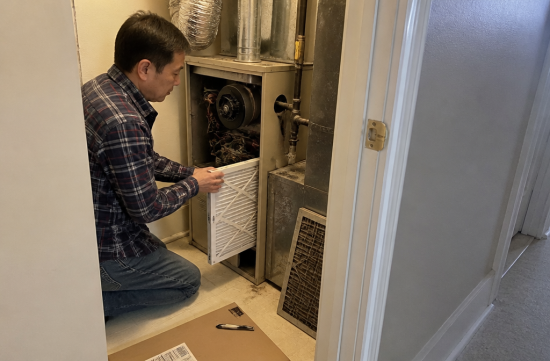
Last weekend, the morning air suddenly turned cold, and I turned on the heating for the first time this fall. I noticed a slight burning dust smell coming from the vents and suddenly wondered when I last changed the filter.
I couldn't quite remember. When I took it out, it was almost a dark brown, beyond gray, and hardly any light passed through it even when held up to the light.
It's just a piece of paper worth a few dollars, but I calmly looked into what happens if I delay changing it. I thought it would help me remember better next year if I organized this information.
First, let's talk about the replacement frequency. ENERGY STAR recommends checking the filter every month and replacing it immediately if it looks dirty, but at the very least, it should be changed every three months.
The reason is simple. When the filter is clogged, airflow slows down, and the system runs longer and harder, wasting energy.
So, how much difference does it make? The U.S. Department of Energy (DOE) states that changing a clogged filter to a clean one can reduce air conditioning energy use by 5% to 15%.
This figure is based on cooling, so it's cautious to apply it directly to heating. However, since the same blower and ducts are used, the principle is not very different.
To be fair, there are opposing studies as well. A study from Oak Ridge National Laboratory found that the energy savings from just changing the filter are not as significant as one might think, but it still concluded that it is meaningful as preventive maintenance.
Therefore, I tend to view the filter more as a preventive measure against breakdowns rather than a way to save on bills. The real costs come from repair expenses.
A gas furnace needs the blower to carry the heat produced by the burner into the air. If the filter is clogged, the path for heat to escape narrows, and the temperature of the heat exchanger continues to rise.
This triggers a safety device called a high limit switch, which turns off the burner. It cools down, turns back on, and if it overheats again, the cycle repeats.
If this cycle continues for too long, the limit switch itself wears out, and various HVAC companies explain that it can also strain the control board or blower motor.
The biggest concern is cracks in the heat exchanger. If overheating occurs repeatedly, it can crack, leading to the risk of carbon monoxide leaking into the home.
So, if your home is less warm and the furnace keeps turning on and off, it's worth checking the filter first. If changing the filter and clearing any blockages from the vents doesn't resolve the issue, then it's time to call a technician.
Now, let's talk about prices. At the time I checked, a pack of two 16x25x1 size Filtrete MPR 800 (MERV 10) filters was priced at $19.88 on Walmart's website, about $9.94 each.
The same brand's MERV 12 product has a pack price that rises to around $26. Prices can fluctuate quite a bit depending on the store and time, so keep that in mind.
One point to note here is that an expensive filter is not necessarily better.
The higher the MERV number, the more small particles it filters out, but that also increases air resistance. If you have an older, fixed-speed blower, a high-grade filter like MERV 13 could actually be a burden.
Most homes find that MERV 8 to 11 is a reasonable range, according to various sources. If you have family members with allergies, it's safer to ask a technician whether your system can handle it first.
The replacement frequency also varies by thickness. A 1-inch filter typically needs changing every 1 to 3 months, while a 4-inch thick filter is often recommended for 6 to 9 months.
If you have pets or have done construction work that created a lot of dust, you should check more frequently. During the peak heating season in winter, checking once a month is the most reliable habit.
The method for checking is not difficult. Remove the filter and hold it up to the light; if light passes through well, it's still okay, but if hardly any light gets through, it's time to change it.
When inserting a new filter, be sure to check the direction of the arrows on the frame. Insert it so that the arrows point toward the furnace, which is the direction of airflow.
This time, I wrote the date I changed the filter on the frame with a marker. That way, I can easily see how many months have passed when I take it out next time.
Setting a reminder on your phone every three months is also a good idea. Aligning it with the changing of the seasons makes it easier to remember.
Based on the price of the MERV 10 filters mentioned above, it would cost less than $40 a year for four filters. Compared to the repair costs for the limit switch or blower motor, it's not a significant amount to worry about.
If it were me, I would choose to change a mid-grade filter on time rather than infrequently using the most expensive filter. Ultimately, I believe consistency makes the difference more than the grade.
After putting in the new filter, the airflow from the vents is definitely cooler, or rather, warmer. I feel like I've completed one of my first tasks for this winter.
 SunBeatbox


 SKy Face |

 gleeful |

 forevergee |

 mortrix |

 cherrydino |

 denvik37 |


 U.S. Weather Bureau News |

 novapixel |

 mintlogic |

 Nevada Teppanyaki |
 aerion99 |
 Golado |
 Maximum Pro |
 Joyce blog |
 Atlanta Business Information |
 Ansaso |
 Soft Feeling That Feeling |
 assa man |
 Yugo Girl I'm So Hot |
 nexaro |
 Experiences Living in America |
 arsnack |
 Nebraska Center Director TOP |
 Florida Gario |
 menmo |
 Arizona AZ Cowboy |
 springw |
 Woooooah |
 frostpup |