
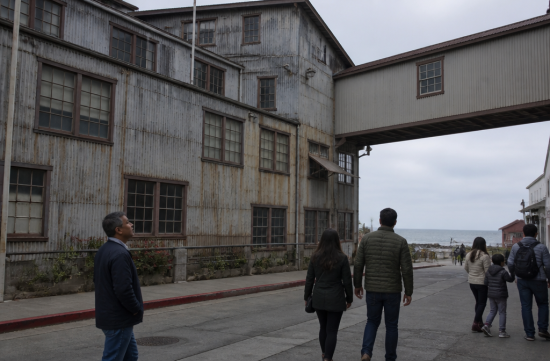
If you've walked along Cannery Row in Monterey, you might have wondered what these old tin buildings by the seaside were originally used for.
Now filled with souvenir shops, restaurants, and wine tasting rooms, this street was once an industrial area lined with sardine canneries. And then, one day, the sardines disappeared.
Today, I will outline what happened to this street after the sardines vanished, as knowing the history can change how you see the area.
Let's start from the beginning. According to historical records, Frank Booth opened the first cannery in Monterey in 1902.
In 1916, Knut Hovden, a Norwegian, established the Hovden Cannery. He is noted as an innovator who improved canning technology.
At that time, the official name of this street was not Cannery Row; it was Ocean View Avenue.
The peak of the industry was around World War II. Records show that during the peak season, nearly 250,000 tons of sardines were processed in a year.
Over 100 purse seiner boats set sail from Monterey Harbor each season. Just hearing those numbers gives you an idea of how bustling the sea must have been back then.
However, I was surprised to learn that nearly two-thirds of the caught sardines went not into cans but into reduction processes for fish meal, fertilizer, and oil.
This means that the main products were not fish for human consumption but powder and oil. Historical records indicate that this reliance on reduction significantly contributed to the collapse of sardine resources.
The results were swift. By the mid-1950s, the processing volume fell below 1,000 tons per season. From 250,000 tons to 1,000 tons means the sea was essentially empty.
The causes were not singular. Richard Parrish's writings, published by the NOAA Southwest Fisheries Science Center, cite overfishing, long-term cooling of California currents, World War II, and El Niño as major factors.
Sardines are known to fluctuate in population based on water temperature. Many explanations suggest that continuing to catch them during naturally declining periods was the final blow.
In my opinion, I do not agree with the perspective that solely blames nature. While no one can change the weather, people could have decided how much to catch.
Interestingly, during this time, the street became famous in literature. John Steinbeck's novel Cannery Row was published in 1945.
Steinbeck mingled with marine biologist Ed Ricketts in this area from the early 1930s. The character Doc in the novel is modeled after Ricketts.
In 1958, when most of the factories had closed, Ocean View Avenue was officially renamed Cannery Row. The street's name became the title of the novel only after the industry ended.
The factories closed one by one. The Hovden Cannery survived by canning other fish during the war and operating the reduction plant.
In its later years, it even canned squid, outlasting neighboring factories. However, in February 1973, it closed as the last cannery on Cannery Row.
I find this point quite striking. While everyone focused solely on sardines, the person who diversified the business was the one who lasted the longest. This is a lesson that still applies to small business owners today.
The next scene is the twist in this story. In 1967, Stanford University's Hopkins Marine Station purchased this site, which was later acquired in 1978 by the organization that would become the Monterey Bay Aquarium.
Then, on October 20, 1984, the Monterey Bay Aquarium opened at the former site of the Hovden Cannery. Just recently, we celebrated its 42nd anniversary.
The initial construction costs were covered by a one-time personal donation from David and Lucile Packard. I want to emphasize that this was not a government project but a private initiative.
In its first year, over 2 million visitors came to the aquarium. Instead of sardines, tourists began to sustain this street.
The aquarium was built by renovating the old Hovden Cannery building, which was constructed in 1916. It's a strange irony that a place that once processed fish is now a place that showcases them.
To summarize, the sea was once abundant, people overfished, the sardines disappeared, and the street was abandoned for a time before being revitalized through literature and private investment.
Two lessons can be drawn: one is that resources are finite, and the other is that even if an industry collapses, a community can revive if people and capital are mobilized.
When you visit Cannery Row, don't just shop; take a moment to slowly observe the signs and old factory buildings throughout the street. Those old tin walls have many stories to tell.
 HateBeanCandy







 Twist Kim |

 U.S. Weather Bureau News |

 Community Cross |

 Conflite Teacher |

 SEVEN SEVEN |

 Until the Day It Gets Better |

 Roman Pan |
 Raymond K. |


 Yugo Girl I'm So Hot |
 nexaro |
 Experiences Living in America |
 arsnack |
 Nebraska Center Director TOP |
 Florida Gario |
 menmo |
 Arizona AZ Cowboy |
 springw |
 Woooooah |
 frostpup |
 chocopup |
 Angeles Choi |
 My Heart Popper |
 comova |
 vintago |
 Sky Way |
 Top Beaches |
 folyfoly |
 ground |