
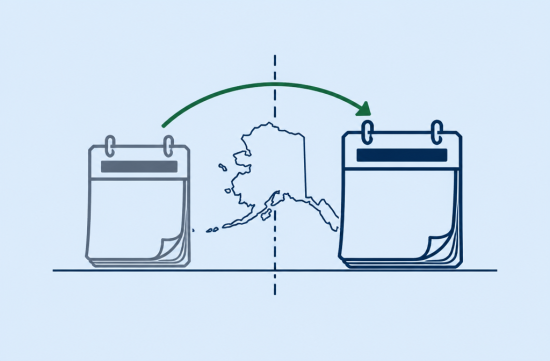
Last Saturday was Alaska Day. October 18th is a state holiday commemorating the day Alaska was transferred from Russian territory to American territory.
However, there's a hidden TMI about this date. In 1867, the day after Friday was also a Friday in Alaska.
When I first heard this, I thought it was like a company party the day after. But the calendar really did transition that way.
To summarize, on the Russian calendar, October 6th was a Friday, and the next day was October 18th, a Friday on the American calendar.
They skipped 11 days, but the day of the week repeated. It was like living through one day twice. This wasn't a calendar error but an official decision made by the government.
To understand why this happened, we first need to look at the transaction itself. On March 30, 1867, Secretary of State William Seward agreed to purchase Alaska from Russia for $7.2 million.
The negotiations went on all night and were concluded at 4 a.m. The Senate approved the treaty on April 9 of that year with a vote of 37 to 2.
However, the House of Representatives didn't make the payment until July 1868. They signed first and delayed payment for over a year, which was quite typical for America.
Calculating it out, the price was less than 2 cents per acre. Considering today's Anchorage rents, it's honestly a tear-jerking number.
Then, on the afternoon of October 18th, the Russian flag was lowered and the Stars and Stripes were raised at Castle Hill in Sitka. From that day on, Alaska officially became American territory.
The problem starts here. Russia was using the Julian calendar at the time, while America was already using the Gregorian calendar.
In the 19th century, there was a 12-day difference between the two calendars. So, ideally, the date should have been moved forward by 12 days.
But there was one more variable. Russian Alaska had been following the Asian date since 1741.
Russians crossed over from Siberia, so they brought the Asian date with them. At the same moment, they were a day ahead of the American mainland.
Once it became American territory, Alaska was moved to the east of the International Date Line, meaning it was shifted back by one day.
So, moving 12 days forward and one day back resulted in skipping only 11 days while keeping the same day of the week, leading to Friday occurring twice.
This structure could confuse students if presented as a math problem. I only understood it after drawing a globe on paper. I never thought history would require geography and math together.
Interestingly, Russia continued to use the Julian calendar for quite some time after that. Russia switched to the Gregorian calendar only after the revolution in 1918.
This means Alaska reformed its calendar 50 years before Russia did. When the land changed hands, time moved along with it.
For the residents of Sitka at that time, it must have been quite confusing. Those calculating payday or contract expiration dates probably had a headache. I can imagine some people complaining that their weekend was delayed because they got an extra Friday.
The time confusion in Alaska didn't end there. By federal law in 1966, Alaska had four time zones.
That was consolidated to two on October 30, 1983, and now only the Aleutian Islands west of the International Date Line use Hawaii-Aleutian Time, while the rest use Alaska Time.
This land seems to have a tradition of struggling with time issues. In winter, the sun rises late and sets early, so the sense of time is still quite unique.
Some media and politicians at the time mocked the deal as Seward's Folly, questioning why anyone would pay for an ice chunk.
As you all know, the outcome was quite different. The gold rush, fishing, and oil led to the land's value increasing significantly.
I consider this deal one of the best in American history. Even if public opinion was unfavorable at the time, betting on a long-term valuable asset is a lesson worth learning even today.
Of course, there are other perspectives. Some Tlingit natives in Sitka remember October 18th as the day they lost their land and held a separate memorial gathering under Castle Hill in 2017.
It's a clear fact that there were people living on the land that Russia and America bought. I believe it's important to remember that part together.
As an immigrant, I often experience losing or gaining a day due to time differences. That feeling of losing a day when going to Korea and gaining it back when returning.
The people of Alaska in 1867 experienced that without even flying. It might be nice to think of those who lived through two Fridays on the next Alaska Day.
 NationalSing


 Twist Kim |

 U.S. Weather Bureau News |

 Community Cross |

 Conflite Teacher |

 SEVEN SEVEN |

 Alaska Salmon Buyer |


 Anchorman |

 Sunny's Travel in America |


 AL ALASKA |
 Arizona AZ Cowboy |
 springw |
 Woooooah |
 frostpup |
 chocopup |
 Angeles Choi |
 My Heart Popper |
 comova |
 vintago |
 Sky Way |
 Top Beaches |
 folyfoly |
 ground |
 averagestudent |
 hot chocolate |
 SODA MAKER |
 james kim |
 All About Cars |
 lomira98 |
 calmbridge |