
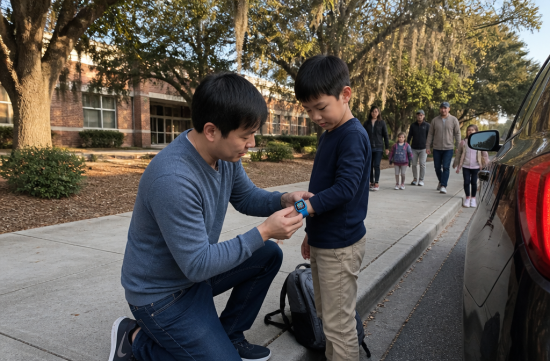
These days, there's a question that pops up frequently in parent group chats: "It seems too early for a phone, but is a watch okay?" I can't count how many times I've heard this from those around me.
The atmosphere has definitely changed. Smartphones feel burdensome, but not being able to communicate at all is unsettling, so parents are looking at kids' smartwatches as a middle ground.
However, once you start looking into it, there are more factors to consider than you might think. You need to look at the monthly fees in addition to the device cost, school regulations, and data issues all at once.
Let's start with the school regulations. In Georgia, the Distraction-Free Education Act, or HB 340, was passed in 2025.
According to this law, starting July 1, 2026, the use of personal devices will be restricted from bell to bell for public school students from kindergarten through 8th grade. This means from the first bell to the last bell.
Many people overlook an important detail here. It's not just smartphones that are prohibited; smartwatches are also explicitly mentioned.
So, the expectation that "if I use a watch instead of a phone, I can still communicate at school" should be set aside. This applies not only during class time but also during breaks and transition times.
There are exceptions. Students designated with an IEP or 504 Plan, or those who need a device for medical reasons, are not included.
The storage method varies by school district. Some require pouches, while others may just ask you to keep it in your bag, so be sure to check your school's policy separately.
According to AJC reports, high school students will also face the same restrictions starting next year. Ultimately, it's realistic to think of the watch as something for commuting and after-school use.
So, is it useful for commuting? This is where the money talk comes in.
Let's take Gabb as an example among kids' brands. According to their official information, the watch fee is $12.99 per month with a 2-year contract, $14.99 with a 1-year contract, and $17.99 without a contract.
There's a $5 difference per month depending on the contract length, but the company states that the service content is the same. Honestly, I was a bit surprised when I first saw this.
Devices that kids wear on their wrists are easy to lose or break. So, I personally wouldn't jump into a 2-year contract just because it's cheaper.
Activation fees are also a checkpoint. Gabb has a $30 activation fee, but there have been cases where Walmart store promotions waived it and offered 3 months of free service.
If you're already using an iPhone at home, Apple Watch For Your Kids, previously known as Family Setup, is also an option. This allows you to set up the watch using a parent's iPhone even if the child doesn't have an iPhone.
The conditions are a bit strict. It must be a cellular model, and it should be a Series 4 or later model or SE.
The parent's Apple Account must have two-factor authentication enabled, and the child must be part of a Family Sharing group. Additionally, the parent must be the organizer or a parent/guardian.
You can set it up without a cellular plan. However, to make calls and check location outside, you will ultimately need a carrier plan, and the costs vary by carrier.
Apple also advises that some features cannot be connected this way. So, if you think, "It'll work just like my watch," you might be disappointed.
Now, I want to highlight what I consider the most important part: the child's data.
Kids' watches continuously exchange location information. Parents need to know who stores that data and how long it is kept.
Fortunately, the FTC has prepared an amendment to the Children's Online Privacy Protection Act (COPPA), which will take effect on June 23, 2025. The compliance deadline for companies was April 22, 2026.
It's a good thing that regulations are being strengthened. I believe the government should actively oversee these matters. However, just because there are rules doesn't guarantee that all companies will comply.
So, before purchasing, make sure to check the privacy policy regarding the duration of location data storage and how to request deletion. It only takes about 5 minutes.
Let's summarize what to check. First, look at when you can use it according to school regulations.
Next, verify if the network works well in your area. Check the contract period, activation fees, and cancellation conditions.
Finally, see if you can restrict contacts to only those approved by the parents and how location data is handled.
Personally, I think a watch is a decent middle step before moving to a phone. However, it's not just about "buying it and being done"; setting usage rules with your child is the real beginning.
My conclusion is that conversation comes before the device. How about having a chat with your child this weekend?
 RedCape




 Round and Round Children's Song Kingdom |

 new sugar |

 Way to easy |

 Magic Cabbage School of Martial Arts |

 Vacation on Hawaii |

 bravo777 |

 Atlanta Business Information |

 Bearded Strawberry Smoothie |

 Maximum Pro |
 Joyce blog |
 Ansaso |
 Soft Feeling That Feeling |
 assa man |
 Yugo Girl I'm So Hot |
 nexaro |
 Experiences Living in America |
 arsnack |
 Nebraska Center Director TOP |
 Florida Gario |
 menmo |
 Arizona AZ Cowboy |
 springw |
 Woooooah |
 frostpup |
 chocopup |
 Angeles Choi |
 My Heart Popper |